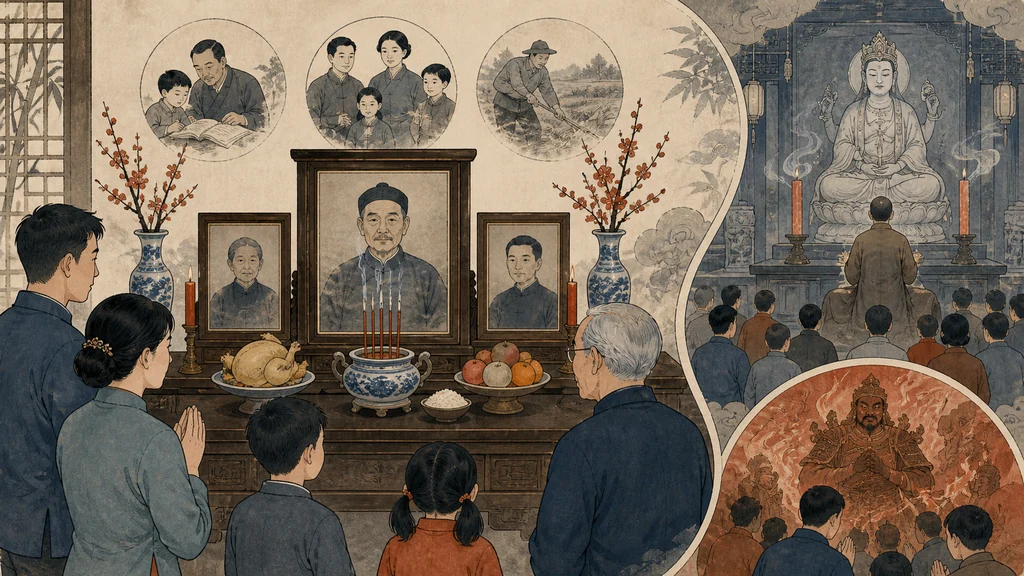
Not necessarily. **Ancestor worship** is an established term in older scholarship, but “worship” can suggest to a British reader that ancestors are treated as an all-powerful God and that every participant accepts the same doctrine of the afterlife. Chinese ancestor rites may include belief that ancestral spirits remain present. They may also foreground remembrance, filial responsibility, kinship and continuity. **Ancestor veneration** or **ancestor rites** usually leaves that range of meanings more open.
Why “worship” can answer the question too quickly
In a Christian setting, worship often means devotion reserved for God. Applied without explanation, the word creates a misleading test: do Chinese families think dead relatives are gods? Ancestors in most rites are neither creators of the universe nor deities worshipped by everyone. They are particular dead persons related to particular descendants.
It would be equally misleading to remove religion altogether and describe every rite as a secular memorial. Inviting ancestors to receive offerings, reporting a marriage or birth, asking for protection, or treating a tablet as a seat of presence can involve claims about an active spirit world. “Veneration” is useful not because it makes the practice non-religious, but because it does not decide every family’s theology in advance.
Translation should therefore follow evidence. A historical study may legitimately use “ancestor worship” as a technical term. A family may use “worship” in its own English. In an introductory museum or school text, “ancestor rites” followed by a description of the acts is often more precise.
The history did not begin with Qingming
Shang oracle-bone inscriptions record royal communication and sacrifice to ancestors. These rites were tied to dynastic authority, harvest, warfare and divination. They cannot simply be projected onto a present-day family cleaning a grave.
Later ritual systems regulated ancestral temples and the number of generations different ranks could honour. In that setting, ancestry organised political and social hierarchy as well as memory. Archaeological and textual evidence also shows that ancestors could be constructed and redefined: a lineage founder, royal predecessor or legendary national ancestor did not all acquire authority in the same way.
Tomb offerings became more broadly distributed over time. Historical summaries trace the expansion of tomb rites across social groups from the Tang period, while Song family ritual, lineage institutions and later household manuals helped shape practices familiar in subsequent centuries. Qingming tomb sweeping is therefore not one unchanged three-thousand-year ceremony. It draws together court, lineage, household and local histories.
Home, grave and ancestral hall are different ritual spaces
At home, a family may place food, tea or incense before tablets, portraits or photographs at New Year and on death anniversaries. At a grave, clearing weeds, repairing the mound, offering flowers and bowing make care for a physical place part of filial action. At an ancestral hall, a much larger lineage may gather; historically, such halls could also be connected with collective property, education, dispute settlement and communal meals.
Modern urbanisation and migration alter all three settings. A flat may have no permanent altar. A cemetery may be far from the city where descendants live. Members of one family may be spread between China, Britain and other countries. Some appoint one relative to visit, remember through photographs, or gather online. Changed form does not prove that meaning has disappeared, but neither does a surviving gesture prove unchanged belief.
A 2016 nationwide study published in The China Review found that visiting ancestral graves and venerating deceased relatives remained widespread. It also found that urbanisation and migration reduced the likelihood of participation, while education affected attraction to explicitly “magical” elements. The evidence supports continuity with variation—not the claim that every Chinese adult holds one ancestral creed.
The same bow can carry different meanings
One person may light incense to welcome an ancestor; another may do so to respect a grandparent’s wishes; a third may understand the rite as family memory. Buddhist or Daoist specialists can take part in funerary and merit-making services. Confucian language highlights ritual propriety and filial conduct. Local traditions govern dates, foods, words and who leads. These layers interact without forming one national church.
Christian families make the problem especially visible. During the Chinese Rites Controversy, Catholic authorities argued for centuries about whether honours to Confucius and ancestors were civil ceremonies or forbidden religious worship. Contemporary churches and households still draw boundaries differently. Some Christians join grave cleaning and silent remembrance but do not offer incense; some regard a bow as respect; others retain more traditional acts.
The physical gesture alone cannot settle the participant’s belief. That principle also prevents the opposite stereotype: assuming that a person who calls the ceremony “cultural” must secretly believe nothing about ancestral presence.
What should a British guest do?
If you are invited to a British-Chinese funeral, burial or Qingming visit, ask the organiser what guests are expected to do. Flowers, standing in silence, bowing, placing food and offering incense do not have identical meanings in every family. If religious conviction, asthma or another reason prevents you from lighting incense, say so quietly and ask whether a bow, flower or period of silence would be appropriate.
Do not move, eat or photograph offerings without permission. Do not turn one family ceremony into proof that “Chinese people believe the dead literally eat meals”. Describe what was done and, when possible, how participants explained it.
The most reliable wording begins broadly—ancestor rites or ancestor veneration—then becomes specific: grave care, an offering, a memorial bow, a lineage gathering or a prayer addressed to an ancestor. “Worship” is not always wrong. It is wrong when it closes a question that the evidence shows to be open.