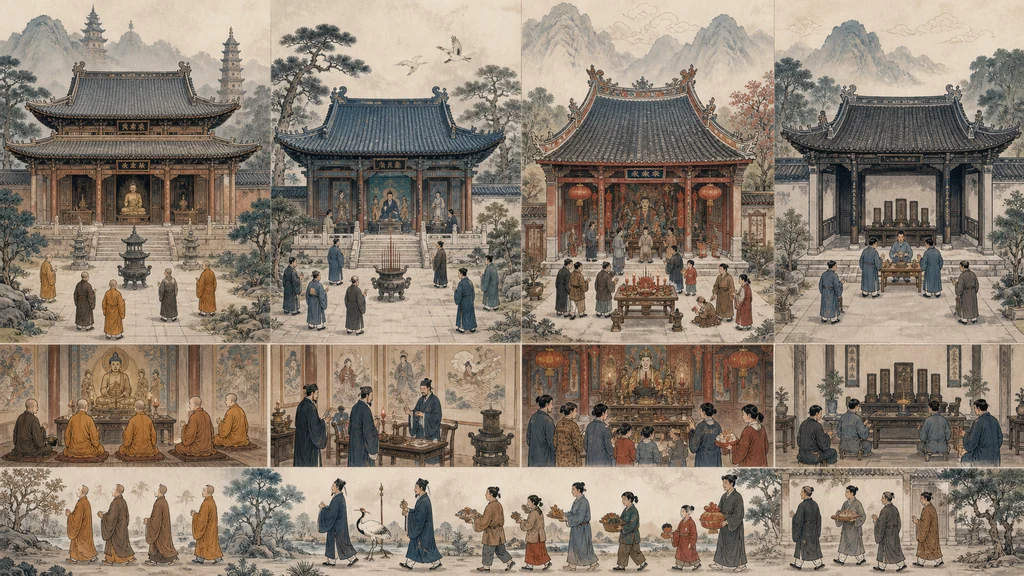
A useful first rule: the name is a clue, not a verdict
As a general guide, si (寺) usually indicates a Buddhist monastery, guan (观/觀) a Daoist institution, miao (庙/廟) a temple for a deity or honoured figure, and ci (祠) a hall or shrine for ancestors, exemplary people, or local heroes. The rule helps a newcomer read place names. Shaolin Si points towards a Buddhist monastic community, a daoguan towards Daoism, a City God Miao towards an urban tutelary deity, and a lineage ci towards a particular descent group.
The four endings are not legally sealed categories. A building may preserve an old name after its function changes, receive a special title from an emperor, or follow regional convention. A large complex can contain halls, courtyards, altars, and shrines bearing several different terms. A scholarly review archived by the University of Hong Kong makes the warning explicit: Chinese religious sites are difficult to classify from their names alone.
Si: normally a Buddhist monastery, not just one worship room
In established religious usage, si is closely associated with Buddhist institutions. A si may include halls for Buddhas, bodhisattvas, and protectors, together with spaces where monastics live, chant, study, ordain, eat, and receive guests. English sources therefore alternate between “Buddhist temple” and “monastery.” Temple stresses public worship; monastery stresses a resident religious community.
The character did not always have this meaning. In early usage, si could name a government office. It became a common term for Buddhist institutions as Buddhism entered China and developed local forms. The Metropolitan Museum of Art’s history of Chinese Buddhist sculpture shows extensive adaptation of ideas and images arriving from India and Central Asia. Buildings and institutional vocabulary likewise evolved rather than appearing as a finished system.
Not every structure inside a si is itself called si. The Great Buddha Hall may be the principal worship building, a scripture repository has a specialised purpose, and a named yuan may be a subsidiary courtyard or branch. When a sign says “hall,” first determine whether it names the whole institution or one building within it.
Guan: usually a Daoist institution and ritual centre
Guan is among the clearest signals of a Daoist establishment. It may be associated with resident Daoists, divine images, scriptures, and formal rites. “Daoist temple” is the most accessible English rendering, although monastery or abbey sometimes better conveys communal religious life. A daoguan is not an ordinary viewing terrace; in a religious proper name, the term identifies a Daoist institution.
Daoist sites can also be called gong (palace), miao, or an. UNESCO’s account of the Wudang Mountains demonstrates the problem vividly. The whole landscape is a major Daoist centre, yet its individual sites bear names translated as palaces, temples, monasteries, nunneries, and shrines. An English description that gathers them under “temples” does not mean their Chinese names are identical.
Look at the principal deities, the identity of religious personnel, notices for rituals, and inscriptions, not only the roof. Timber courtyards, mountain gates, and incense burners are not exclusive property of either Buddhism or Daoism. Similar architecture can support different institutions.
Miao: the broadest category, not merely a small folk temple
A miao most often centres on a recipient of sacrifice, as in an Earth God, City God, Mazu, or Lord Guan temple. That recipient may be a local god, a deified historical person, or a figure recognised by state ritual. A miao can be a tiny neighbourhood building, but it can also have several courtyards, an opera stage, and a pilgrimage network. The word alone does not reveal scale.
Confucian temples show why miao cannot simply mean “folk shrine.” A Confucius temple is a ritual institution historically connected with education and government. Beijing’s Imperial Ancestral Temple, the Taimiao, is more striking still: it was the royal site for sacrifices to dynastic ancestors. Miao could thus belong to a village community or stand at the centre of state ceremonial order.
A deity temple might also invite Buddhist monastics or Daoist priests for a particular service, or house gods interpreted by more than one tradition. The specialist conducting one ceremony does not necessarily determine an exclusive denomination for the entire site.
Ci: a relationship of descent or commemoration comes to the foreground
Ci is commonly translated as “shrine” or “ancestral hall.” A lineage or family ci generally holds tablets for common ancestors. It can also provide space for meetings, genealogy compilation, education, resource management, and rites marking stages of life. The connection between participants and recipients is normally narrated through descent, unlike a public deity temple where any visitor might petition the god.
Yet not every ci serves blood ancestors. Shrines honouring worthy officials, loyal figures, or celebrated local people commemorate contributions to a community or state; visitors need not be descendants. Research on Southern Song shrines finds that ci often carried a stronger commemorative or elite association, while miao more often pointed to deities. The same research cautions that no hard boundary separated the two.
Spaces for ancestral sacrifice also long predate the later institution named a lineage hall. UNESCO’s account of Yinxu identifies royal ancestral shrine and altar remains from the late Shang capital. Those ruins reveal ancient ancestral ritual, but they should not be relabelled as a Ming- or Qing-style clan hall. Architecture, kinship, and terminology belong in their own historical settings.
What about gong, an, yuan, tan, and dian?
Gong literally evokes a palace or exalted residence and can suggest high status in a sacred name. It is especially common in Daoism, though other sites use it. An often suggests a modest religious residence or a women’s religious establishment, but its historical range is wider. Yuan can mean an institution organised around a courtyard or a subsidiary unit. Tan foregrounds an altar or platform for sacrifice or ordination and need not be a complete roofed complex.
Dian (hall), tang (hall), ge (pavilion), and lou (storeyed building) frequently name components or functions rather than religions. A Buddhist monastery can contain a Guanyin Hall, a Daoist institution a Patriarch Hall, and an ancestral complex a sacrificial hall. Chinese names shift between the scale of the full precinct and that of a single structure, so translation must establish which is meant.
English makes the distinctions easier to lose
“Temple” is a large umbrella that routinely covers si, guan, and miao. “Monastery” highlights a practising community, but visitors may still call a historic Buddhist site without current residents a temple. “Shrine” can mean a tiny sacred focus or an entire commemorative complex. “Ancestral hall” is clearer, but it cannot describe every ci dedicated to a worthy figure rather than an ancestor.
The safest translation is therefore not a fixed character-for-word substitution. Retain the official name and add the function when necessary: “Jinci, a large shrine complex with several religious associations,” or “a lineage ancestral hall.” If a guide says only “Chinese temple,” ask who is honoured, who administers it, and whether a resident religious community is present.
On site, read people and ritual as well as the signboard
Start with practical questions. Who occupies the main altar? Do tablets carry a divine title, a Buddhist name, or the personal names of ancestors? Is the site run by monastics, Daoists, a lineage committee, or a local temple association? Does it host chanting, Daoist rites, community festivals, ancestral sacrifices, or several of these? Inscriptions, plaques, guidebooks, and event notices usually tell more than roof shape.
Basic courtesy travels across the categories. Do not step over an altar, photograph a ceremony without permission, or move offerings and tablets. Do not call every Buddhist monastic a Daoist or every guan a Buddhist temple. If a living religious site is open to visitors, ask before offering incense, entering an inner hall, or taking pictures. Reading the name begins the interpretation; respecting the people who use the place completes it.