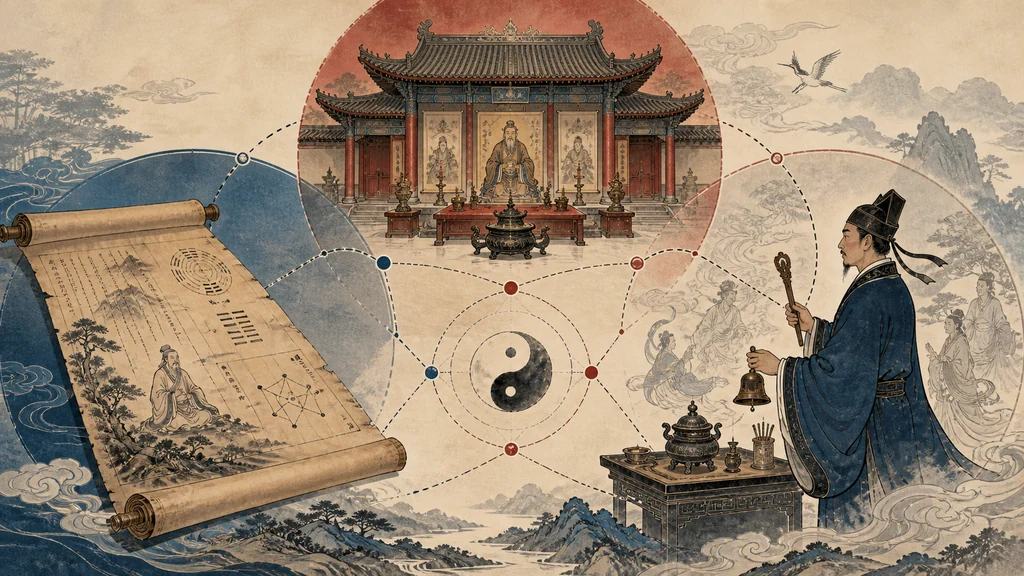
Daojia and daojiao are not quite the same, but neither are they two sealed boxes labelled “philosophy” and “religion”. In present-day Chinese, daojia commonly points to thought associated with texts such as the Daodejing and Zhuangzi. Daojiao normally points to organised traditions with scriptures, priests, temples, deities and ritual lineages. That distinction is useful in a classroom. It is not a boundary that Chinese history has consistently observed.
Daoism and Taoism are two spellings, not two traditions
The first trap is orthographic. **Taoism** reflects an older romanisation system that became familiar in English. **Daoism** uses Hanyu Pinyin, now standard in most academic writing and in mainland China. Both spellings represent the Chinese word dao, “way” or “path”.
An older British museum label that says Taoism is not therefore identifying a more religious tradition, and a recent philosophy book that says Daoism is not necessarily excluding ritual. The surrounding nouns matter more: is the writer discussing the Daodejing, a Celestial Masters community, meditation, a priest’s robe, a pantheon or a modern religious identity?
The same caution applies to pronunciation. The initial sound in dao is closer to an English unaspirated “d” than the spelling Tao suggests. Changing the spelling improves consistency; it does not rewrite the tradition.
Daojia was a retrospective Han category
Laozi and Zhuangzi did not announce that they belonged to a school called Daojia. The category was created by Han historians looking back at the intellectual landscape of the Warring States period. Sima Tan, writing around 135 BCE, described six broad approaches in his “Essential Points of the Six Schools”; his son Sima Qian preserved the classification in the Records of the Historian.
This is important because it reverses the popular founding story. There was not first a Daoist institution whose members then produced all the texts filed beneath its name. “Daojia” was partly a work of intellectual cataloguing: it gathered writers who addressed related questions about guidance, government, language, nature and cultivated action.
The Daodejing and Zhuangzi do share concerns, but they are not chapters of a single creed. They differ in voice, argument and textual history. Treating “Laozi founded Daoism” as a simple biographical fact also runs into a major scholarly dispute: the received Laozi figure may represent a sacred or composite authorship rather than one securely documented historical writer.
Why organised Daoism is often dated to the second century
Histories of religion commonly identify the Way of the Celestial Masters as the earliest well-documented organised Daoist movement. Daoist tradition dates Zhang Daoling’s revelation from the deified Laozi to 142 CE. The movement developed territorial communities, religious officers, membership obligations, communal rites and moral rules. Dao was no longer only a subject for court debate or private reading; it organised a durable social body.
Yet 142 is a historical anchor, not a birthday on which “religion” suddenly appeared. Earlier China already had Huang-Lao political thought, specialists later grouped as fangshi, practices of self-cultivation, sacrifices and traditions concerning immortals. Later Daoism diversified again through Shangqing and Lingbao revelations, monastic institutions, the Quanzhen movement and many local lineages.
The tidy story—pure philosophy before the Later Han, gods and ritual afterwards—therefore fails in both directions. Earlier thought already inhabited ritual and cosmological worlds. Later religious communities continued to interpret texts and develop sophisticated accounts of body, cosmos and ethics.
The Daodejing belongs on both sides of the supposed divide
The Daodejing makes the overlap visible. A British philosophy course can read it for arguments about rule, desire, language, naturalness and wuwei. Daoists have also treated it as foundational scripture and Laozi as a divine manifestation, commonly known as the Most High Lord Lao.
The Celestial Masters commentary known as the Xiang’er joined interpretation of the text to communal discipline. During the Tang dynasty, the ruling Li family claimed Laozi as an ancestor, connecting scripture, sacred history and imperial legitimacy. Commentators did not all agree: Wang Bi’s third-century reading became exceptionally influential in later philosophical study, while other commentaries circulated within religious settings.
Nor does organised Daoism consist only of worship. Its history includes meditation, visualisation, moral precepts, liturgy, alchemy, bodily cultivation, canon-making and philosophical commentary. If “religious Daoism” means only priests and public ceremonies, it leaves out activities Daoists themselves regarded as central.
Modern scholars have therefore challenged the hard Daojia–Daojiao split. Kristofer Schipper and Franciscus Verellen noted that in the Daoist Canon printed in 1445 the two terms can be effectively interchangeable. Premodern Chinese did not carry modern European concepts of “philosophy” and “religion” as ready-made opposing departments. The distinction can clarify a particular discussion, but it should be presented as our analytical tool.
How to read “Daoist” on a British museum label
Start with the object’s function. A Ming or Qing ritual robe in the Metropolitan Museum is embroidered with a hierarchy of Daoist deities. Scholars connect its arrangement with the spatial order of a Daoist temple, and a priest wore such a garment in ritual. “Nature philosophy” alone cannot explain it.
An image of Laozi riding an ox, by contrast, might participate simultaneously in literary legend, elite painting and Daoist sacred history. A painting of star deities could have been commissioned for a Buddhist Water-and-Land ritual. A local god could be admitted into a Daoist pantheon through a petition modelled on imperial bureaucracy. Shared artisans and images did not erase institutional differences; they show why exclusive Western membership categories often fit badly.
For practical reading, treat **Daoism** as an umbrella and ask the label to become more specific. Does it mean early texts reconstructed as Daojia, an organised lineage, an ordained ritual specialist, a sacred figure, a technique of cultivation or a person’s modern identity? That question preserves the useful distinction between Daoist thought and Daoist institutions without inventing an iron wall between them.
Sources and further reading
- Stanford Encyclopedia of Philosophy: Laozi
- Stanford Encyclopedia of Philosophy: Daoism
- Stanford Encyclopedia of Philosophy: Religious Daoism
- Metropolitan Museum of Art: Daoism and Daoist Art
- Metropolitan Museum of Art: Daoist priest’s ritual robe
- Metropolitan Museum of Art: Star deities of the northern and central dippers