The short answer: it overlays a direction measurement with traditional reference tables
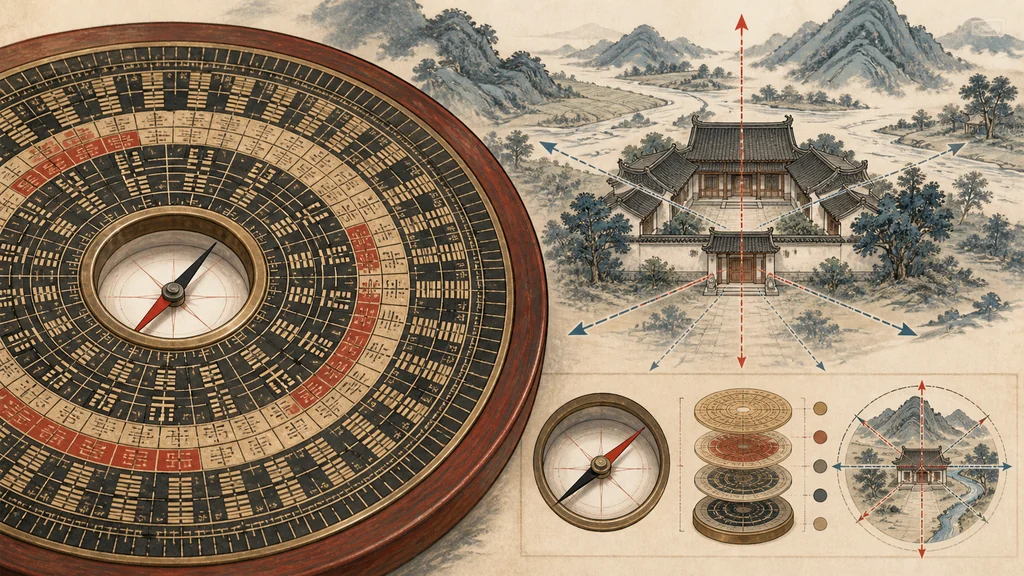
At the centre of a feng shui compass, or luopan, a magnetic needle indicates the horizontal direction of the local magnetic field. Concentric inscriptions divide the circle into named bearings and may record trigrams, stems and branches, twenty-eight lunar lodges, sixty-four hexagrams, or formulas belonging to a particular tradition. The instrument is both a directional tool and a compact reference system joining space, time, and cosmological categories.
A luopan does not detect qi, luck, or misfortune as a thermometer measures temperature. Its needle supplies a physical reading; its rings tell a trained user how an inherited system interprets that reading. Separating those two layers is the essential step in understanding the object.
Begin with three parts: needle, dial, and sighting lines
The small central housing is often called the Heaven Pool. It lets a magnetised needle rotate. A circular dial around it carries the information rings and often sits within a square base; the circle and square can themselves invite interpretations of heaven and earth. Perpendicular lines or stretched red threads help align the axis of a building with marks on the dial. Materials, needle colours, and construction vary among instruments.
The Penn Museum holds a Chinese example made around 1850. It is wood covered with lacquer, with red and gold writing on black, and bears the mark of the maker Lin Junzhou on its reverse. This provenance shows that a luopan was not merely an abstract diagram now reproduced on posters. It was a portable working object made by specialist craftspeople.
A level dial and a location free from magnetic interference are necessary for a stable bearing. Projecting the “sitting” and “facing” axes of a building onto the rings belongs to particular methods. Explaining the material instrument does not require offering instructions for auspicious or inauspicious readings.
The Twenty-Four Mountains are bearings, not twenty-four physical peaks
One of the most recognisable rings divides the full 360 degrees into twenty-four named sectors, each approximately fifteen degrees wide. “Mountain” here functions as a directional unit; it does not require a visible mountain in the landscape. A building’s front and rear can fall into opposed sectors, producing a description more precise than north, south, east, or west.
The names are normally drawn from twelve Earthly Branches, eight Heavenly Stems, and four trigrams. One symbol such as zi can participate in a time cycle and mark a sector around north. This reuse displays correlative thinking. The angular division is geometry; associations of those characters with yin-yang, the Five Phases, and fortune are cultural interpretation.
A museum label that says only “compass” may make visitors imagine four cardinal points. One that says only “divination tool” can obscure the fact that the needle supplies a genuine bearing. The Twenty-Four Mountains join the measurable and interpretive aspects.
Why do trigrams and calendrical signs appear on a directional instrument?
The Eight Trigrams are three-line figures named Qian, Kun, Zhen, Xun, Kan, Li, Gen, and Dui. They can be placed in more than one sequence. On a luopan they are not ornamental borders: they relate directions to yin-yang, the Five Phases, and patterns of cosmic change. Some dials contain both Earlier Heaven and Later Heaven arrangements for different formulas.
The ten Heavenly Stems and twelve Earthly Branches also name years, months, days, and double hours. On the compass, the same signs allow direction and time to share a symbolic vocabulary. A practitioner can place a site, date, cycle, or client information within one framework rather than describing orientation alone.
The dial does not store the history of the house under inspection. It resembles a preprinted coordinate and relationship table. The user supplies a site bearing and other data, then consults selected rings according to a learned procedure.
Lunar lodges, solar terms, and hexagrams are additional information layers
The Penn Museum compass includes the twenty-eight lunar lodges, a traditional division of the sky. Other dials may carry twenty-four solar terms, sixty-four hexagrams, Nine Stars, numerical diagrams associated with the Yellow River and Luo River, or a 360-degree scale. These rings place a terrestrial alignment beside calendrical, celestial, and classical categories.
More rings do not automatically create a more accurate instrument. Some apply only to a particular question or lineage, some are interpreted in pairs, and some are reference material chosen by the maker. The dial compresses much information, but a result depends on knowing which layer the method calls for.
An online diagram assigning one fixed meaning to every band therefore usually describes one model. A historic object should be read from its visible characters and inscription rather than forced into the manual for a modern commercial compass.
Why can two luopans look entirely different?
The instrument has also been called luojing and by other names. It was made in different Chinese regions and travelled with geomantic knowledge elsewhere in East Asia. A Rice University study of these movements lists yin-yang, seasons, Five Phases, trigrams, Nine Stars, stems and branches, twenty-four directions, lunar lodges, and hexagrams among possible contents, while emphasising that combinations and ordering varied.
Later classifications commonly distinguish Sanhe, Sanyuan, and combined compasses, but actual practitioners do not always fit a clean division. Small instruments have fewer rings; large professional examples can carry dozens. Construction, burial, and other applications may call for different references. Period, lineage, locality, purpose, and maker all shape the dial.
Chinese examples in the Horniman, Spurlock, and Penn museums consequently differ in materials and detail. Variation does not mean that one maker failed to complete the object. There has never been a single worldwide standard luopan.
The magnetic needle has real-world sources of error
Modern geomagnetism clearly defines the limits of the central needle. NOAA explains that a compass aligns with the horizontal component of the magnetic field at its location; it does not point directly to the geographic North Pole. The angle between magnetic and true north is magnetic declination, which changes with place and time. The same physical alignment can therefore yield different magnetic readings in different locations or periods.
Nearby metal introduces further error. USGS compass guidance warns against reinforcement bars, vehicles, and other metallic objects. Electrical equipment and magnetised rocks can also disturb a bearing. Reinforced concrete, phones, and appliances make stable measurement particularly difficult inside a modern building.
These problems affect the magnetic direction. Correcting declination and avoiding metal can improve a bearing, but neither action validates an auspicious interpretation assigned to a sector. The luopan measures direction; it is not a sensor for good fortune.
How to read a luopan in a museum
First see whether the central needle survives, whether the base is square or round, and whether sighting lines cross it. Look for the Twenty-Four Mountains, trigrams, stems and branches, degrees, or lunar lodges, and count the rings. A maker’s mark may identify a workshop or place, while an acquisition date establishes a latest possible date. If the needle is lost or stuck, the object still preserves a knowledge table but no longer demonstrates its original measurement state.
Next test the scope of the label. Does the museum know the maker, date, and use, or infer identity from appearance? Colonial collection, travel purchase, and older exhibition categories also shaped how these instruments were named. The Penn object appeared in a nineteenth-century exhibition of religious objects, charms, and implements of divination. That classification is part of its collecting history, not a neutral description from the maker.
The richest reading holds two facts together: the central needle belongs to physical geomagnetic measurement, and the surrounding rings belong to a complex historical system of interpretation. The former does not prove the latter, and the latter does not deprive the object of technical and cultural significance.