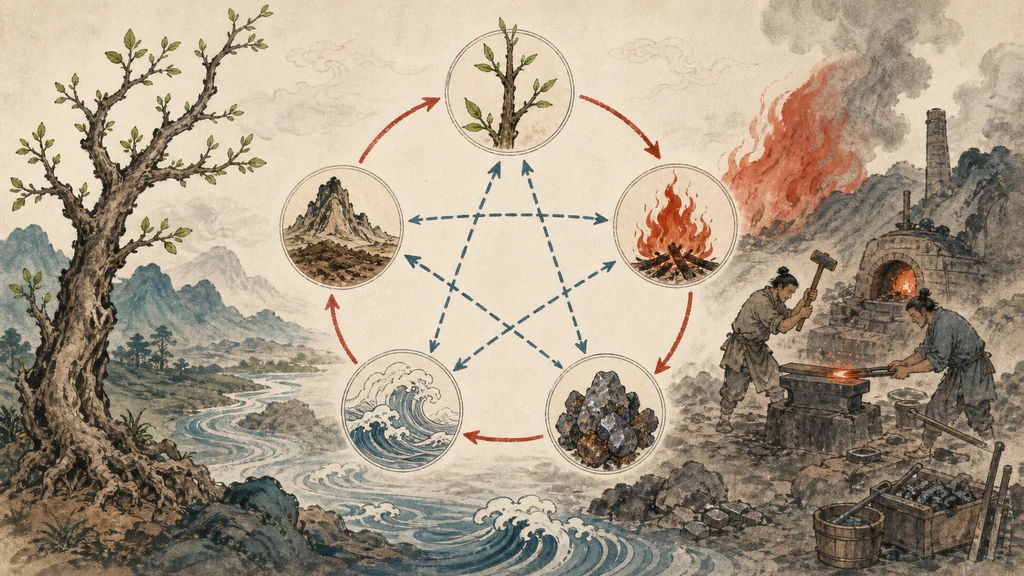
The short answer: “elements” suggests the wrong picture
Wuxing does name wood, fire, earth, metal and water. Yet it is not merely an inventory of five materials. The word xing carries associations of movement, action and changing course. For that reason, many scholars prefer “Five Phases” or “Five Agents”: both translations warn that the five categories act on one another and perform different roles in different settings.
“Five Elements” is an established translation, so it is too simple to call it incorrect. The trouble is the image that the English word element can create. It may suggest five permanent building blocks from which the universe is made. Wuxing grew from material experience, but Chinese thinkers developed it into a language for patterns, order and transformation. A better translation can correct a first impression; it cannot replace attention to the particular text in front of us.
The Great Plan describes five kinds of action
The transmitted “Great Plan” chapter of the Book of Documents does more than list five nouns. Each category comes with characteristic activity. Water moistens and descends; fire blazes and rises. Wood can be bent and straightened; metal submits to alteration; earth receives seed and produces crops.
This grammar directs attention towards what each category typically does, not only what substance it might be. Material qualities still matter, but they are joined to tendencies, uses and transformations. That is one reason “phase” or “agent” can be more helpful than “element.”
There is an important historical limit. Scholars debate the date and textual layers of the “Great Plan.” Its surviving wording is strong evidence for how an influential classical text presents the five categories, but it is not a dated certificate showing the whole system invented at one precise moment. Treating a composite textual tradition as a single flash of discovery would create certainty that the evidence cannot support.
The system was not tidy from the beginning
Early Chinese classifications did not always arrive in the familiar set of five. The Zuo Tradition, for example, mentions “six resources”: water, fire, metal, wood, earth and grain. Including grain makes sense in a list concerned with the resources that sustain life, but it also warns us not to project a later diagram unchanged into every early text.
During the late Warring States period, the fivefold scheme increasingly became a systematic way of describing time, political succession and cosmic order. Encyclopaedia Britannica associates a developed cosmological theory with Zou Yan in the third century BCE. “Associates” is the careful word here: a complex tradition should not be presented as the solo invention of one famous thinker.
The Han dynasty brought much wider synthesis. Authors combined the five phases with yin and yang and aligned them with seasons, directions, colours, musical tones and political conduct. The intellectual worlds represented by the Huainanzi and Dong Zhongshu are major parts of that history. The perfectly coloured charts now circulating online compress centuries of selection and argument. They are historical products, not timeless diagrams handed down in finished form from remote antiquity.
Generation and control describe relationships
The best-known generating sequence runs wood–fire–earth–metal–water–wood. The controlling sequence runs wood–earth–water–fire–metal–wood. The first expresses support, production or succession; the second expresses restraint and regulation. Wood helping fire burn is easy to connect with ordinary experience. “Metal generates water,” however, becomes misleading if it is forced into the role of a modern laboratory mechanism.
The cycles place five categories within continuing relationships. They allow an interpreter to ask what promotes a process and what checks it. The Stanford Encyclopedia of Philosophy also stresses the contextual character of such classification: the same thing can be assigned differently when the relevant action or relationship changes. A five-phase chart is therefore more like a map made for a particular system of interpretation than a permanent identity card issued to every object in nature.
This also explains why memorising correspondences is not enough. A list may tell us that a colour, season or direction was associated with one phase, but it does not yet tell us who made that association, when it mattered, or what work it performed in an argument.
Wide application did not make it a universal key
Five-phase reasoning entered discussions of political legitimacy, calendars, ritual, music, medicine and divination. Those applications share vocabulary, but evidence from one field does not automatically validate a claim in another. A court programme using seasonal colours to represent order does not prove that a modern interior-design diagram has the same origin. Likewise, correspondences in historical medical writing cannot be turned into a personal diagnosis by consulting a popular chart.
Debate existed within the tradition. The Han thinker Wang Chong, who lived in the first century CE, criticised arbitrary correlations and predictions. His objections matter because they show that scepticism is not simply a modern judgement imposed from outside. Historical participants themselves asked whether analogies had been carried too far.
Readers need not choose between treating wuxing as a mystical code that explains everything and dismissing it as failed primitive chemistry. It is more illuminating to ask what a specific author was classifying and why. This article concerns intellectual history and responsible reading; it offers no medical diagnosis, treatment or health advice.
How to read a British museum label or diagram
When a British museum or an English-language book uses “Five Elements,” there is no need to declare the label wrong on sight. Mentally add a qualification: five interacting modes whose meanings depend on the text and practice concerned. Then ask three questions. What period does the label describe? Is it interpreting an object, a medical manuscript, a political symbol or a modern popular chart? Does it identify a source for the particular correspondences it displays?
Comparison with the Greek scheme of earth, air, fire and water can be useful, but only in the right order. First preserve the Chinese emphasis on cycles and relational classification. Next recognise that Greek element theories have their own varied history of matter and change. Only then compare similarities. If the two traditions are overlaid at the start, the result produces familiarity rather than understanding.
What to remember
“Five Elements” can be a doorway into wuxing, but it should not become the final explanation. Wood, fire, earth, metal and water begin with tangible experience; historical thinkers used them to organise transformation, restraint and order. Put dates, texts and purposes back into the attractive diagrams, and the subject becomes richer: the same five names could form different relationships when people were trying to answer different historical questions.