The short answer depends on what “religion” means
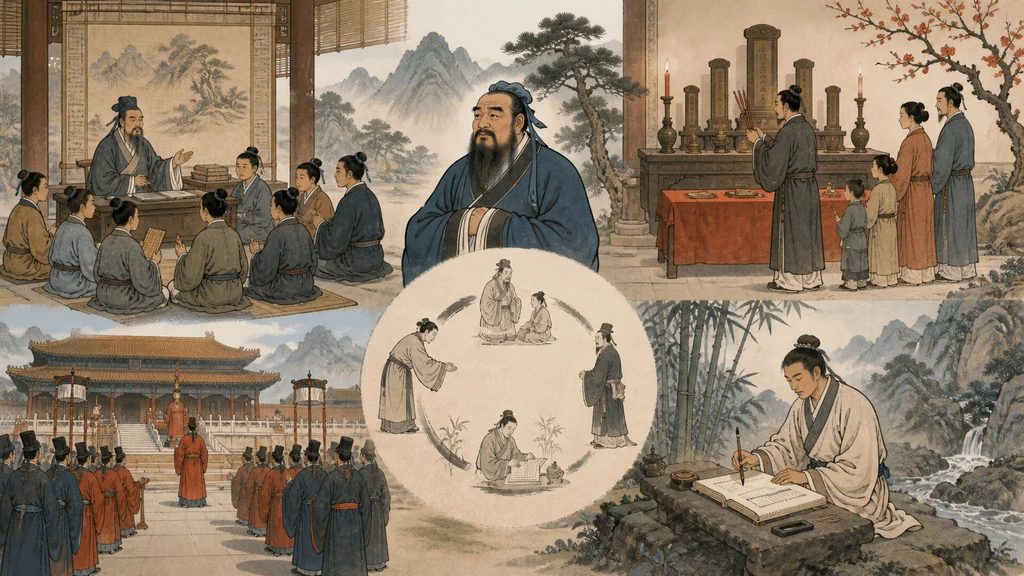
Confucian traditions emphasise self-cultivation, family duties, education and political ethics, which can make them look like a way of life or a philosophy. They also engage with Heaven and its mandate, ancestral offerings, mourning rites, Confucius temples and state ceremonies. Those are dimensions that many definitions would readily call religious.
At the same time, Confucianism has had no single church governing every period, no consistently exclusive membership and no creed to which all Confucians have had to assent. It does not fit neatly into the model of religion that many British readers inherit from Christianity. If religion means belief in one creator God plus membership in a church, Confucianism will probably be excluded. If it includes ritual, sacred order, ultimate values and communities extending across generations, exclusion becomes much harder.
“Confucian traditions” is often the most accurate starting phrase. It allows the writer to specify a period, institution and practice before deciding which analytical label helps.
Ritual shapes both ceremony and ordinary conduct
The early meaning of li, conventionally translated as ritual, included formal offerings of food and drink to ancestors or spirits. Its range expanded to mourning, diplomacy, family roles, hospitality, etiquette and political conduct. Analects 2.3 contrasts government by punishment with guidance through virtue and ritual, which encourages a sense of shame and self-correction. Ritual in this account does not happen only before an altar. Repeated gestures, emotions and relationships train a person’s character.
It would nevertheless be misleading to make li entirely secular. Analects 3.12 says that Confucius sacrificed to the ancestors as if they were present and sacrificed to the spirits as if the spirits were present. The line asks for an attitude of presence and reverence during performance. Other passages criticise empty form: without respect in ceremony or grief in mourning, correct movements do not accomplish their ethical purpose.
Religious rite and moral education are therefore not separate boxes here. The same act can orient a participant towards ancestors, discipline emotion and express a social relationship. Calling it “only etiquette” is no more neutral than calling every form of etiquette an act of worship.
Heaven cannot simply become “God,” but it cannot be deleted
Confucius inherited Zhou language concerning Tian, Heaven, and the mandate that legitimised political rule. In the Analects he sometimes links his own virtue or cultural mission to Heaven. At the death of his disciple Yan Hui, he cries that Heaven has bereft him. Heaven can account for matters beyond human control, such as lifespan and political success, and can also function as a source of ethical ideals.
Other passages present its activity less personally. “What does Heaven ever say?” Confucius asks in Analects 17.19, before pointing to the movement of the seasons and the growth of living things. The Stanford Encyclopedia of Philosophy describes a historical tendency for some uses of Heaven to become increasingly naturalised, without making all passages identical.
Translating Tian uniformly as the Christian God imports attributes—such as a particular account of personality, creation and salvation—that a passage may not contain. Rendering it everywhere as impersonal nature erases contexts of command, awe and moral authority. Confucian texts possess languages of order that exceed an individual’s wishes, but those languages do not add up to one theology signed by every Confucian thinker.
Ancestral rites need not choose between belief and culture
The “Meaning of Sacrifices” chapter of the Book of Rites relates ancestral offering to remembering the sources of one’s life, showing gratitude and maintaining the order of kinship. Seasonal rites involve reverence, food, music, sorrow and recollection. They are meant to shape the living as they address the dead.
Offering food and drink, placing ancestral tablets or bowing may express a belief in an ancestor’s continuing presence. The acts may also foreground family memory, filial gratitude and the continuation of identity. Participants do not always experience these as mutually exclusive explanations. The modern demand to declare an act either “real belief” or “mere culture” can be less faithful to the practice than the ambiguity it tries to eliminate.
Nor is the Book of Rites a survey of every household. It articulates normative ideals, while actual ritual varied with class, region, gender, period and personal conviction. In British Chinese families today, one person may understand an ancestral rite as a religious duty, another as respectful custom, and another may decline it. An outsider cannot settle all three identities by inspecting the offering table.
Confucian traditions changed institutional form
There was no “Confucian headquarters” in Confucius’s lifetime. From the Han dynasty onwards, classical education, court learning and state ritual tied Confucian learning closely to government. Temples to Confucius and successive grants of official titles gave the master a public ceremonial status. In the examination era, studying the classics cultivated an ethical and literary ideal while also opening a route into official employment.
Song and Ming thinkers developed far-reaching accounts of Heaven, pattern, qi and the heart-mind. Their self-cultivation was embedded in a vision of cosmic order, not confined to advice about being polite. Yet their positions also differed, and later critics revised them.
When East Asian intellectuals encountered modern Western classifications of religion and philosophy, some reformers proposed organising a modern “Religion of Confucius.” Others presented Confucianism as philosophy, ethics or national culture. These were not simply discoveries of its timeless essence. They were creative responses to new schools, laws and categories. The disagreement now built into English introductions is itself part of Confucianism’s modern history.
How British schools, museums and families can describe it
A school text can say: “Confucian traditions combine ethical, educational, ritual and cosmological dimensions; scholars disagree about whether ‘religion’ is the best overall category.” That sentence gives pupils an answer while making its definition visible. A museum displaying a Confucius image, ritual vessel or genealogy should describe when and how that object was used instead of allowing a Philosophy or Religion label to do all the explanatory work.
In an intercultural family discussing grave visits, offerings or funerals, ask participants what the acts mean to them. Do not infer a complete creed from participation, or assume that a person who uses the word “custom” feels no sacred obligation.
It is also worth testing the fairness of the measuring stick. If a tradition requires a weekly congregation and uniform creed to count as religion, the definition may merely reproduce British church experience. If every solemn custom is classified as religious, however, the category loses useful discrimination. A good explanation states its criterion, shows the evidence and acknowledges what remains unsettled.
What to remember
Under some analytical definitions, Confucianism can reasonably be called a religion; under others, it is better described as an ethical-political tradition and way of life. The mistake is to treat those English labels as natural, mutually exclusive and unchanged across time. Looking at how ritual, Heaven, ancestral relations, education and institutions combine in a specific setting reveals more than a contest over a single noun.