The short answer: it crosses modern category boundaries
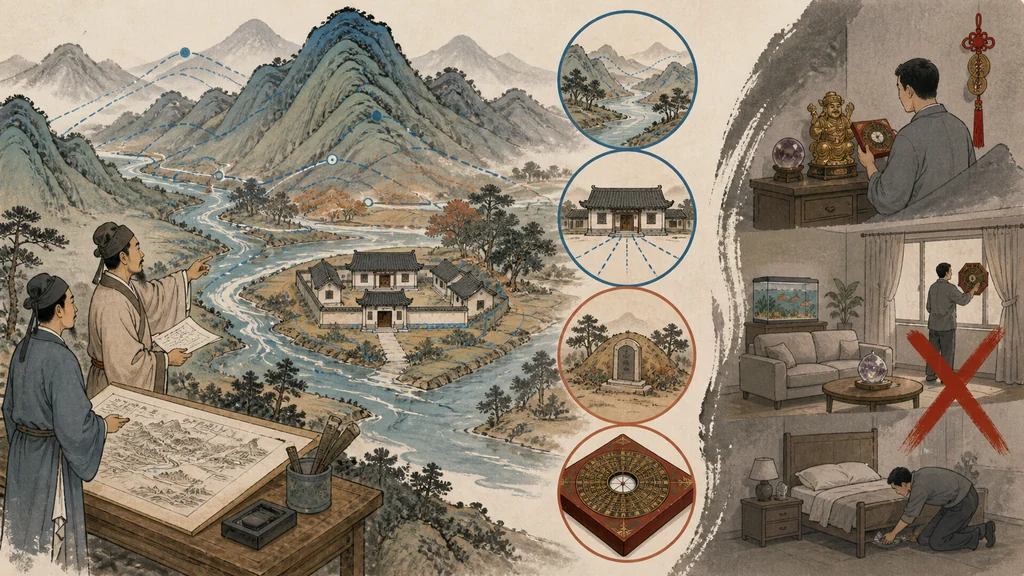
Feng shui is a family of traditions for assessing the location and orientation of homes, graves, temples, villages, and cities. It can consider hills, waterways, sunlight, wind, and entrances, while also using qi, yin and yang, the Five Phases, trigrams, calendrical cycles, and auspicious timing. Some judgements resemble environmental experience, some are explicitly divinatory, and others are embedded in ancestor rites, burial, or temple building.
It is therefore not a religion with one deity, church, creed, and initiation. Calling it interior design alone would erase its cosmology and predictions of fortune. A more accurate description is a set of site-selection and spatial-interpretation practices. It may serve religious life or be commissioned independently, and historically it has overlapped with divination.
“Feng shui” was not one unchanged system from antiquity
Modern accounts often label every ancient choice of site “feng shui,” but the term itself became common only in the Song period. Ole Bruun’s history notes earlier vocabulary including xiangzhai (examining dwellings), kanyu (heaven and earth), yin-yang, and dili (earth principles or geography). The further back one looks, the harder these practices are to separate from general cosmology, court divination, and mortuary ritual.
That history prevents us from projecting rules in a modern paperback onto a Shang or Zhou settlement. People have always sought sites with water, shelter from wind and flood, and useful routes. Such practical selection is not automatically the mature tradition later called feng shui. Historical feng shui was also more than common sense: it placed terrain, direction, and time within a correlative cosmos used to infer a family’s prospects.
Methods later grouped under labels such as “forms” and “patterns of qi” developed through varying lineages and regions. Presenting them as two perfectly bounded schools existing unchanged since antiquity makes the past artificially tidy.
First read the landscape: some judgements concern observable conditions
Form-based assessment attends to the movement of ridges, relative elevation, the approach and departure of water, openings, and shelter. A site with higher ground behind, an open outlook, accessible water, and protection from severe wind may offer real residential advantages. Drainage, soil, sunlight, and roads directly affect safety and comfort.
The UNESCO nomination for Kaiping Diaolou and Villages describes geology, topography, stream networks, midday sun, prevailing wind, and background mountains as considerations in settlement. This shows how feng shui language can preserve close local observation. It does not prove that every decision came from feng shui: defence, property, engineering, wealth, and migration also shaped those villages.
Some modern scholars reinterpret “mountain behind, water in front” through ecology or environmental psychology. Those approaches can test shelter, prospect, or risk. They support only measurable features; they do not thereby demonstrate that qi travels along dragon veins or that one orientation necessarily produces wealth.
A luopan is more than a direction-finding compass
A feng shui luopan places a magnetic needle at the centre of densely inscribed rings. A Chinese example made around 1850 in the Penn Museum combines the needle with the Eight Trigrams, stems and branches, and twenty-eight lunar lodges. The needle supplies a measurable bearing; the rings relate direction to calendrical, astronomical, and traditional formula systems.
A practitioner may ask not only “where is north?” but which of the Twenty-Four Mountains describes a precise alignment, how a building or grave corresponds with a period, and how information about a client relates to a site. Compasses differ in their rings and formulas, so possessing one does not provide a single universal algorithm.
The instrument exposes feng shui’s mixed epistemology. Magnetism and bearing are repeatable; transforming combinations of rings into an auspicious or inauspicious judgement depends on inherited interpretation. A working scientific component does not make every conclusion modern science.
Homes and graves belong to one spatial system
Yang dwellings are spaces used by the living, while yin dwellings are graves. Traditional feng shui treats place as affecting present residents and connecting ancestral peace with descendants’ wellbeing. The position of a grave within hills and water, its orientation, burial date, and surrounding forms can therefore become part of a relationship extending across generations.
The UNESCO documentation for the Imperial Tombs of the Ming and Qing dynasties explicitly describes geomantic site selection seeking natural beauty and good omens while expressing an order linking cosmos and humanity. Yet an imperial necropolis was also a political and engineering project. Terrain served procession, security, drainage, and dynastic symbolism. A curved landscape does not reduce every design decision to one geomancer’s formula.
Burial also explains why feng shui enters religious life. Reburial, funerals, and ancestor rites involve ethical and ritual obligations. A specialist may advise on location and time without being a Buddhist monastic or Daoist priest. Technical and liturgical roles can cooperate while remaining distinct.
Its relationship with Buddhism and Daoism is one of overlap, not ownership
Concepts such as qi, yin-yang, the Five Phases, and trigrams belong to a broad Chinese correlative cosmology rather than to one religion alone. Daoists may know feng shui, and Buddhist monastics have taken part in selecting sites for monasteries, pagodas, and graves. Research on the Song documents both Buddhist and Daoist authors using geomantic texts and techniques.
Use does not equal ownership. Buddhism is not defined by feng shui, and Daoist scriptures, ordination, and ritual extend far beyond it. A household may hire an independent consultant without performing any formal Buddhist or Daoist rite. The relationship is best understood as shared concepts, tools, and client situations rather than simple denominational affiliation.
Governments likewise used geomancy in some settings while condemning grave disputes, costly relocations, or profiteering in others. Acceptance and criticism place feng shui at an unstable junction of ritual order, expertise, and material interest—not within one permanent sect.
Measurable claims and symbolic claims require different evidence
Daylight, ventilation, noise, drainage, slope, escape routes, and sightlines can all be measured. If a traditional suggestion improves one of them, its result can be explained through architectural or public-health evidence. Houses, climates, and occupants still vary; an occasionally sensible maxim is not a universal law.
There is no reliable scientific evidence that auspicious qi flows through a room, that an ornament attracts money, or that a grave’s bearing causes a descendant’s promotion. Stephan Feuchtwang describes feng shui as pattern recognition combining observation and experience with signs whose truth is not experimentally tested. Respecting a historical practice does not require relabelling every causal claim as science.
Conversely, dismissing the whole subject as nonsense conceals how it organises family decisions, land conflicts, and environmental memory. Scholarship can describe those social effects while remaining strict about evidence for physical effects.
Modern feng shui products often simplify the tradition
In a global home-design market, terrain, compass calculations, lineage, and time are often compressed into rules such as “never place a bed opposite a door,” a prescribed colour, or a fixed wealth corner in every room. Such advice is easy to circulate and pair with products, but it may represent no historical school. Consultants can reach opposite answers for one floor plan because they use different systems, data, and goals.
When assessing a claim, ask whether it rests on site conditions, building standards, or symbolic correspondence. What outcome is observable? Is cultural interpretation being sold as a medical, financial, or scientific guarantee? Structural changes, fire safety, health, and investment should be decided with qualified professionals and reliable evidence, never with promises of changed fortune.
Feng shui is most revealing neither as a decorating checklist nor as a category to declare wholly religious or scientific. It shows how people in Chinese history placed environment, time, ancestors, and family hopes on one spatial map. Recognising that map’s cultural power while separating measurable conditions from unsupported causation gives the subject a clearer and fairer reading.