The short answer: the comparison is convenient, but not equivalent
The Jade Emperor is an immensely important heavenly ruler in Daoist and Chinese popular religious traditions. He is not, however, a single creator worshipped by all Chinese people. Calling him “the Chinese God” quickly signals high status to an unfamiliar audience, but it also turns “governing Heaven” into “creating the universe” and compresses several religious worlds into one creed.
A more accurate introduction is that the Jade Emperor resembles an emperor of Heaven, presiding over an order filled with divine offices. That is still a simplification, but it preserves the feature around which much of his imagery and ritual authority is organised.
His defining role is that of a heavenly sovereign
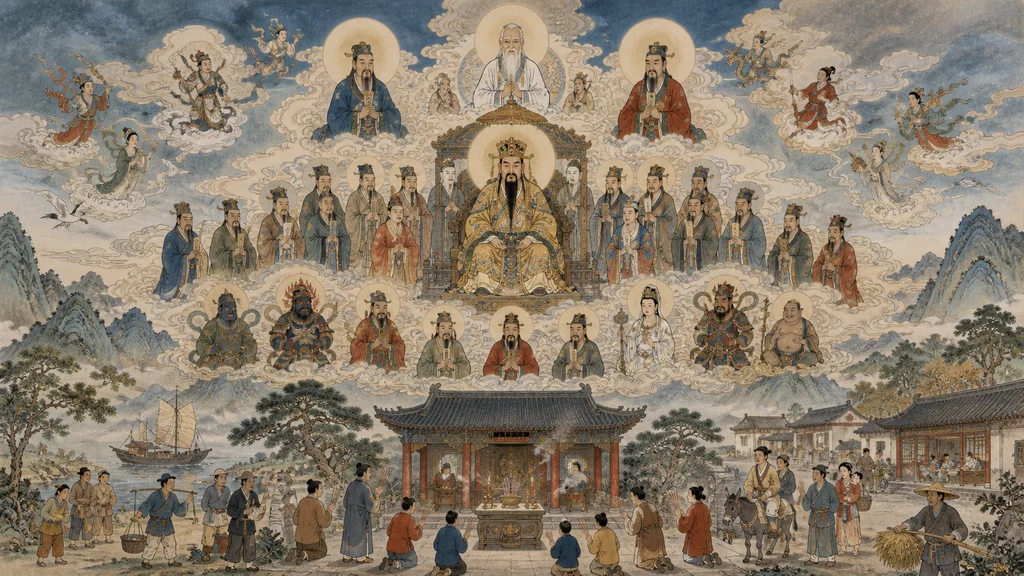
In familiar images, the Jade Emperor sits in imperial robes, attended by divine officials. He may oversee the celestial realm, supervise offices, confirm ranks, and maintain order across Heaven, Earth, and the underworld. The governing metaphor matters. It is not the same as bringing all existence into being from nothing.
Popular accounts also connect him with moral records, reports submitted by other gods, and observances in the ritual calendar. These practices show how his authority can enter household and community life. They do not add up to a single national job description: temples, regions, and ritual traditions place different emphasis on his roles.
Heaven resembles a court because government supplied a language for order
People living under imperial rule knew magistrates, documents, evaluations, promotions, and reports moving up a hierarchy. The invisible world could be imagined through similar relationships. City Gods, Earth Gods, the Kitchen God, and numerous other figures held particular territories or responsibilities, while the Jade Emperor occupied a much higher administrative position.
This does not mean that every deity was copied from an actual official. Nor was the pantheon always tidy. Local cults absorbed historical people, gods received new titles, and old offices acquired fresh interpretations. The celestial bureaucracy was a flexible cultural model: it made power and responsibility intelligible without producing one permanent organisation chart.
The Jade Emperor’s authority has a history
Early Daoist sources contain titles such as Jade Sovereign and Jade Emperor, but the identities and ranks attached to them were not always consistent. Scholars generally locate the maturation of the Jade Emperor as the supreme ruler of the popular pantheon in the Tang and Song periods. In the early eleventh century, Emperor Zhenzong established a state cult and granted elevated titles to the deity, linking celestial authority with imperial claims.
The Scripture on the Jade Emperor’s Fundamental Conduct, formed around the twelfth to thirteenth century, further established him within major Daoist ritual traditions. The Jade Emperor familiar today is therefore not an unchanged character handed down from the remote beginning of Chinese civilisation. Texts, rites, state sponsorship, and popular worship all contributed to his development.
“Highest deity” can mean more than one thing in Daoism
Religious Daoist pantheons commonly give the Three Clarities, or Three Pure Ones, the most exalted status. They are associated with sacred principles preceding the formed cosmos, with celestial realms, and with bodies of scripture. The Jade Emperor, meanwhile, is often presented as ruler or chief administrator of the manifested world.
Schools, rituals, and popular explanations arrange these relationships differently, so the question “Who outranks whom?” has no answer valid for every period and community. As a provisional guide, one might distinguish a sacred source or cosmic principle from the sovereign who administers Heaven. It is a teaching aid, not a universal chart to which every worshipper subscribes.
There is no single membership list for “Chinese belief”
Religious life in China has long interwoven Daoist and Buddhist institutions, Confucian ritual, ancestor reverence, local temples, and household festivals. One person might honour ancestors, visit a Buddhist temple, employ a Daoist priest, and make offerings to a local protector without feeling obliged to choose one exclusive identity.
Even “popular religion” is a broad scholarly convenience that can conceal differences of place, class, and period. The Jade Emperor stands at the centre of some communities and ceremonies but remains peripheral to other people’s daily lives. Many Chinese people hold no such belief at all. Asking whether he is “the God Chinese people believe in” assumes a uniform religious population before the comparison has even begun.
Why “God” is not a ready-made slot
In many monotheistic contexts, God combines uniqueness, creation, ultimate authority, and exclusive worship. The Jade Emperor’s characteristic function is to govern a cosmos already populated by other gods, ancestors, and spiritual beings. His eminence does not depend on a claim that no other deity is real.
Nor can the name Yuhuang Shangdi settle the issue. Terms including di, Shangdi, and Tian have passed through ancient state sacrifice, philosophical interpretation, changing cults, and modern translation debates. The same English or Chinese word may build a useful bridge between traditions while quietly implying a theological identity that the evidence does not support.
The Jade Emperor of fiction is famous, but incomplete
The Journey to the West and its many theatrical, television, and cinematic descendants helped make the Jade Emperor widely recognisable. He appears as the head of the heavenly court, issuing commands while Sun Wukong disrupts its hierarchy. These portrayals are culturally important, but they serve comedy, satire, and narrative drama. They cannot substitute for scriptures, ritual manuals, temple practice, and local worship.
When viewing an image in a museum, it is more revealing to notice the imperial robe, court arrangement, ceremonial tablet, and attendant officials. These elements show how authority is made visible. The object’s date, place, and ritual setting usually tell us more about its meaning to worshippers than a search for one canonical mythology.
Compare functions only after naming the context
For a child, student, or museum visitor, a sound introduction would be: “In many Daoist and popular religious traditions, the Jade Emperor is an important ruler who administers Heaven; he is not the sole creator of the world.” The next questions should concern where the image came from, when it was made, and what people did with it.
Comparison itself is not forbidden. It becomes useful when we specify the feature being compared and where the resemblance ends. That approach recognises the Jade Emperor’s genuine religious importance without forcing the varied landscape of Chinese religion into a theological category made elsewhere.
Sources and further reading
- Stanford Encyclopedia of Philosophy, “Religious Daoism”
- *Encyclopedia of Religion*, “Yuhuang”
- Columbia University Asia for Educators, “The Jade Emperor & Other Gods of the Earthly Domain”
- Columbia University Asia for Educators, “What Is Popular Religion?”
- Stephen F. Teiser, “The Spirits of Chinese Religion”
- CUHK, *Journal of Chinese Studies* 60, study of the Jade Sovereign Scripture
- *The Encyclopedia of Taoism*
- Columbia University Asia for Educators, “God in the Context of Chinese Religion”