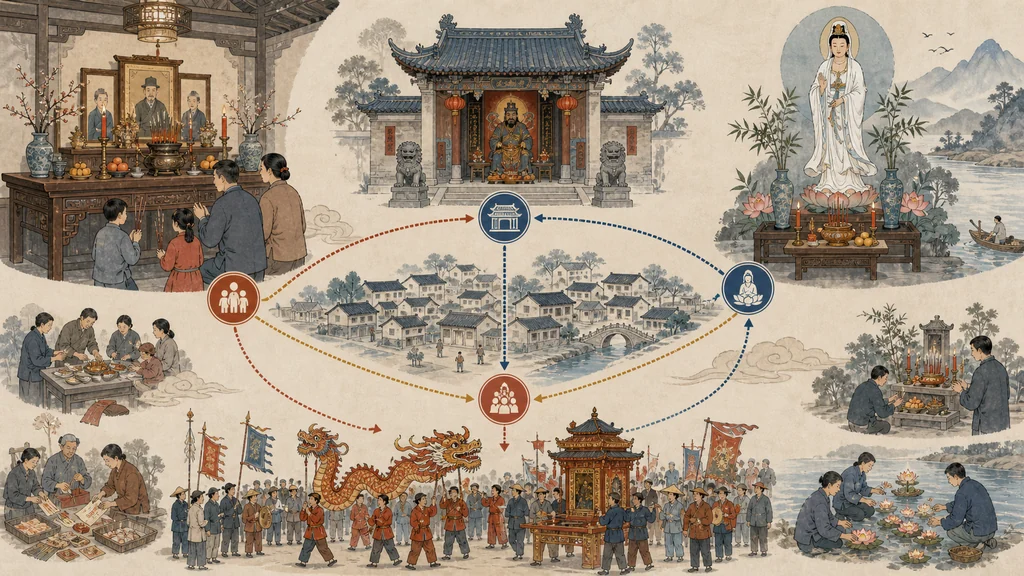
The short answer: relationships can overlap without cancelling one another
Chinese popular religion often organises deities by place, responsibility, kinship, and immediate need rather than requiring exclusive loyalty to one god. A household may honour the Kitchen God, join a neighbourhood festival for an Earth God, associate Lord Guan with a business, and look to Mazu as the protector of a coastal community. Offering incense to one of them does not normally declare all the others false.
That flexibility is not the same as “believing in everything,” nor does every person carry a complete pantheon in mind. Family inheritance, a temple’s territory, an occupation, and a vow once made can turn certain relationships into real obligations. Some people participate only on family occasions; others visit temples often. Many Chinese people are atheists or identify specifically as Buddhist, Daoist, Christian, or Muslim and do not combine practices in this way.
“Popular religion” is not a church with a membership list
Chinese popular or folk religion is a broad scholarly label for practices dispersed through households, villages, marketplaces, and temples. Participants do not necessarily use the phrase as an identity. They do not all answer to one scripture, clergy, church, or nationally standardised theology. Teaching materials from Columbia University’s Asia for Educators make the contrast neatly: there are families, shrines, and temples, but no single church organising them all; acknowledging one tutelary deity does not prevent a person from worshipping others.
This differs from models in which religion is primarily measured by assent to an exclusive creed and formal membership. Asking whether someone “believes” may not yield a simple yes or no. A person may avoid claims about whether gods objectively exist yet still light incense on a grandmother’s death anniversary. Another may donate at the village festival because the temple belongs to their home community. Participation, conviction, family duty, and local identity can coincide, but they need not.
Deities meet people at different scales of life
Some sacred relationships are organised by social scale. The Kitchen God belongs to household routine. A 1939 New Year print in the Metropolitan Museum of Art shows how an inexpensive printed image could locate his divine seat within the home. An Earth God may protect a village or urban neighbourhood, while a City God historically corresponds to a city and its administrative territory. Ancestors are different again: they are connected to particular descendants through kinship rather than serving as public gods for everyone.
Responsibilities overlap as well. A person might approach Mazu about safety at sea, Wenchang about study, or Lord Guan about commercial trust and protection. Yet these are not departments with airtight job descriptions. UNESCO’s account of Mazu customs notes that although she is famous as a sea goddess, devotees also seek peace, pregnancy, help with a problem, or general wellbeing. A deity’s field can expand through the accumulated experience of a community rather than remaining locked to one label.
The pantheon can grow and a god’s identity can change
Many deities did not begin with a permanent office in a completed cosmic chart. A local story might commemorate someone believed to have protected the population. Temple inscriptions and festivals could stabilise that account, while an imperial government might grant honorific titles. Mazu tradition elevated a woman of Meizhou, remembered for helping people in danger at sea, into a goddess. Maritime travel and migration then carried her from a local setting into a transregional network of temples and homes.
Lord Guan shows how one historical figure can acquire several roles. A late Ming porcelain figure in the British Museum represents Guan Yu, the third-century general who became a deity associated with loyalty, integrity, and warfare. The museum notes that he was also treated as a god of wealth. This does not simply mean that worshippers “confused” two gods. Different communities drew the qualities and powers they required from an expanding body of stories about the same figure.
Local gods could also gain prestige because people credited them with protecting a community or answering a request promptly. Historical research on institutions from the Song period onward describes tutelary figures acquiring temples and followers across several villages through local ties and reputed efficacy. Here, “efficacy” means a participant’s interpretation of events. It is evidence about why devotion spread, not historical proof of supernatural intervention.
Heaven resembles an administration, but it has no single permanent chart
Chinese religious images often describe a divine hierarchy spanning heaven, earth, and the underworld. The Jade Emperor, City Gods, Earth Gods, and Kitchen Gods may appear to occupy different ranks and jurisdictions. The year-end dispatch of the Kitchen God to make his report connects household affairs with a larger cosmic administration. Offices, memorials, seals, inspections, and official titles give people familiar language with which to imagine an invisible order.
The bureaucratic metaphor does not create one organisation chart valid everywhere and forever. Temples may use different titles for the same god, while regions insert local figures into wider pantheons. Identities can even overlap: a community guardian may also be explained as a Buddhist protector or a general within a Daoist divine order. Hierarchy helps rituals arrange relationships, but it never fully erases local invention.
Buddhism, Daoism, ancestors, and local gods can meet without becoming identical
A temple may contain Guanyin, Daoist deities, and a local protector. A domestic altar may place images of gods near ancestral tablets. This does not prove that Buddhism, Daoism, and ancestor rites are “really one religion.” Guanyin belongs to Buddhist scriptures and institutions; Daoism has its own texts, ordinations, and ritual specialists; ancestors are constituted through genealogical relationships. Their histories and structures should not be flattened.
Overlap occurs in lived practice. For a funeral, a family might invite Buddhist monastics to chant, employ Daoist priests for another ritual, and continue its own ancestral procedures. An Oxford history of Daoism and popular religion notes that Daoist priests came to serve the wider popular pantheon and could provide elaborate rites for particular crises or occasions. Hiring one kind of specialist did not necessarily create an exclusive, lifelong denominational identity.
Efficacy, fulfilled vows, and temples sustain the relationship
People choose a temple for several reasons. It may be nearby or inherited through family custom; a friend may say that its deity is especially responsive. If circumstances improve after a petition, a devotee may return to fulfil a vow, present a plaque, or fund a festival. Reciprocity turns a private event into public reputation and adds another story to a god’s career. If nothing improves, a person may reinterpret the result, try another temple, or withdraw.
A temple is more than a counter for individual requests. Kenneth Dean’s fieldwork on village religion in Fujian found that temple networks could raise funds, provide services, and mobilise whole communities for collective rituals. Carrying a deity’s palanquin, sponsoring opera, or repairing a temple honours the deity while also negotiating who belongs to the locality and who supplies labour and money. Multiple gods coexist partly because multiple family, occupational, and territorial networks intersect.
Today, observe the practice before assigning an identity
Urbanisation, migration, regulation, and generational change all reshape contemporary worship. A temple containing many gods does not mean that every visitor believes in every image. One person may address only the main deity, another may be accompanying a relative, and a third may treat the festival as local culture. Diaspora temples may rearrange their altars as communities from different places meet. Conversely, a home containing one image does not prove that its residents reject all other traditions.
When visiting, better questions are “Who is the principal deity here?”, “How are the other figures connected with this place?”, and “For whom is today’s ceremony being held?” Do not move an image, step across an offering table, place incense where it is not permitted, or decide that a companion ought to kneel or donate. The coexistence of several relationships is the beginning of understanding this religious world. Respect for the particular people and place is the condition for entering it.