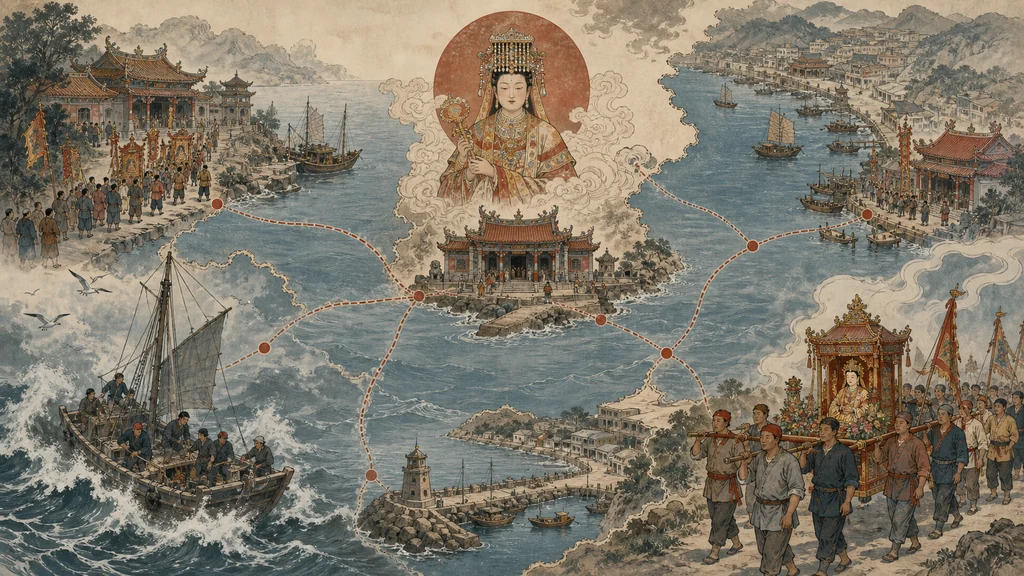
The short answer: a local goddess travelled along real sea routes
Mazu is a female protector whose tradition developed around Meizhou Island in Fujian. In the received story, she was a tenth-century woman of the Lin family who understood the sea, helped her neighbours, and continued to guide ships through storms after her death. She became one of the most influential sea goddesses in Chinese communities not through one legend alone. Fishers, sailors, merchants, and migrants repeated accounts of rescue and safe return, carried her incense into new ports, and built temples. From the Song period onward, imperial governments also granted her increasingly exalted titles.
Her expansion therefore worked from below and above. Local communities established the relationship; maritime networks moved her reputation; official recognition placed a local goddess within a larger political order. Today, her concerns are not limited to shipping. Families may seek peace, pregnancy, help with a problem, or general wellbeing, while festivals sustain communal identity.
Lin Moniang: a traditional biography and a historical record are not the same
The mature biography calls her Lin Mo or Lin Moniang. It dates her birth to 960 and her death to 987, describes a quiet child able to anticipate weather or rescue vessels through extraordinary power, and often says she died while trying to save people at sea. Meizhou residents then supposedly built a temple and called her Mazu, a title carrying the intimacy and honour of a maternal ancestor or grandmother.
These details matter within the tradition, but they do not all constitute a contemporary personnel file. Hong Kong’s intangible-heritage account introduces Lin’s life as legend, while historians trace clearly visible Mazu devotion through inscriptions and other texts from the twelfth century. The responsible formulation is that tradition remembers a tenth-century woman of Meizhou and that her cult is documented in the Song. Exact dates, miracles, and genealogy became fuller in later temple histories, lineage records, and devotional biographies.
Maritime risk made protection an especially powerful bond
Sailing ships faced typhoons, reefs, currents, illness, piracy, and long periods without communication. Those departing could not promise to return on schedule, and families ashore might have no news of them. Knowledge, maintenance, and cooperation were essential to survival, but technology could not remove uncertainty. Petitioning Mazu provided a shared ritual sequence: entrust the voyage before departure, call for help in danger, and give thanks after a safe return.
A successful voyage could become more than a private memory. Crew members might donate a plaque, pay for repairs, set off firecrackers, or recount an appearance of the goddess in a storm. Other crews heard the account and made their own offerings, turning individual interpretation into port reputation. Cambridge research on maritime cosmologies notes that fishing boats, merchants, and even maritime groups outside official control could honour Mazu. Common exposure to danger crossed occupational and political lines.
Ports, trade, and migration carried Mazu outward
A deity crosses regions through people, objects, and routes. Quanzhou’s Tianhou Temple was founded in 1196. UNESCO’s evaluation situates it within the physical system of a Song–Yuan maritime emporium, alongside docks, bridges, religious sites, and diverse merchant communities. The temple was not an isolated expression of abstract ocean worship. It was an institution embedded in moving ships, cargo, and populations.
When merchants and sailors established a temple abroad, they gained a place for common rites, meetings, and mutual support. After settling, migrants used Mazu to connect a new port with Fujian. A seventeenth-century calligraphy work at the Metropolitan Museum of Art points to such movement in Nagasaki, where a temple sponsored by Chinese maritime merchants contained a hall for Mazu. Temples also appeared throughout Southeast Asian ports and formed new combinations with local languages, architecture, and sacred figures.
This was not a one-way process of perfect copies moving from centre to edge. Every port added its own maritime experience, migrant composition, and local alliances while retaining relationships with Meizhou or another recognised parent temple.
From Lady to Empress of Heaven: why courts promoted her
One way Song governments incorporated a local deity into official order was by granting a temple plaque and honorific title. Research on Mazu’s canonisation shows the court first recognising names associated with timely aid to shipping, then raising her from Lady to Consort. The Yuan title Celestial Consort, Tianfei, elevated her further. Ming and Qing titles increasingly described protection of state and people; Tianhou, Empress of Heaven, became one of her best-known names.
These were not merely additions to an honours list. Grain transport, diplomatic voyages, coastal security, and military operations all depended on maritime routes. Governments had practical reasons to endorse a protector already trusted by sailors. Recognition could supply ritual rank and resources, while turning miracle accounts into evidence that a dynasty enjoyed divine support. Local temples and the Lin lineage, in turn, used inscriptions, genealogies, and title lists to strengthen their authority.
The court did not “invent” Mazu. Without devotees, maritime testimony, and temples, an official title had no living base. Without state endorsement, her worship could still move along informal routes. The two forces amplified one another.
Maternal compassion did not make her passive
Mazu is often shown seated, crowned, and formally robed, sometimes attended by the far-seeing Qianliyan and the far-hearing Shunfeng’er. Her costume expresses celestial rank; her pose joins maternal accessibility to official authority. A seventeenth-century inscription now at the Met praises her compassionate “elderly woman’s heart.” In some cross-cultural settings, this quality encouraged links with Guanyin, the Buddhist bodhisattva of compassion.
Mazu and Guanyin should not simply be equated. Guanyin belongs to Buddhist scriptures and bodhisattva traditions. Mazu has a Meizhou biography, temple genealogies, and imperial titles. Temples that associate them demonstrate religious overlap, not proof that they have always been one identity.
Nor is a female sea deity merely a mother waiting for ships to return. Her legends give her the power to enter storms, direct vessels, and command divine assistants. State titles make her a guardian of territory and transport. Tenderness and governing authority coexist in the same image.
Temples reproduce relationships through incense, pilgrimage, and procession
A new temple may receive incense ash or an image from an older, more authoritative temple. This process, often described as dividing incense, creates a traceable relationship between the two. Pilgrimage and procession then set images, worshippers, and ceremonial groups in motion. People visit a parent temple, or welcome Mazu on a tour through their own community. The route is a religious geography and a map of kinship, commerce, and migration at once.
Festivals may combine flowers, incense, lanterns, opera, processions, and communal food, with no universal checklist. Fulfilment of vows expresses reciprocity: worshippers who believe a request was answered return to perform a promised act. UNESCO’s Mazu listing accordingly treats oral tradition, temple festivals, household ritual, and community participation as a connected practice, not merely a statue.
Large modern processions also require traffic, noise, fire, heritage, and tourism management. Size does not automatically make a public festival more authentic than a family’s quiet offering. They maintain relationships at different scales.
To understand a Mazu temple today, learn the port’s own story
Contemporary devotees may be fishers, shipping workers, merchants, or migrant descendants. Others have no occupational connection with the sea and approach Mazu as a family or community guardian. Some affirm divine power; some emphasise cultural inheritance; many do both. Many Chinese people do not worship Mazu at all. UNESCO status recognises transmission by communities; it neither proves miracles nor standardises one ritual for every place.
When visiting, ask where the temple received its incense lineage, whether its main title is Mazu, Tianfei, or Tianhou, and which local pilgrimage or birthday observance matters most. Do not block a procession, touch a palanquin or offerings, or convert a lunar date into a permanently fixed Gregorian day. Seek permission before photographing a rite, an inner hall, or worshippers at close range. The larger story is not simply one rescue legend. It is how generations used temples, routes, and memory to sustain a protective relationship across the sea.