The short answer: a useful hint is not a scientific equation
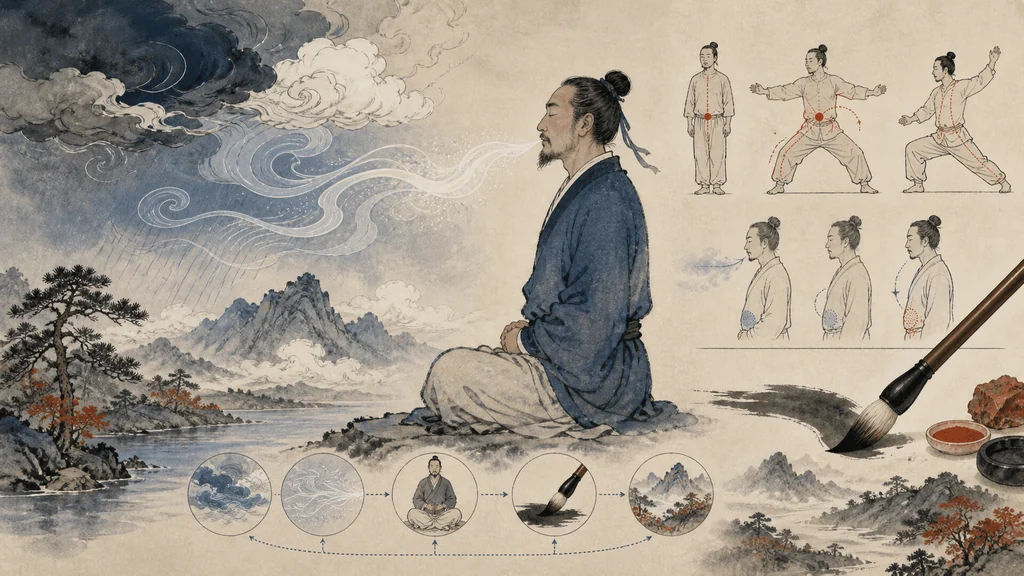
Qi can be associated with air, breath and vapour. It also appears in words for weather, atmosphere, emotion, manner and courage. In philosophical and medical texts, it may perform more specialised work in accounts of bodies, minds and cosmic change. “Energy” sometimes helps an English reader grasp that qi is active rather than inert. It can also create a dangerously precise impression: that an old text is naming the same measurable quantity that modern physics expresses in joules.
There is no automatic equation of that kind. In careful English, the best choice is often to retain qi and explain what it is doing in the passage concerned. Is the author describing breath, the condensation of tangible things, living activity or moral bearing? No single fluent equivalent can answer those questions in advance.
Ordinary Chinese already reveals several meanings
The Taiwan Ministry of Education’s revised Mandarin dictionary includes air, water vapour and the breathing of humans or animals among the meanings of qi. Everyday compounds make the range still clearer. Tianqi means weather, not “sky energy.” Shengqi commonly means becoming angry. Keqi describes a polite or socially restrained manner. Yongqi is courage, yuqi is tone of voice, and qifen is the atmosphere felt in a setting.
Replacing every occurrence with “energy” makes these phrases nonsensical. Everyday usage is not itself a philosophical theory, but it supplies an excellent warning for readers. The word moves among material phenomena, bodily experience, emotions and social judgement. Historical thinkers could exploit that range when describing the world. A translator must therefore examine the compound, genre and date before assuming that every instance conceals one mysterious substance.
English once allowed words such as “spirit” and “pneuma” to range between breath, life and disposition in comparable ways. That comparison can aid understanding, but it should not be used to claim that the Chinese and Mediterranean concepts have identical histories.
Mencius uses qi in an ethical argument
In the “Gongsun Chou I” chapter, Mencius says that he is skilled at nurturing his haoran zhi qi. He calls it supremely great and firm, says that it accompanies rightness and the Way, and explains that it is generated by the accumulated practice of right action. The conversation concerns courage, an unperturbed heart and the ability to act morally.
Bodily and respiratory experience may form part of the language’s background, but Mencius is not reporting the detection of fuel inside the body. “Moral energy” can convey something of the passage’s power, yet it weakens the unusual connection among embodied condition, moral bearing and repeated just action. “Physical energy” is worse: the text gives no unit, instrument or conservation law.
A responsible translation may keep haoran zhi qi and gloss it as a vast, steadfast moral vitality or bearing cultivated through right conduct. The explanatory phrase is not a perfect substitute. It tells the reader which aspect matters in this particular argument while leaving the Chinese term visible.
Cosmological qi was never one timeless doctrine
The Stanford Encyclopedia of Philosophy describes qi as originally connected with air and breath and later used as a broad kind of “stuff” in explanations ranging from the formation of heaven and earth to weather and the human heart. “Stuff” is deliberately loose. Modern divisions among matter, mind and energy do not necessarily map neatly onto early Chinese categories. The excavated fourth-century BCE text known as Xing zi ming chu, for instance, speaks of the qi of pleasure, anger, grief and sadness moving when things stimulate the heart.
In the Northern Song, Zhang Zai understood the formation and dissolution of things through qi’s gathering and dispersal. Condensation produces tangible forms; dispersal returns them to the “Supreme Emptiness.” The Internet Encyclopedia of Philosophy explicitly cautions that “substance,” “matter” and “material force” all fail to capture his meaning completely. His model is neither a simple pile of particles nor a modern field theory waiting to be renamed.
Zhu Xi made the relationship between li and qi central to a different synthesis. Li concerned intelligible patterns or coherence; qi was the concrete, dynamic medium in which patterns were realised and differences emerged. Zhang and Zhu did not assign explanatory priority in exactly the same way, and later thinkers such as Wang Fuzhi continued the dispute. “The Chinese theory of qi” is consequently a misleading singular. There are connected arguments with long histories, not a definition accepted unchanged for two millennia.
Medical language requires two kinds of caution
Early Chinese medicine and philosophy did share a vocabulary of qi, yin-yang and the Five Phases. Textual traditions associated with the Huangdi Neijing used these concepts to organise relations among the body, seasons, organs and illness. Shared terms, however, do not prove that philosophers, technical specialists and physicians deployed them identically in every passage. Nor does a historical category automatically correspond to one structure in modern anatomy.
Translating all medical qi as “bioenergy” can make a text sound contemporary while adding an entity that neither philology nor experiment has separately established. The reverse shortcut is also inadequate. Declaring the concept empty merely because it does not match current terminology fails to explain how a historical medical language organised observation and practice.
The history of an idea and the clinical effectiveness of a treatment are different questions. They demand different evidence. Understanding what qi meant in a medical classic does not by itself prove or disprove a particular intervention. This article offers intellectual history and translation guidance, not diagnosis, treatment or health advice.
A translation toolkit for British readers
For breathing exercises, “breath” may be exactly right. In passages about clouds, steaming or rarefaction, “vapour” can preserve the physical image. When explaining Zhang Zai, scholars may use “material force” or “vital stuff” as labelled working translations. Ordinary yuqi and qifen call for “tone” and “atmosphere,” not a technical theory. “Vital energy” can sometimes indicate living activity, but it risks both mystical and physical-scientific misunderstandings.
Ask three questions whenever “energy” appears in a label or translation. Who wrote the statement, and when? Which verbs, adjectives and nouns accompany qi? Does the English word silently add a claim about measurement, supernatural action or medical efficacy that the source has not established? If the answer remains uncertain, transliterating qi and adding one concise contextual explanation is usually more honest than false precision.
What to remember
Qi became historically powerful because it could connect breath, weather, affect, tangible formation and processes of change. Connection does not make all these usages identical. “Energy” illuminates one corner of the term but cannot confine it within modern physics. Restore the sentence’s context first and choose English second: that order protects a many-sided historical concept from becoming a neat but inaccurate answer.