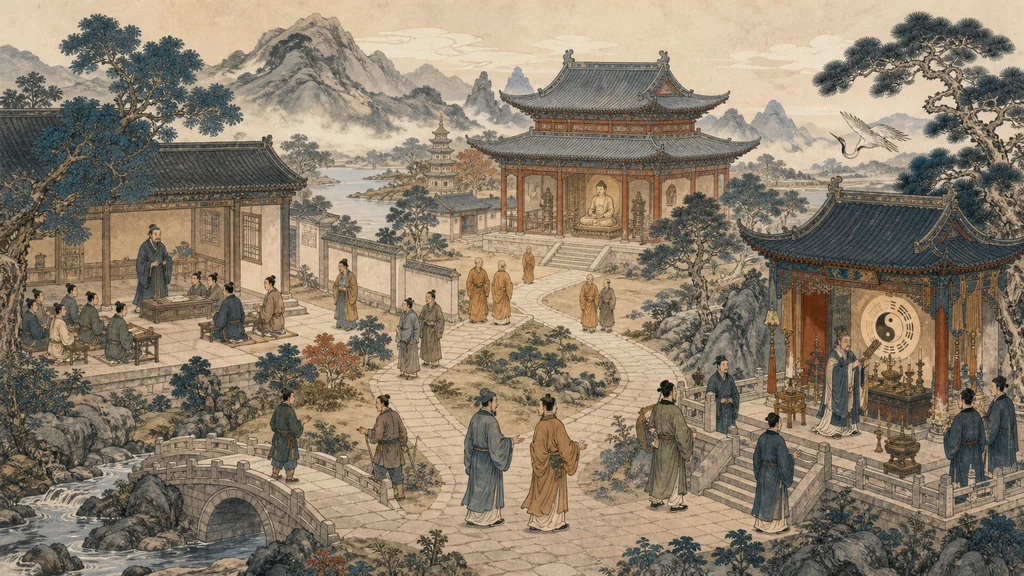
The short answer: distinct traditions did not always require an exclusive choice
The Three Teachings are Confucianism, Buddhism, and Daoism. They possess different texts, representative figures, institutions, and aims of cultivation. Across Chinese history they competed for court support, criticised one another, and also borrowed one another’s language. Ordinary participation, meanwhile, often centred on family rites, festivals, life-cycle events, and local communities rather than a declaration of exclusive membership.
Their coexistence does not mean that boundaries never mattered or that everyone followed one blended religion. Difference, rivalry, and overlap existed at the same time.
They were not three matching churches founded side by side
Confucian traditions made classical study, ethical relationships, education, political order, and state ritual central concerns. Buddhism originated in India; in China it established monastic communities, temples, precepts, translated canons, and many schools. Daoism grew from indigenous Chinese thought, deities, techniques, and ritual traditions, developing its own scriptures, priestly transmissions, and liturgies.
All three addressed self-cultivation, but they posed different questions about the person, family, society, cosmos, and liberation. The familiar slogan that Confucianism governs social life, Daoism health, and Buddhism the afterlife is memorable precisely because it is too neat. Each tradition ranges far beyond its assigned compartment.
The word “teaching” does not produce three modern religions
The Chinese jiao can describe teaching, transformation, and a transmitted path. If each Teaching is imagined as a modern church with one creed, a fixed membership list, and exclusive allegiance, much of the historical evidence appears contradictory. Scholars still debate whether Confucianism is best classified as philosophy, ethical-political tradition, or religion. Buddhism and Daoism had professional religious organisations, but their boundaries were not identical everywhere.
A person might clearly identify as a monk, Daoist priest, or Confucian scholar without requiring every member of a household or village to register in the same category. The single-choice box on a modern survey is a poor tool for reconstructing all premodern lives.
Multiple participation usually happened around a particular task
A family could speak of filial responsibility in Confucian terms, invite Buddhist monks to chant at a funeral, employ Daoist priests for another part of the ritual, continue ancestral offerings, and attend a local temple festival. Participants did not necessarily understand these actions as repeated conversions between mutually exclusive truth systems. They might instead be fulfilling different obligations within different relationships.
This practical movement should not erase specialist boundaries. Monastics lived under precepts and belonged to temples. Daoist priests possessed lineages and ritual repertoires. Confucian writers could fiercely reject Buddhist and Daoist claims. Participation across traditions did not make the traditions identical.
Coexistence was never permanent harmony
Buddhist and Daoist institutions competed for imperial patronage, ritual authority, and the status of their scriptures. States sometimes suppressed monasteries or restricted religious organisations. Confucian critics attacked monastic withdrawal, temple wealth, and perceived failures of family duty; Buddhist and Daoist authors defended their own legitimacy.
At the same time, Song and Ming Confucian thinkers absorbed and transformed powerful Buddhist and Daoist questions about mind and cosmos while arguing against those rivals. Borrowing did not always arise from a friendly embrace. A tradition might study an opponent closely in order to defeat it on stronger intellectual ground.
“Three Teachings in One” was an argument, not a census result
From the Song period onward, statements and images about the shared source or unity of the Three Teachings became increasingly prominent. The “Three Laughers of Tiger Ravine” brings together the Buddhist monk Huiyuan, the Daoist Lu Xiujing, and the poet Tao Yuanming in joyful companionship. “The Three Vinegar Tasters” commonly places the Buddha, Confucius, and Laozi around the same vat, their reactions embodying different perspectives.
Such pictures do not prove that the historical figures met, nor do they record the beliefs of an entire population. They advance an ideal: differences may approach a common truth, or contrasting perspectives may be complementary. Other authors continued to insist that their own Teaching was fundamental. Unity was itself one position in an ongoing debate.
The Three Teachings leave much everyday religion outside the frame
An account limited to Confucianism, Buddhism, and Daoism can omit ancestor rites, local protective gods, household deities, seasonal festivals, spirit mediums, and practices that fit none of the three neatly. Daoist professionals may conduct a communal rite, or Buddhist images may enter a local pantheon, without every activity becoming simply “Daoist” or “Buddhist.”
“Popular religion” provides a temporary label for this wider field, but it too can hide distinctions of region, class, and period. The Three Teachings are a powerful historical classification, not a closed inventory of Chinese religious life.
In Three Teachings art, look at how difference is staged
A museum image of the Three Teachings says more than “everyone got along.” Notice who occupies the centre, and whether clothing, hairstyle, or attributes identify each figure. Does the inscription celebrate a common source, or quietly privilege one path? An object made for a temple, a scholar’s gathering, or the commercial market can carry a different argument.
Putting three representatives into one scene shows that the artist wanted them to converse. It does not prove that monasteries, Daoist institutions, and state ritual had merged. Art turns an abstract dispute into a visible social encounter.
The most accurate summary is: overlapping, but not the same
When asking whether people had to choose, first ask which people, in what period, and in which role. An ordained monastic, an initiated Daoist priest, or a scholar in a doctrinal controversy might have sharp commitments. A household organising different occasions could move across traditions.
The Three Teachings could coexist because religious life was not always organised through one exclusive membership identity. Appreciating that flexibility requires us to preserve institutional boundaries, contests for power, and genuine historical conflict as well.
Sources and further reading
- Columbia University Asia for Educators, “Sanjiao: The Three Teachings”
- Stephen F. Teiser, “The Spirits of Chinese Religion”
- The Metropolitan Museum of Art, “Daoism and Daoist Art”
- Oxford Research Encyclopedia of Asian History, “Confucianism, Daoism, Buddhism, and Chinese Popular Religion”
- Judith Berling, “Rethinking Syncretism: The Unity of the Three Teachings and their Joint Worship in Late-Imperial China”
- The Metropolitan Museum of Art, “Three Laughers of Tiger Ravine”
- British Museum, “The Three Vinegar Tasters”
- Stanford Encyclopedia of Philosophy, “Comparative Philosophy: Chinese and Western”