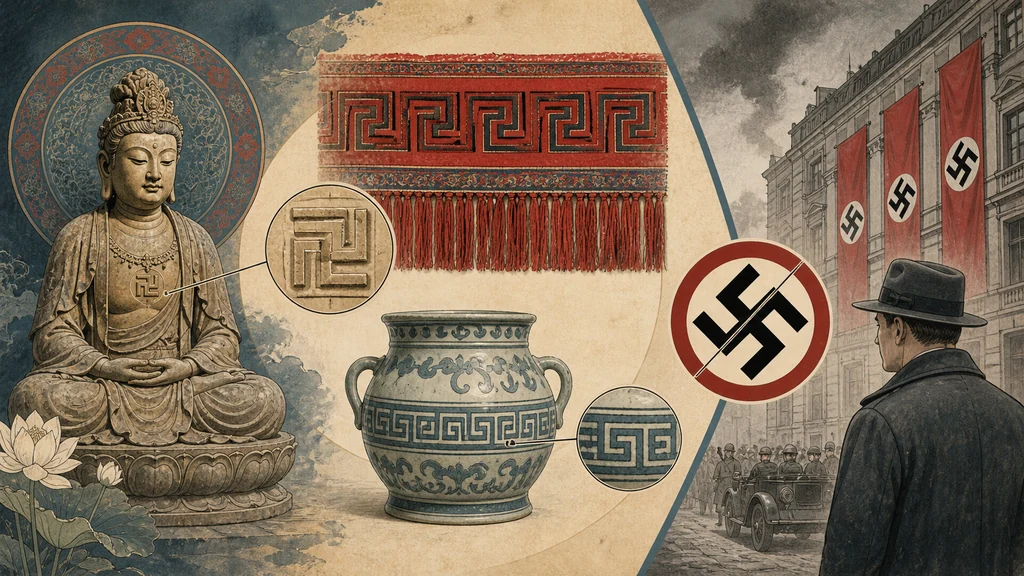
The short answer: it carries two real histories
In Chinese Buddhist and decorative art, the forms 卍 and 卐 have long conveyed auspiciousness, qualities of the Buddha, myriad virtues, longevity, and unbroken continuity. Their history began centuries before Nazism. In the twentieth century, however, the Nazi Party made the related form central to a racist state emblem, and the Holocaust transformed it into an exceptionally powerful sign of hatred in Europe and North America.
Neither history erases the other. “It was originally auspicious” cannot make modern trauma disappear, while the mere sight of a hooked cross cannot tell us the date, place, or purpose of an object.
On a Buddha image, it marks auspicious qualities
Recent historical research traces surviving Chinese Buddha statues bearing the sign at least as far back as the Northern Wei period. Placed on the Buddha’s chest, it could function as an auspicious mark or a sign of virtues too numerous to count. The motif entered China through Buddhist worlds in India and Central Asia, then acquired further meanings through Chinese writing, translation, and visual culture.
Both 卍 and 卐 appear on early Chinese images. The two orientations therefore cannot be divided neatly into a benign “Asian version” and an evil “European version.” Direction is a visible feature, but it is not a machine-readable code that supplies meaning without context.
The name wanzi has a more complicated history than a famous decree
A familiar story claims that Empress Wu Zetian assigned the sign the reading wan in 693, making it represent a multitude of auspicious virtues. A historical reassessment published in 2024 argues that this was probably a later explanation rather than the true origin of the name. Popular forms of the character 萬, meaning ten thousand, had already produced the simpler form 万, whose shape resembles 卐. Medieval writers also described outlines by saying that something was shaped like a particular character.
Wanzi may therefore have begun as “the sign shaped like the character wan,” before absorbing associations with ten thousand, multitude, and good fortune. Wu Zetian did create new characters and was a major patron of Buddhism, but a long history of forms and readings should not be reduced to a single act of imperial naming.
In decoration, it became longevity and endless extension
The word wan is both the number ten thousand and a conventional way to suggest an immeasurable quantity. Joined to shou, longevity, it forms wanshou: “ten thousand years of long life.” The sign consequently appears with longevity characters, bats, peaches, cranes, and other auspicious motifs.
Weavers could also link the hooked arms into a repeating lattice without an obvious beginning or end, producing patterns known as wanzi jin or “unbroken wan-character” designs. Its geometry fits warp and weft especially well. Verbal abundance and visual continuity reinforce each other. On clothing, ceramics, windows, or borders, the motif may offer a general wish for enduring fortune rather than refer to a particular Buddhist doctrine.
The Nazis did not invent the form, but changed its public meaning permanently
Hooked-cross designs existed in many cultures for thousands of years. In nineteenth-century Europe, scholars connected archaeological examples to a supposed “Aryan” ancestral culture; racist movements then appropriated those claims. In 1920 the Nazi Party formally adopted a flag combining a tilted black sign with a white disc and red field. It spread across propaganda, uniforms, rallies, and state power.
The emblem became inseparable from antisemitism, aggression, and the Holocaust. It is historically correct to call this an appropriation of a much older sign. Yet ancient origins do not cancel the terror it evokes for survivors and their descendants, nor excuse its current use for intimidation.
Clockwise versus counter-clockwise is not a reliable test
Online diagrams often declare that 卍 is Buddhist and 卐 is Nazi, or reverse the rule. Material evidence refuses that shortcut. Early Chinese Buddhist figures use both orientations; Asian patterns may mirror or alternate them; Nazis and later extremists have also used variants.
What makes the Nazi flag readily identifiable is a whole composition: a tilted black emblem, a white circle, a red field, and a twentieth-century German political setting. Orientation can contribute to an assessment, but it cannot replace one.
In a museum, ask four questions about the object
When the motif appears, ask when the object was made, where it came from, what kind of object it is, and which images surround it. A repeated sign woven through Chinese silk alongside longevity characters and flowers normally belongs to an auspicious decorative programme. A red, white, and black European political banner from the twentieth century belongs to a radically different history.
A single mark on a Buddha image should be read with the figure’s pose, inscription, and temple use. Context is not an excuse invented to rescue a symbol. It is the evidence required to interpret any visual sign responsibly.
Displaying it today calls for knowledge and care
Showing Asian religious objects in a British classroom or exhibition can be essential historical education. Organisers should give advance notice where appropriate and label both the Buddhist history and the Nazi appropriation. Jewish pupils or visitors should not be expected to explain Holocaust trauma for everyone else. Buddhist, Hindu, or Jain practitioners should not be treated automatically as if they were displaying hatred.
If the sign appears beside antisemitic writing, threats, or extremist slogans, the contemporary hostile context must take priority. If it appears in a temple, ritual, or historical collection, its original function should be described accurately while acknowledging that local viewers may still experience distress.
One sign can hold conflicting histories
The Chinese wan sign is not a relic of Nazism, and the injury carried by the Nazi emblem is not simply a Western “misunderstanding.” Symbols accumulate meaning as they travel through communities, political power, and catastrophe. Later violence can dominate public memory without travelling backwards in time to create earlier statues and textiles.
A mature explanation does not force audiences to choose one meaning. It identifies who used the form, when, in which composition, and for what purpose. Cultural knowledge and historical sensitivity then support each other instead of competing.
Sources and further reading
- Zhiru Ng, “Did Wu Zetian Name ‘卍’ as ‘Wanzi’? A Historical Reassessment”
- The Metropolitan Museum of Art, *Chinese Textiles: An Introduction*
- The Metropolitan Museum of Art, “Longevity in Chinese Art”
- British Museum, Chinese textile MAS.901.a
- United States Holocaust Memorial Museum, “History of the Swastika”
- Anti-Defamation League, “Swastika”
- Les caractères de l'impératrice Wu Zetian dans les manuscrits de Dunhuang et Turfan
- N. Harry Rothschild, *Emperor Wu Zhao and Her Pantheon*