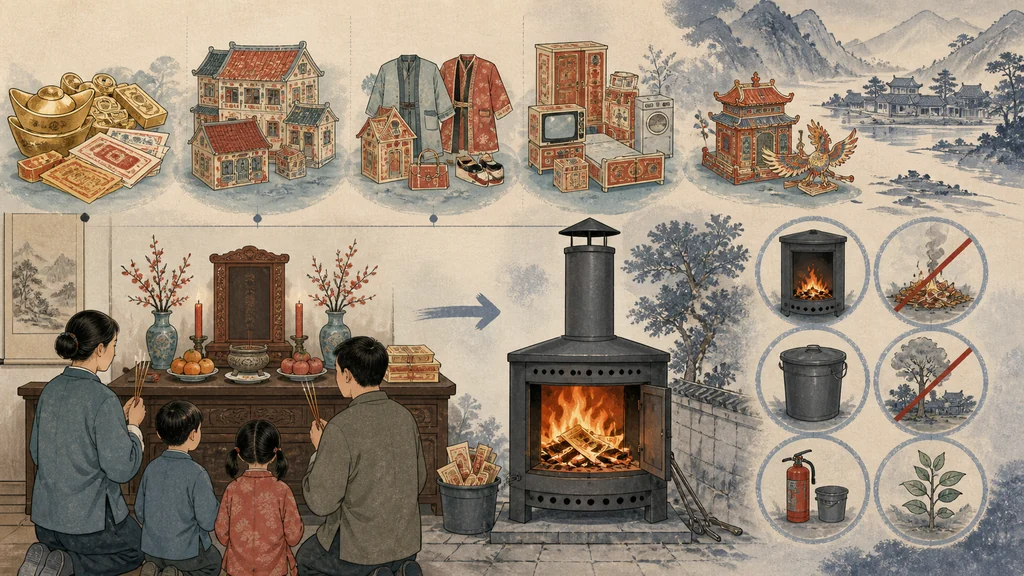
The short answer: it turns care into something that can be sent
Some Chinese families burn paper money because paper offerings can stand for cash, clothing, and everyday goods, while fire transforms those objects into gifts for the dead. The act often expresses a practical obligation rather than an abstract doctrine: a relative should not be left without resources in another world, and the living have not stopped caring about what that person may need. Burning an offering can therefore resemble both a gift and a letter with a named recipient.
This does not mean that every Chinese person shares one map of the afterlife. Some people believe that an ancestor literally receives the offering. Others treat the rite as symbolic remembrance. Some participate only at a funeral, Qingming, or a death anniversary, while others do not burn anything because of religion, environmental concerns, or personal preference. What recurs is not a single creed but the attempt to maintain a relationship with the dead through a material action.
People provisioned the dead before paper money existed
Early Chinese tomb objects called mingqi provide useful background. Made from pottery, wood, and other materials, they reproduced houses, animals, attendants, and household equipment, creating a reduced world for the tomb. The Metropolitan Museum of Art explains that these “spirit articles” played several roles: they served the deceased while also displaying the status and social order of the living.
Mingqi were not paper money, however, and the two should not be presented as an unbroken line. The cautious conclusion is that providing substitutes for the dead was an old idea, and paper later offered a medium that was comparatively easy to make, carry, and burn. Paper money was already a recognisable practice in sources from the Tang period. Later stories traced it to earlier centuries or credited a particular inventor, but the available evidence does not establish one uncontested date or founder.
What goes into the fire is not always money
The simplest offerings may be sheets printed with coin patterns or paper folded into gold and silver ingots. Specialist shops also produce paper clothing, shoes, houses, cars, and, today, models of phones and other consumer goods. Nor do they all have the same destination. Some are offered to ancestors, some appear in rites for deities, and others are given to unclaimed spirits during particular festivals. Janet Lee Scott’s study of Hong Kong paper offerings places paper money, incense, food, and crafted figures in these different relationships. Seeing paper and flame is not enough to label every ceremony “ancestor worship.”
English speakers often call modern imitation notes “hell money” or “hell banknotes.” A high-denomination example in the British Museum documents that modern form, but it cannot be used to reconstruct ancient practice. The word hell can also be misleading. Chinese ideas of an underworld, a realm of the dead, or an ancestral domain do not necessarily correspond to the Christian idea of a place of eternal punishment.
Why burn the gift instead of leaving it intact?
A paper coat left on a table remains an object that the living can touch, retrieve, or reuse. Once burned, it becomes smoke and ash. That irreversible change allows participants to understand fire as a means of crossing a boundary. The offering is not simply wasted; its use in this world is cancelled so that it can become effective in another.
Small details can strengthen the sense of dispatch. Offerings may be sealed in an envelope bearing a name, and relatives may say aloud who should receive them. A dream may later be understood as confirmation of delivery. One community interview archived by the Smithsonian’s National Museum of Asian Art describes a family burning paper clothing and spirit money in an addressed envelope and interpreting a later dream as evidence that the gifts had arrived. The account clarifies one family’s ritual logic; it is not a rule for all families.
Why does the other world have banks, officials, and expenses?
Paper offerings sometimes picture the afterlife in terms borrowed from this one: roads, houses, offices, banks, and payments. This is not a fixed theology that every participant recites. It is better understood as a way of imagining an unknown world with familiar social language. If people need food, clothing, and money here, relatives may suppose that the dead need equivalents. If administration produces paperwork and anxiety in life, the underworld may also be pictured as hierarchical and bureaucratic.
Calling all paper burning “bribing ghosts” therefore misses the central family relationship. Some ceremonies do include gifts to deities or wandering spirits and may ask for protection. Yet offerings to parents and grandparents often say that duties of support did not end abruptly at death. The extravagant face value on a paper note need not represent a real exchange rate. Its more important message is: “I have not forgotten to provide for you.”
Even members of one family may disagree
Practice varies with region, religion, migration, generation, and individual conviction. One household may follow procedures taught by a Daoist or local ritual specialist. Another may associate burning with a Buddhist festival. Some Christian families reject the rite; some secular relatives doubt a literal afterlife but still accompany an older family member. Certain participants insist that a recipient must be clearly named, while others say intention is sufficient.
Change does not necessarily mean that tradition has disappeared. Another Smithsonian community interview mentions a grandmother who reduced the amount of scattered and burned paper for environmental reasons while retaining offerings of food, wine, and incense. This is one household example, not a national trend line. It nevertheless shows that tradition is not a checklist that can only be copied unchanged. Families negotiate among devotion, relationships with neighbours, and present conditions.
Smoke and ash make the practice a public question
Large fires produce smoke, drifting ash, and a risk of accidental fire, especially in dense cities or during dry weather. Disagreement is more complicated than “tradition versus modernity.” Residents may worry about air quality; cemeteries must protect vegetation and memorials; participants may fear that restrictions drive an important rite out of public space. Communal furnaces, smaller quantities, papers without plastic decoration, flowers, food, and online memorials are among the responses people use.
None of those alternatives has an automatic religious rank. For one person, visible flame may be essential to transformation. Another may accept central burning by a temple or cemetery. Someone else may believe that writing a name, telling stories, and gathering the family preserve what matters. The family concerned is better placed to say what counts than an outside observer.
In Britain, ask both the family and the venue
There is no single shortcut that replaces the rules of individual British cemeteries. The Royal Borough of Kingston upon Thames generally prohibits open fires in its cemetery and crematorium grounds. It may grant prior written permission where fire is a cultural or religious funeral requirement, provided the activity is supervised by a funeral director or officiant and suitable firefighting equipment is present. Other grounds may prohibit burning entirely or impose a temporary ban during high fire risk. UK government guidance also makes clear that burning waste can become an environmental and safety matter when it causes pollution, harms health, creates a smoke nuisance, or endangers traffic.
The safest etiquette is simple. Do not light a fire, move offerings, or imitate relatives without being asked. Find out who the offering is for, whether the family wants you to participate, and what the cemetery, temple, or residential site permits. Never burn real banknotes, and do not treat “hell money” as a novelty joke. If flame is not allowed, ask whether flowers, food, a written message, or quiet remembrance would be welcome. Respect does not require performing an unfamiliar gesture. It requires allowing the bereaved family to decide how they will continue to care for and remember their dead.