The short answer: the female image developed historically
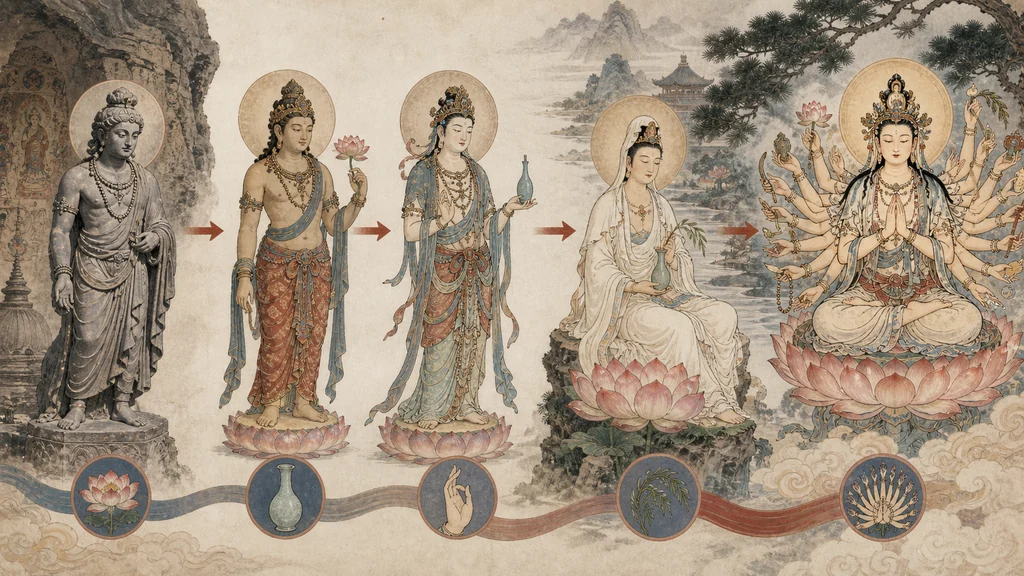
Guanyin developed from the Indian Buddhist bodhisattva Avalokiteśvara. Early Indian art, and many images made after the tradition reached China, gave the figure male or gender-ambiguous features. Buddhist scripture also emphasises that this bodhisattva can appear in many identities to help different beings, including female ones. Chinese artists gradually adopted more explicitly feminine forms, especially from the Song dynasty onwards. White-robed Guanyin, Princess Miaoshan and the Bestower of Sons added further layers to that identification.
It is therefore sound art history to say that Guanyin is frequently female in Chinese art. Saying that Guanyin “was originally a Chinese goddess” confuses Indian origin, Buddhist doctrine and later imagery. Compassionate activity is not confined by the scriptures to one body or sex.
Avalokiteśvara did not arrive in China as a woman
Guanyin abbreviates Guanshiyin, one Chinese name corresponding to Sanskrit Avalokiteśvara. The figure is commonly understood as the bodhisattva who hears or attends to the suffering of the world. A bodhisattva is not a creator god, but an enlightened or enlightenment-directed being committed to helping others escape suffering.
Early Indian images usually present Avalokiteśvara through the body of a male prince, with a bare chest, jewellery and an elaborate crown. Those ornaments should not be judged by current British clothing codes: jewellery and graceful posture did not necessarily mark a bodhisattva as female.
The same visual lineage survives in China. A Dunhuang painting of Water-Moon Guanyin in the Smithsonian’s National Museum of Asian Art has facial hair and a bare, flat chest. Its inscription and attributes identify the subject. This object proves that an early Chinese Guanyin need not be a woman, and that a gentle face, jewellery or an elegant pose cannot independently settle the gender of a Buddhist image.
Scripture offers many bodies, not one permanently female body
The Guanyin chapter of the Lotus Sutra first describes people calling on Avalokiteśvara amid fire, flood, shipwreck, violence and other dangers. It then lists forms that the bodhisattva may assume according to the needs of those being taught. Chinese traditions commonly summarise these as thirty-three manifestations, although the exact count can depend on version and method of division.
The list includes nuns, female lay devotees and other women. It also includes buddhas, monks, officials, children and nonhuman beings. The operative logic is often paraphrased as appearing in whatever body will enable someone to be saved. It does not disclose a single biological sex concealed behind all the appearances.
This scriptural flexibility created doctrinal room for female Guanyin. It does not, by itself, explain why female reading became increasingly stable in particular periods of Chinese art. Between textual possibility and visual predominance lie local cults, pilgrimage centres, patronage, legends and habits of representation.
Feminisation was gradual, and older forms continued
The British Museum describes female portrayals in Chinese art from the Song dynasty onwards while also stressing that Guanyin transcends gender and may appear as male, female or in other forms. This is not a story of a single year in which the bodhisattva suddenly “changed sex.”
Masculine Dunhuang figures, multiarmed Tang esoteric images, the refined ambiguity of Song and Yuan Water-Moon Guanyin, white-robed forms and unmistakably female Ming or Qing figures could coexist. Regional and ritual traditions did not all move at the same speed or towards one uniform result.
A museum visitor should combine date, place, inscription and attributes with bodily appearance. Facial hair or a bare chest can be relevant, as can clothing, a small image of Amitabha in the crown, a water flask or willow branch. Modern viewers often classify a beardless, soft-featured bodhisattva as a woman, but premodern visual gender did not always operate by the same conventions.
Princess Miaoshan is a Chinese sacred biography, not an Indian birth record
The most influential female life story is that of Princess Miaoshan. Scholars trace the earliest securely datable written account to around 1099–1100, when the Song official Jiang Zhiqi recorded the narrative for Fragrant Mountain Monastery in present-day Henan. Later precious scrolls, plays and images expanded it substantially.
Miaoshan refuses the marriage arranged by her royal father and insists on Buddhist practice. He persecutes her. When he later becomes gravely ill, she gives her hands and eyes as ingredients for his cure and is eventually revealed as the Thousand-Armed and Thousand-Eyed Guanyin. Different retellings vary, but the dramatic core places a woman’s refusal of marriage, Buddhist compassion and filial obligation into a single conflict.
The legend enabled Chinese devotees to imagine Guanyin as a princess with a local human life. It powerfully reinforced female identity, but it arose many centuries after Avalokiteśvara worship entered China. Miaoshan is a Chinese hagiography of Guanyin, not historical evidence for the bodhisattva’s original birth.
White robes, children and courtly motherhood added distinct layers
White-robed Guanyin images emerged around the tenth century and became associated with centres including Sichuan and Hangzhou. Their plain pale garment and contemplative presence formed one influential path towards a feminine reading, though white robes alone do not amount to a universal gender rule.
By the Ming dynasty, the Bestower of Sons made the connection more explicit. A sixteenth-century ivory in the Metropolitan Museum of Art shows Guanyin tenderly holding a boy and addressed prayers for offspring. The maternal pose joins compassion to a specific social hope; it is not merely an abstract theological statement.
The Met’s 1593 painting Guanyin as the Nine-Lotus Bodhisattva belongs to patronage associated with Empress Dowager Cisheng. A maternal Guanyin receives the boy pilgrim Shancai in a palatial garden, allowing the empress’s devotion, motherhood and authority to meet in the bodhisattva. These works demonstrate how fertility wishes, maternal roles and female patrons altered visual language. They do not prove that compassion is naturally feminine. Eleven-headed, thousand-armed, Water-Moon and other manifestations pursue very different visual aims.
How to read a Guanyin label in a British museum
“Goddess of Mercy” is accessible English but imprecise. In Buddhist classification Guanyin is a bodhisattva, not simply the equivalent of a goddess from another religious system. When a label uses “she,” it may accurately describe the female form of the Chinese object before you. It need not legislate a permanent pronoun for every Avalokiteśvara tradition. Tibetan forms, for example, are often male or androgynous.
Ask in sequence: where and when was the work made? What does its inscription call the figure? Are there facial hair, a bare chest or explicitly feminine dress? Does it carry a flask, willow, lotus or an Amitabha image in the crown? Is it a Bestower of Sons, White-Robed, Water-Moon or multiarmed manifestation? Gender then becomes historical evidence about Buddhist translation and localisation rather than a quick guess from facial softness.
What to remember
Female Guanyin resulted from the scriptural capacity for multiple manifestations, gradual changes in art, Chinese sacred biography and specific devotional needs. No one cause explains the entire development. Recognising the historical importance of female Guanyin while preserving the bodhisattva’s freedom from fixed gender gives a fuller answer than the phrase “Goddess of Mercy” alone.