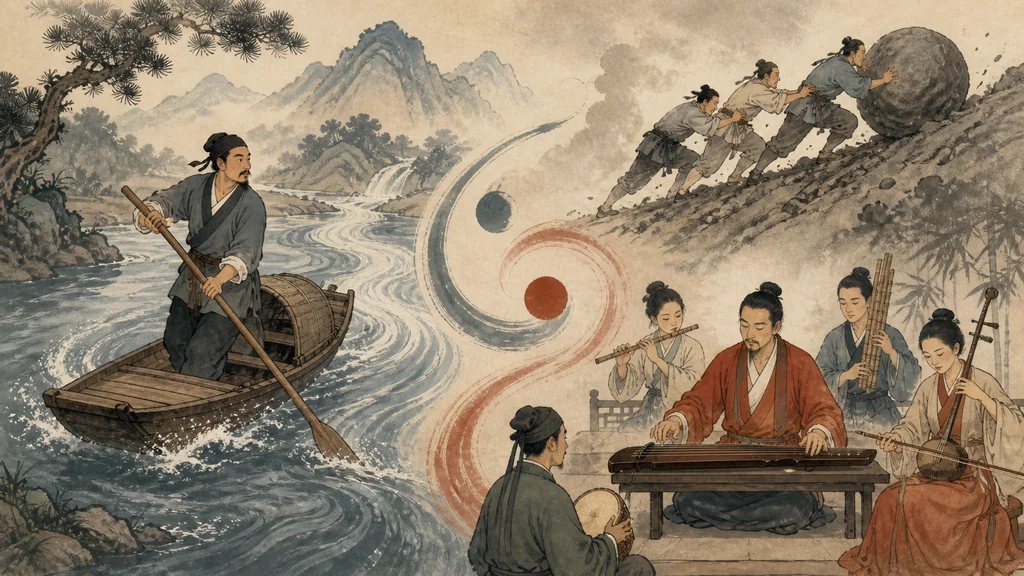
The short answer: it rejects forcing, not action
Wu wei does not require a person to remain idle whatever happens. It warns against action driven by self-serving desire, a compulsion to control, or a rigid scheme imposed on circumstances. Someone responding to the grain of a situation without creating needless resistance may be very active and still approach wu wei. Someone who ignores harm, care duties or a safety emergency is not practising Daoist wisdom but failing to act.
“Non-action” is the conventional English translation, but it easily suggests zero activity. “Non-coercive action,” “non-assertive action” and “effortless action” each correct part of that impression while introducing difficulties of their own. Good English prose often retains wuwei and explains whether a passage concerns personal desire, political interference or skilled responsiveness.
“Doing nothing, yet nothing is left undone” is not a contradiction
Chapter 37 of the Laozi says that the Dao is constantly wuwei, yet there is nothing it does not do. If wu wei meant simple immobility, the second half would make no sense. The sentence depicts a process that does not issue subjective commands to compel the myriad things, while excluding none of their transformations. The chapter then turns to rulers: if lords and kings could hold to this, the myriad things would transform of themselves. Leadership has not vanished; acquisitive desire and artificial manipulation have ceased to dominate it.
Chapter 48 approaches the subject through subtraction. Learning increases day by day, it says, whereas pursuing the Dao decreases day by day; through decreasing again and again, one reaches wu wei. This “decrease” is not a loss of all capacity. It removes accumulated intention, craving and interference. In a system already confused by constantly changing instructions, adding another order may deepen the disorder. Suspending the self-defeating intervention can reveal what action is actually necessary.
The passage does not reject education, nor does it promise that abandoning preparation produces success. It challenges an assumption that improvement must always arrive through adding one more technique, target or act of will.
Political wu wei criticises excessive disturbance
Chapter 57 has a ruler say: “I practise wu wei, and the people transform themselves; I love stillness, and the people correct themselves; I undertake no meddlesome business, and the people enrich themselves; I have no desires, and the people become simple.” The same chapter associates multiplying prohibitions, weapons and statutes with damaging consequences.
Its political target is rule distorted by the leader’s appetite and fear. Each attempt at control makes people reorganise themselves around new commands, generating further problems that invite further control. Restraint allows local knowledge and social coordination to operate.
This is not a direct manifesto for abolishing government, refusing disaster relief or allowing the powerful to injure the vulnerable. The Laozi remains concerned with order, warfare, resources and leadership. Turning an ancient criticism of meddling into an endorsement of a modern political party, laissez-faire economics or administrative paralysis crosses a large evidential gap. The sounder lesson is that power must examine the disorder it creates and leave room for people to organise their affairs.
Cook Ding’s fluency was trained—and included slowing down
The story of Cook Ding in the “Nourishing the Lord of Life” chapter of the Zhuangzi is frequently offered as a model of effortless action. His knife follows the gaps between joints. After nineteen years and thousands of oxen, its edge remains as if newly sharpened; his movements and sounds resemble a ritual dance. The performance looks unforced.
Yet the story expressly includes an apprenticeship. When Ding began, he saw nothing but a whole ox. Only after three years did his perception change. Fluency comes from long experience, close knowledge of structure and refusal to hack through bone by brute force. It is not an innate productivity trick.
An even more revealing detail appears when Ding reaches a tangled or difficult place. He becomes alert, fixes his attention, slows his movement and makes a minute cut. “Following what is so” does not mean pretending complexity has disappeared. The Stanford Encyclopedia of Philosophy notes that such virtuosity belongs to particular learned abilities; no single shortcut gives a person a knack for every activity. Training, concentration and caution can all belong within responsive, unforced action.
Strictly speaking, the Cook Ding episode does not define its own activity with the term wuwei. It is better presented as a related illustration developed within Zhuangzian discussions of skilled conduct, rather than treated as a dictionary entry for the word.
Commentators did not merely repeat one answer
In the third century CE, Wang Bi glossed wu wei in chapter 37 as following ziran—what is so of itself or naturalness. His wider interpretation connects nonaction with freedom from the rule of selfish desire. A few centuries later, Guo Xiang’s commentary on the Zhuangzi explicitly said that nonaction does not mean folding one’s arms in silence. On his account, a person can fulfil every function while acting according to the patterns of things rather than forcing self and world towards an alien ideal.
These interpretations profoundly shaped later understanding, but they are not a single definition jointly written by every pre-Qin author. The Laozi’s political criticism, Wang Bi’s account of naturalness, Guo Xiang’s interpretation of fulfilling one’s role and the modern psychology of “flow” can illuminate one another. Declaring them identical erases the history in which the question kept changing.
What modern life can borrow—and where it must stop
At work, wu wei can prompt a manager to stop changing direction hourly or repeating approvals merely to display control. Allowing information and professional judgement to circulate may achieve more than another layer of supervision. In personal anxiety, the concept can help distinguish necessary action from refreshing, chasing and escalating simply to relieve the feeling of uncertainty.
Doing less here must follow observation; it cannot use laziness as a disguise. Some situations demand immediate action. A fire requires evacuation and an alarm. Abuse requires intervention and help. Patient care requires appropriate safety procedures. Promises and public duties do not dissolve because inaction feels calm.
Wu wei supplies no universal decision chart and no guarantee of effortless productivity. Two questions provide a stricter test. Is my intervention responding to the actual structure of the problem, or satisfying my desire to feel in control? If I stop, will that remove resistance—or merely transfer danger and labour to someone more vulnerable?
What to remember
Wu wei opposes strained, self-defeating imposition, not every form of action. The Laozi uses it to criticise excessive desire and governance; the Zhuangzi’s skill stories show that responsiveness can rest on training, discrimination and deliberate slowing at a hard point. Acting without forcing and stopping without abandoning responsibility preserve the productive tension of the idea.