The difference you can see immediately
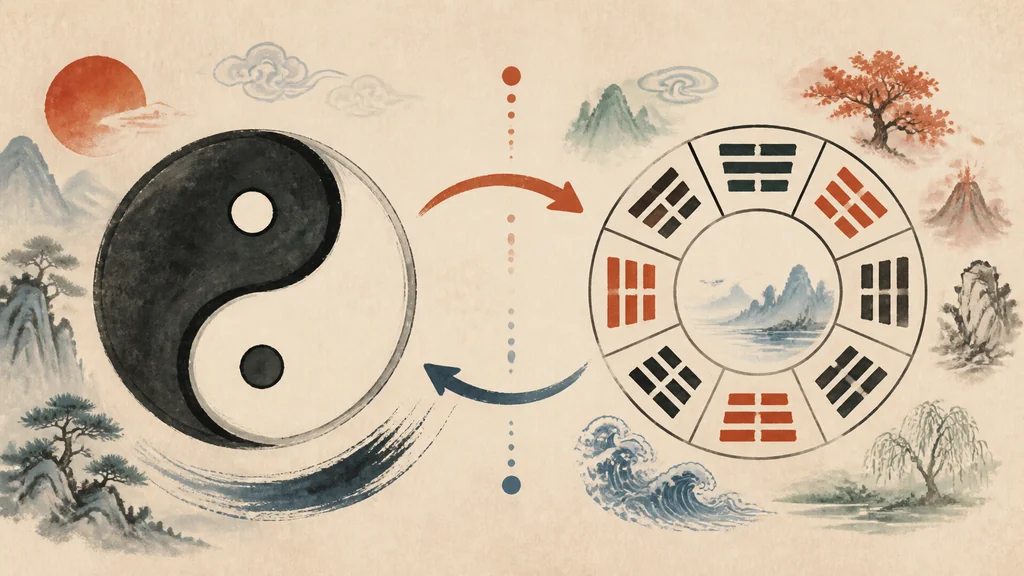
The most familiar taijitu is a circle of interlocking black and white. Its two curving fields each contain a dot of the other colour, producing the design sometimes nicknamed the “yin-yang fish.” It visualises yin and yang as mutually dependent tendencies that wax, wane and turn into one another. The bagua, by contrast, consists of eight three-line figures: Qian, Kun, Zhen, Xun, Kan, Li, Gen and Dui.
Each position in a trigram can contain either an unbroken or a broken line. Three positions therefore produce eight possible combinations. The popular taijitu presents movement within a whole; the bagua uses a set of eight linear figures to classify and explore change. The two are related, but they are not alternative names for the same emblem.
The bagua is a language made from lines
An unbroken line is conventionally treated as yang and a broken line as yin. With two choices in each of three positions, the structure yields 2³, or eight, trigrams. Traditional associations link Qian and Kun with heaven and earth; Zhen and Xun with thunder and wind; Kan and Li with water and fire; and Gen and Dui with mountain and lake or marsh.
Placing one trigram above another creates the sixty-four six-line hexagrams of the Yijing, or Book of Changes. A trigram is therefore more than a decorative icon. The position of its lines, the upper and lower figures, the words attached to hexagrams and individual lines, and centuries of commentary all contribute to interpretation. Reducing the bagua to eight compass points misses much of its textual life. Treating the figures only as protective decoration overlooks their roles in interpretation and divinatory practice.
Different contexts activate different parts of this history. A ceramic pattern, a page in a Changes commentary and a modern feng-shui compass may display related lines without making exactly the same claim. Similar appearance is evidence of connection, not proof of identical function.
“The Changes has a taiji” is not a birth certificate for the modern image
The transmitted “Appended Statements” commentary to the Yijing says: “In the Changes there is the taiji. This gives rise to the Two Modes; the Two Modes give rise to the Four Images; the Four Images give rise to the Eight Trigrams.” This sequence gives later readers a powerful reason to connect taiji, yin and yang, and the bagua.
Yet taiji in this passage is first a concept concerning an ultimate whole, source or organising limit. The appearance of the word does not prove that the black-and-white swirling circle existed when the passage took shape. A concept and its best-known later illustration need separate histories.
The Yijing itself also has textual layers. Early hexagram and line material should not simply be collapsed into the explanatory commentaries attached later. Tradition attributed the “Ten Wings” commentaries to Confucius, but modern scholarship has no firm evidence that he personally wrote them all. It is reasonable to quote the transmitted commentary when explaining the conceptual sequence. It is not reasonable to turn that quotation into proof that Fuxi or Confucius drew the emblem now printed on T-shirts.
Yin-yang ideas are old; the familiar swirl is much later
Ideas of complementary yin and yang and their alternating strength have a long textual history. The S-curved black-and-white disc has a more particular visual history. The Internet Encyclopedia of Philosophy notes that neither an exact date nor a single creator can be established for the popular symbol.
Diagram-making flourished in the Song dynasty. Zhou Dunyi’s eleventh-century “Explanation of the Diagram of the Supreme Polarity” became exceptionally influential in Neo-Confucian thought. His diagram, however, is a vertical arrangement of circles and fields, not the familiar pair of swirling “fish.” Calling every historical diagram a copy of the modern logo erases the very variation that diagrams were designed to express.
The IEP article connects an important early example approaching the familiar swirling design with Zhao Huiqian (1351–1395), whose diagram was titled “The Natural River Diagram of Heaven and Earth.” Scholars can still debate lines of visual transmission. The evidence nevertheless establishes a useful boundary: ancient yin-yang concepts, Song taiji diagrams and the later popular swirl should not be compressed into a single moment of invention.
Why do the two so often appear together?
Taiji and bagua share a language of yin-yang change. The generative sequence in the “Appended Statements,” together with the later tradition of explaining the Changes through diagrams, made a central taijitu surrounded by eight trigrams an attractive composition. The centre represents differentiation and movement within unity; the ring unfolds that difference into eight linear patterns.
Visual combination does not erase identity. The surrounding trigrams do not become “the taijitu,” and the central circle is not “the bagua.” It is rather like a map placed inside a compass rose: the parts cooperate while retaining different structures and jobs.
Nor is there only one authorised order for arranging the eight trigrams. Layouts often called “Earlier Heaven” and “Later Heaven” use different positions and sequences within different interpretive systems. When two bagua rings differ, one is not necessarily a printing mistake. The first questions should be which arrangement is intended and what purpose it serves.
The trigrams can also appear without a central yin-yang image. The Metropolitan Museum of Art, for example, holds a Qing-dynasty Shiwan ware tripod bowl decorated with the Eight Trigrams. That object is solid evidence for one use of bagua imagery on ceramics. It cannot, by itself, stand for every ritual, philosophical or popular use of the figures.
How to identify them in a British museum
Count lines before guessing at hidden meanings. Three broken or unbroken lines form one trigram. Eight groups of three arranged in a ring make a bagua layout. An interlocking black-and-white circle is what an English label will usually call the yin-yang symbol or a taijitu. Then read for date, arrangement and object type. Does the label name the trigram sequence? Were the centre and outer ring made at the same time? Is the design explaining a text, decorating a vessel or organising a specialist instrument?
Three shortcuts are especially misleading. Yin and yang are not permanently evil and good; the contrasting dots specifically resist such absolute separation. The popular swirl should not be labelled an unchanged prehistoric image without evidence. Finally, the taijitu is not the exclusive badge of a single religion. Its histories pass through Changes scholarship, Daoist contexts, Song Neo-Confucianism and modern visual culture.
Recognising the symbol is therefore the beginning, not the end, of interpretation. The better historical question is why this particular design appears on this object, in this arrangement, at this date. This article explains visual and intellectual history; it does not offer divination, feng-shui, medical or fortune-changing advice.
What to remember
The taijitu condenses the interdependence and alternation of yin and yang into a whole. The bagua organises difference and change through eight three-line figures. They can be combined because they share an intellectual vocabulary. They should not be confused because their construction, visual histories and practical uses remain distinct.