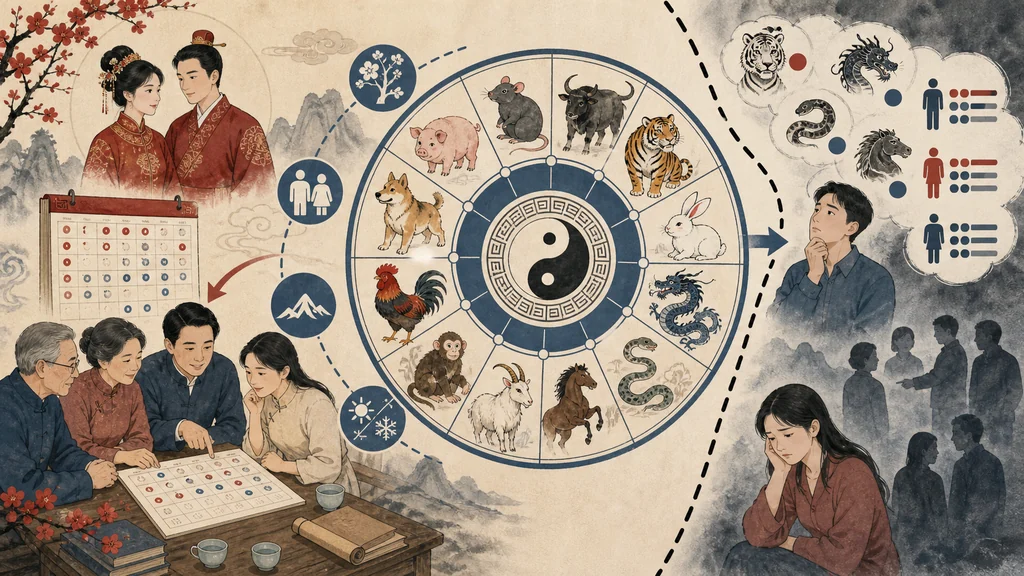
The short answer: a clash is a classification, not a personality test
When two Chinese zodiac signs are said to “clash,” their Earthly Branches occupy opposing positions in a traditional calendrical and divinatory model. The label is often invoked when discussing marriage, partnerships, or the outlook for a particular year. It does not, however, demonstrate that two people have incompatible personalities, nor does it predict that their marriage will fail.
Two different claims are easily confused here. A belief can affect real decisions because people act on it. That does not mean the belief has successfully measured personality or revealed a couple’s fate. There is evidence for the first kind of effect, but not for the second.
The animals are the memorable outer layer
The Rat, Ox, Tiger, and the other zodiac animals did not begin as a stand-alone personality quiz. Each is attached to one of the twelve Earthly Branches: Rat to zi, Ox to chou, Tiger to yin, and so on through Pig and hai. The branches have also been used to organize months, hours, and directions, and they combine with the ten Heavenly Stems in a sixty-unit cycle.
Mirrors, calendar images, and decorative objects in museum collections make this abstract order visible through animals. At its most basic, being born in the Year of the Rat means that the year occupies the zi position. Descriptions such as clever, cautious, or timid are cultural stories accumulated around the animal. They are not personality measurements derived from a birth year.
The six clashes come from positions on a circle
Place the twelve branches around a circle and every branch faces the one six places away. Those oppositions produce the six standard clashes: Rat and Horse (zi–wu), Ox and Goat (chou–wei), Tiger and Monkey (yin–shen), Rabbit and Rooster (mao–you), Dragon and Dog (chen–xu), and Snake and Pig (si–hai).
The arrangement is positional. It was not produced by observing a large sample of couples and discovering which animal groups argued most often. Animal names make the pattern easy to remember, but they also invite readers to mistake a geometric relationship for natural hostility between two kinds of person.
“Clash” does not mean “born enemies”
Within traditional interpretation, chong can suggest opposition, movement, collision, or disruption. Texts, regional customs, and practitioners may place that relationship inside wider accounts of yin and yang, the Five Phases, and changing time. The same configuration can therefore be described as an obstacle in one reading and as a force for change in another.
Calling such pairs “enemy signs” is needlessly dramatic. “Opposing branches” or “clashing branches” preserves the structural meaning more accurately. Even then, the phrase describes the internal vocabulary of a traditional model; it does not certify that model as modern science.
A birth-year sign is a simplification even within divination
The popular zodiac uses one Earthly Branch from the year of birth. Four Pillars, or bazi, records a stem and branch for the year, month, day, and hour, then interprets relationships among them. Judging an entire relationship from two year animals is therefore a highly compressed popular practice even by the standards of the larger divinatory system.
That distinction should not be turned into a sales pitch for a “more accurate” chart. More variables and more elaborate interpretive rules can produce a richer narrative, but complexity is not the same as scientific validity. Without repeatable testing, the expanded system is still not a validated psychological assessment.
A label may not predict marriage, yet still shape the marriage market
The absence of demonstrated personality effects does not make zodiac belief socially inert. A 2026 study in the Journal of Economic Behavior & Organization combined Chinese census data with an incentivized online experiment. Couples classified as badly compatible by a traditional matrix appeared significantly less often, while experimental participants rated supposedly incompatible prospects less favourably.
This is evidence that belief can filter the marriage market. A prospective partner may be rejected by the individual, their parents, or an intermediary before a relationship develops. The study did not show that clashing couples fight more, divorce more often, or possess incompatible personalities. If a category appears less frequently among married couples, avoidance is the immediate mechanism under study—not a cosmic force breaking couples apart.
Relationship science measures people and their interactions
To ask whether two people work well together, researchers must turn “compatibility” into observable questions. How do the partners handle conflict? Do they behave reliably? Do they express appreciation? Do they agree on important plans? A large project drawing on 43 longitudinal couples datasets found that robust self-reported predictors of relationship quality included perceived partner commitment, appreciation, sexual satisfaction, perceived partner satisfaction, and conflict.
Such research cannot promise a flawless forecast either, but it measures the people and the relationship in question. Birth-year categories also become entangled with age, generation, and cultural expectations. If relatives repeatedly tell a couple that they are doomed, the resulting pressure can create genuine conflict. That is a social consequence of the label, not evidence that the zodiac prediction came true.
When relatives take a clash seriously, ask what they want it to decide
In a cross-cultural family, dismissing an elder as “superstitious” usually turns a practical disagreement into a contest over identity and respect. A better first question is what the clash is expected to decide. Is it festive conversation, a wish for symbolic reassurance, or a proposed veto over the relationship? The first two can be acknowledged as cultural practices. If the label is being used to force a breakup, rush a marriage, or control a wedding, clear boundaries are appropriate.
The conversation can then return to evidence from the couple’s life: whether both people freely consent, communicate safely, and can negotiate money, care, family obligations, and conflict. Zodiac clashes are worth understanding as a cultural language. They should not replace the experience, consent, or judgement of the people whose relationship is at stake.
Sources and further reading
- The Metropolitan Museum of Art, *Chinese Decorative Arts*
- The Metropolitan Museum of Art, “Notes on Time: Art, Language, and the Night Sky”
- William Matthews, *The Homological Cosmos*(UCL 博士论文)
- Journal of Daoist Studies, stems-and-branches study
- “The Sexagenary Cycle and Chinese Zodiac of Oracle Bone Inscriptions”
- Wudang Daoist Wellness Academy, “Twelve Earthly Branches”
- “Traditional beliefs matter in the marriage market: Evidence from zodiac compatibility in China”
- Joel et al., “Machine learning uncovers the most robust self-report predictors of relationship quality across 43 longitudinal couples studies”