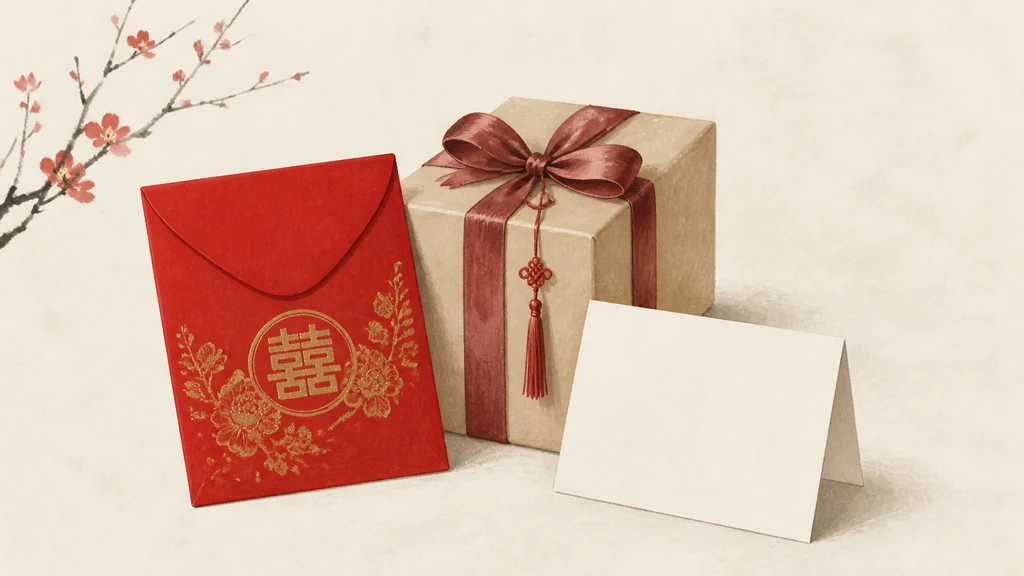
Read the invitation before choosing a gift. Cash in a red envelope is common at many Chinese wedding banquets, but it is not a rule for every Chinese or diasporic wedding. A celebration in Britain may use a department-store registry, honeymoon fund, charity donation, bank transfer, gift box, or an explicit request for no presents. The couple's instructions outrank any online list of “Chinese wedding rules”.
If the invitation is silent, ask the couple, a member of the wedding party or the relative managing reception: “Would you prefer a red envelope or a present, and where should I leave it?” That practical question is more respectful than guessing a supposedly magical amount.
Why are red envelopes common at weddings?
Money is flexible for a couple beginning a household. A red wrapper turns ordinary currency into a visibly celebratory gift and provides space for the giver's name. A modern wedding envelope collected in London by the British Museum combines a red ground, a gold Double Happiness character and bridal imagery. It documents the object in British Chinese life as well as in China.
Hong Kong's Government Records Service points to film from a 1965 banquet in which a bridal attendant collects red packets from guests. This gives the custom a concrete social setting: named reception helpers received and safeguarded gifts during the meal.
A red envelope is not simply a ticket paying for dinner. Scholarship on cash and in-kind gifts in China describes red-packet giving as part of relationships and reciprocity. Families remember support at major life events and may later reciprocate, but this does not make every amount a restaurant bill calculated by formula.
How much should you give?
There is no figure that fits Beijing, Guangzhou, Hong Kong, Singapore, London and every overseas family. The relationship to the couple, whether a partner is attending, the style of celebration, local costs, family practice and the guest's means all matter. A sibling, a close friend and an occasional colleague would not naturally give the same amount.
“Cover your plate” is popular advice, not a cultural law. Guests usually do not know the venue's actual price, and an expensive choice by the hosts does not oblige somebody to exceed a safe budget. A student, a person between jobs or a guest already paying for international travel can reasonably give less. Generosity that creates debt is not better etiquette.
Number symbolism need not become an exam. Eight can suggest prosperity because of sound association; six can evoke smooth progress; four is avoided by some speakers because it resembles the word for death. Yet languages and regional preferences differ, and a sterling bank transfer may not be read through the same pattern. Follow a specific family request; otherwise choose a clear round amount you can afford.
How should the envelope be prepared and delivered?
Use a clean red envelope with an appropriate wedding design. Do not recycle one printed for a child's birthday or Lunar New Year if its wording does not fit. Write the couple's names and a brief wish on the front if space allows, and put the giver's full name on the back. When two people give jointly, include both names.
Currency depends on location. Sterling is natural for a British wedding; an event in mainland China, Hong Kong or elsewhere may require local currency or an electronic method. Ask rather than carrying a large sum across a border. If the couple provides bank details, a QR code or a wedding website, use that channel and identify the payment.
At the venue, place the envelope at the designated gift table, give it to the named reception relative, or use a locked card box. Do not push money into the bride's or groom's clothing while they greet tables. If nothing is marked, ask the coordinator. There is usually no reason to demand that the couple open or count it in front of you; Hong Kong public etiquette guidance likewise treats not opening a red packet immediately before its giver as courteous.
Can you give a physical present instead?
Yes, especially when the couple supplies a registry. British weddings commonly use household lists, experiences, honeymoon contributions or charity funds, and intercultural couples may deliberately choose those systems. Buying from the list avoids duplicate appliances and respects the couple's judgement about their space.
Without a list, compact and transportable gifts are safer than large decorative objects. A well-made tea set, frame or item linked to a shared experience may work if it suits the couple. Do not buy an unidentified “dragon and phoenix antique” or decoration with incorrect Chinese characters merely because the wedding is Chinese. A cultural theme does not make an object useful.
Check alcohol, food and fragrance against religion, diet, allergies and travel restrictions. Online taboo lists repeatedly mention clocks, knives and shoes, but reactions differ. Asking what is wanted and retaining a receipt is more helpful than memorising a national prohibition list.
Which wedding payments are not a guest's responsibility?
Betrothal gifts, dowry, guo da li and gifts exchanged during a tea ceremony belong to arrangements between the couple's families or particular relatives. They are not items an ordinary British guest must reproduce. Hong Kong's Family and Women Portal describes contemporary guo da li packages containing money, cakes, tea and other goods, sometimes simplified into an inclusive red envelope. That is a specific pre-wedding family rite.
A guest's congratulatory envelope is different. Both may use red paper and cash, but they occupy different relationships and moments. Confusing them can make a foreign guest think that a bride price is expected, or lead outsiders to misread private negotiations between parents.
Gold jewellery or red packets given by elders during a tea ceremony are likewise governed by kinship and local practice. Unless the couple has invited you to participate in a defined family role, follow the ceremony rather than inventing one.
What works best at an intercultural wedding in Britain?
Respect the wedding the couple has chosen, not an imagined template. If the invitation provides a registry, an extra envelope is not required to demonstrate cultural awareness. If it requests money, insisting on a toaster because that seems more British is equally unnecessary. Families can combine practices or simplify all of them.
Give within your budget. Travel, accommodation and clothing may already be substantial personal expenses, although they need not be itemised to the couple. If you cannot attend, whether to send a card or gift depends on the relationship; absence does not create an automatic fine.
Finally, make the gift identifiable and secure. Sign it, use the stated channel, retain a transfer record and add one or two genuine sentences of congratulation. Do not compare amounts publicly or ask what other guests contributed.
For a British guest, the best Chinese wedding gift is rarely a mysterious “Eastern” object. It is a present that fits the couple's instructions, the actual relationship and the giver's means. A red envelope is common, a physical gift can be welcome, and a digital transfer may be the simplest choice. Clear communication and safe delivery matter more than performing a formula.
Sources and further reading
- British Museum: wedding-themed hongbao
- Hong Kong Government Records Service: Traditional Marriage thematic guide
- Journal of Institutional Economics: Money or in-kind gift? Evidence from red packets in China
- Hong Kong Family and Women Portal: contemporary traditional wedding practice
- Hong Kong Talent Engage: red-packet etiquette