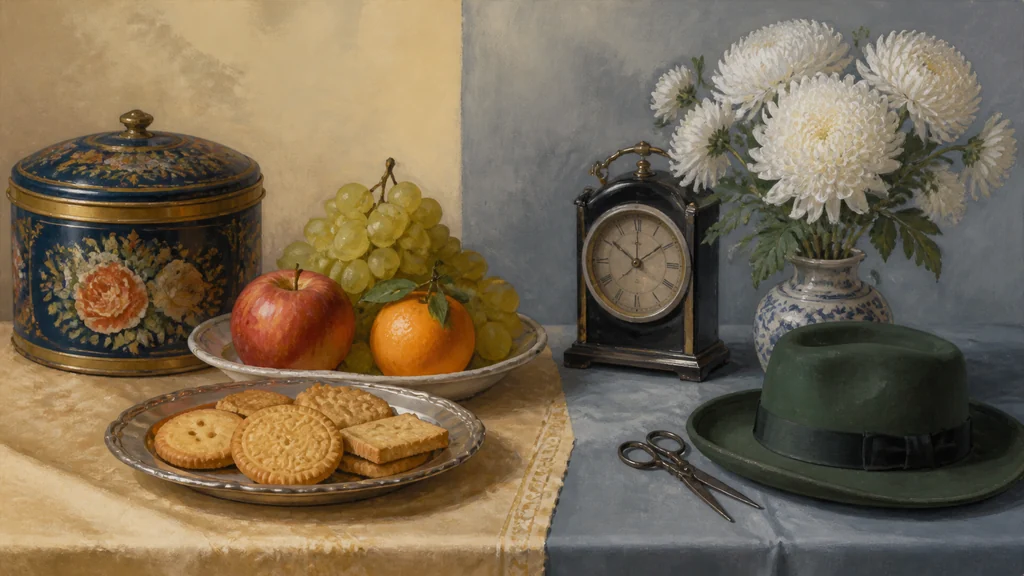
You do not need to memorise dozens of internet taboos before giving a present to a Chinese friend, host or colleague. The combinations most worth avoiding are those in which both the recipient and the negative association are clear: a clock for an older person, a pear or umbrella for newlyweds or a partner, knives or scissors as a relationship gift, a green hat for a man, or white and yellow chrysanthemums as the default flowers for a celebration.
These risks arise from Chinese homophones, established idioms, the function of an object and its ritual setting. They are not beliefs held with equal force by everyone in China. Age, dialect, region, family, relationship and occasion all affect how a present is understood. Knowing the recipient is more respectful than performing an endlessly expanding taboo list.
How wordplay enters gift giving
Chinese gifts often acquire favourable associations through their names, numbers or colours. An apple may suggest peace; an orange may suggest good fortune. The same habit of listening for an auspicious phrase can produce unwanted associations.
The best-known example is a clock. The Mandarin word for clock, zhōng, sounds like zhōng, “end”. The phrase sòng zhōng, “to give a clock”, can therefore evoke sòngzhōng, attending to someone at the end of life and arranging their final rites. Local-government folklore records from Yueyang and Dongguan, as well as university language-teaching materials, all document this association. A clock given at an elderly person’s birthday or during illness carries more risk than a design object requested by a young collector.
A pear, lí, sounds like lí, to leave or separate. Umbrella, sǎn, is close to sàn, to disperse. The associations become especially awkward at weddings, anniversaries or occasions intended to affirm a lasting partnership. Eating pears as part of an ordinary fruit bowl, or lending a friend an umbrella in the rain, does not declare the end of a relationship. Formal gifting gives the object extra symbolic weight.
Homophones are not secret codes, and Chinese varieties do not all produce identical sounds. They explain why someone may object; they do not prove that every recipient will.
The higher-risk categories
Clocks and some timepieces
A clock is least suitable for an older recipient, a patient or a longevity celebration because the “final rites” association overlaps directly with age and mortality. A wristwatch is called shǒubiǎo in Mandarin and is not linguistically identical to zhōng. Some people therefore make a distinction; other families group all timepieces together. Unless the recipient has asked for a particular watch, choose something else for a formal first gift.
Knives, scissors and sharp tools
Sharp objects cut. As relationship gifts they can suggest cutting ties, reinforced by expressions such as “one cut into two”. A professional knife may be perfect for a chef and secateurs useful to a gardener. Without that explicit personal interest, however, they are poor default choices for a first home visit, romantic occasion or new business relationship.
A green hat
“Wearing a green hat” is an established Chinese idiom for a man whose partner is unfaithful. A green hat can therefore invite embarrassment or ridicule even when its design is attractive. The fixed expression concerns the combination of green and a hat; an ordinary green scarf or jumper does not automatically carry the same meaning.
White or yellow chrysanthemums
In a number of Chinese settings, white and yellow chrysanthemums are associated with graves, remembrance and funerals. They are an uncertain default for a birthday, housewarming or celebratory first visit. This does not make every white flower forbidden or every family hostile to chrysanthemums. It means that a visitor who does not know the recipient has easier floral choices.
Are watches, pears and umbrellas always forbidden?
No. Context can outweigh the association. If a young friend has asked for a particular watch, their stated preference is better evidence than a generic list. If someone needs a durable umbrella, practical value may matter more than wordplay. A mixed fruit hamper containing pears is not identical to presenting a pair of pears to a patient or couple as a symbolic centrepiece.
Ask three questions. Does the negative association overlap directly with this occasion? Has the recipient clearly said that they like or need the object? Is your relationship close enough for explanation and humour? If the first answer is yes and the other two are no, change the gift.
The number four works similarly. Four, sì, is close in sound to death, sǐ, and some people avoid sets of four. Four books explicitly requested by a reader, or food intended for a household of four, does not become an automatic insult. Do not buy an unsuitable or more expensive quantity merely to demonstrate that you avoided a number.
Safer gifts for a British visitor
For a first visit to a home, choose something shareable and not extravagantly priced: regional British biscuits, chocolates, tea, preserves, good fruit or another food you know the household enjoys. The point is to show that you prepared for the visit, not to prove generosity with luxury goods.
Check allergies, sugar restrictions, vegetarian or halal requirements, and whether the family drinks alcohol. Wine and whisky are not universal safe gifts. Tea, alcohol-free food or a local speciality is a better default when you do not know. For a hospital visit, ask about medical and ward restrictions rather than choosing fruit solely for its symbolism.
Business gifts must be modest, transparent and permitted by both organisations’ gift and anti-bribery policies. Cultural custom never overrides compliance rules. An expensive present may also create uncomfortable pressure to reciprocate.
Wrapping, price and presentation
Use clean, secure wrapping appropriate to the event. Red and gold are familiar celebratory colours, but every parcel need not look like Chinese New Year. A birthday, hospital visit or formal business meeting may suit restrained neutral packaging. Avoid wrapping that strongly resembles mourning materials when the event is joyful.
In a formal setting, present the gift with both hands and add a short explanation: “This is a local speciality from Yorkshire,” or “I thought your family could share these.” Explaining why the object fits the recipient redirects attention from an abstract symbol to the real relationship.
Some recipients may politely decline once before accepting, or may choose not to open the present in front of you. Do not interpret the first hesitation as final rejection, and do not demand an immediate performance of delight. Follow the host’s pace.
What if you have already given the wrong thing?
Do not turn a small mistake into a cultural emergency. If the recipient shows no concern, explain naturally why you chose the gift. If they are clearly uncomfortable, apologise briefly and offer to exchange it.
Research on gift giving in Hong Kong and related folklore records cases in which a recipient returns a token coin so that a clock or knife becomes a symbolic purchase rather than a gift. Similar customs exist in some British and European families for knives. This is not a universal Chinese ritual. Follow it if the recipient or family suggests it; do not instruct a stranger to perform it.
For a first home visit, choose a shareable local food. For a patient, ask about health and hospital restrictions and avoid clocks or a conspicuous pear gift. For a wedding or partner, avoid objects that foreground separation or cutting and follow any gift list. For business, keep the gift public, moderate and policy-compliant.
No object can be guaranteed free of every possible association. A good gift is one that fits the person, relationship and occasion. Put the recipient before the checklist and the most awkward errors become easy to avoid.