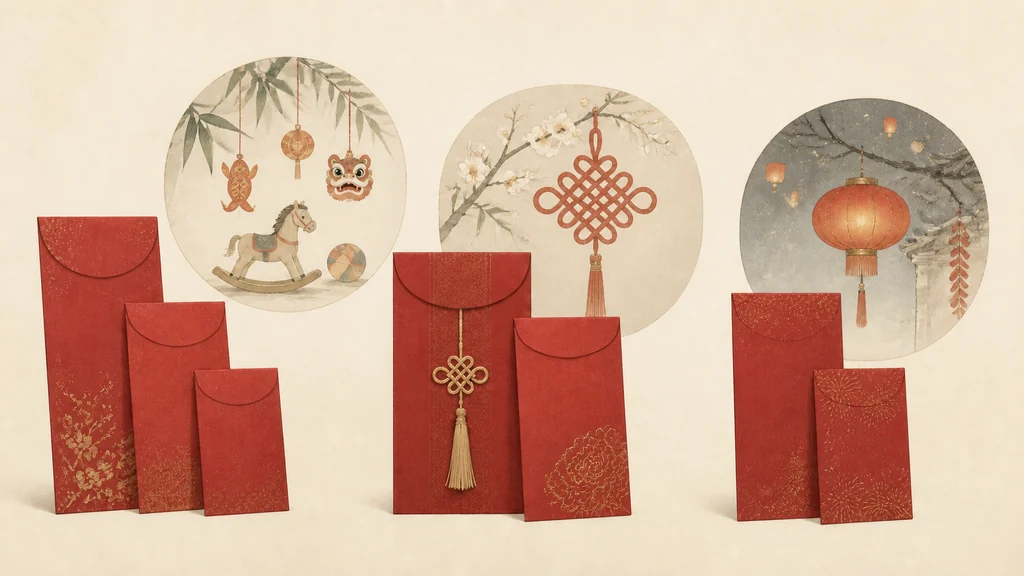
A red envelope is not an all-purpose tip, nor simply a greeting card with a different colour. It turns money into a gift associated with a particular relationship, blessing and occasion. Red envelopes appear at Chinese New Year, weddings, birthdays, births and other family milestones, but there is no single national rule governing who gives, how much goes inside or when it should be opened.
For a British guest preparing one for the first time, the safest order is simple: identify the occasion, consider your relationship with the recipient, ask about the family or community’s practice, and choose an amount within your own budget.
Why the envelope changes the meaning of money
A Bank of England Museum education resource describes Chinese red envelopes as gifts of money used on occasions including Chinese New Year, weddings and birthdays, with red associated with good luck. A red envelope in the British Museum’s collection, made in Hong Kong and catalogued as hong bao in Mandarin and lai see in Cantonese, was likewise intended for giving money at Chinese New Year and birthdays.
These records show that the envelope is a real material tradition, not merely a list of internet rules. The red wrapper marks cash as a blessing. The giver, recipient and occasion determine its social meaning. The same ten pounds can be a child’s New Year gift, a small workplace token or part of a wedding gift, and those three transactions are not equivalent.
Use a clean envelope in good condition. A plain red packet available in Britain is sufficient; you do not need an ornate design printed with characters you cannot read. Avoid envelopes left over from an unrelated event if their wording is specific. The gift should look deliberate without pretending to be an official document or certificate.
Who gives at Chinese New Year?
The most familiar pattern is older relatives giving to younger family members, especially children. In some places and families, married adults give to unmarried younger relatives or friends. Hong Kong government information, for example, describes married people giving lai see to unmarried people during New Year visits.
That is useful evidence for Hong Kong practice, not a rule for every Chinese family. Elsewhere, age and generation may matter more than marital status. Some families limit envelopes to children; some continue giving to adult students or unmarried relatives; some British-Chinese households use small symbolic amounts; others have adopted digital red packets or do not expect an unfamiliar guest to participate at all.
If you are visiting a Chinese family in Britain, do not assume that every person in the room needs an envelope of the same value. Ask your host or partner beforehand: “Would it be appropriate for me to bring red envelopes for the children?” If the answer is yes, check how many children will be present. This avoids both omission and an awkward display of money.
A wedding red envelope is a different gift
At many Chinese and Chinese-diaspora weddings, guests give money to the couple in a red envelope. This is not simply the New Year custom transferred to another date. Wedding money can express congratulations, practical support and a continuing relationship of reciprocity. Expectations may vary with the city, venue, banquet style, closeness of the relationship and the family’s record of earlier gifts.
There is therefore no reliable online tariff that applies equally to London, Hong Kong, Guangzhou, Beijing and every intercultural wedding. Read the invitation first. If the couple has stated a preference for no gifts, a charity donation, a registry or bank transfer, follow it. Otherwise ask your partner, a member of the wedding party or another guest who knows the family.
Write your name and a short appropriate wish on or inside the envelope so the couple can identify the giver. Do not treat the amount as the price of admission to a banquet, and do not exceed what you can afford merely to match a rumoured local average.
Can you put pounds inside?
Yes. Pounds are entirely suitable for an event in Britain. The meaning comes from the relationship and occasion, not from making the currency Chinese. Clean notes are easier to present than a packet full of heavy coins. For a wedding, follow whatever cash, transfer or registry method the couple has chosen.
Some transnational families use renminbi, Hong Kong dollars or digital red packets because those forms suit their own networks. They are choices, not tests of cultural authenticity. Chinese payment platforms may require accounts or verification unavailable to a British guest, so never make the recipient install a service simply to accept your gift.
Digital red packets preserve parts of the custom—an amount, a coloured wrapper on screen, a greeting and sometimes group play—but they are not always the easiest choice for a first in-person visit. A physical envelope is visible, transferable and independent of platform access.
How much should you give?
Start with the occasion. A child’s New Year envelope is usually a blessing; a wedding gift may carry a more substantial expectation; workplace lai see is often smaller because many people are included. A close niece, a friend’s child and a colleague do not automatically receive the same amount.
Then consider relationship and precedent. Your age and generation, how close you are, whether gifts have previously been exchanged, and the family’s normal practice can all matter. British living costs and your own income matter too. A “lucky” amount that forces the giver into debt has lost sight of the purpose.
Number symbolism can be a final detail, not the starting tariff. Eight may evoke prosperity through a favourable sound association; four is sometimes avoided because of an unfavourable homophone; even numbers may be preferred for celebrations. These associations are not equally important to every recipient or region. Do not raise a manageable gift to £88 or £888 merely to satisfy a numerology list.
Choose an amount you can comfortably afford and that makes sense for the relationship. For a wedding or another event with strong local expectations, ask someone who knows that family rather than relying on a search result written for a different country.
Giving, receiving and opening
In a formal moment, offering and receiving an envelope with both hands is a safe way to show attention and respect. In a relaxed household the exchange need not become a stiff ceremony. Add a suitable greeting, and when receiving one, thank the giver before discussing anything inside.
Opening customs vary. British gift etiquette often encourages opening a present in front of the giver. Hong Kong New Year guidance, by contrast, advises against opening lai see immediately in the giver’s presence. If you do not know the household’s preference, thank the person, keep the envelope closed and watch for an invitation to open it.
Parents may collect children’s envelopes, note who gave them or decide when they are opened. That does not necessarily mean the child has been denied the gift; it may be part of the family’s way of managing money and reciprocity.
Four useful British scenarios
For a first New Year visit, ask whether envelopes for the children would be welcome, confirm the number of recipients, and use clean sterling notes. For a Chinese wedding, read the invitation and ask a guest familiar with the couple’s family rather than guessing from an online amount chart. At an office celebration, follow the company or staff network’s arrangement and avoid singling out colleagues with conspicuously large gifts. When receiving an envelope, take it with thanks and wait if you are unsure whether to open it.
The central skill is not memorising one lucky amount. It is recognising what relationship the money is expressing. Context, family difference and affordability are more dependable guides than a universal rule that does not exist.