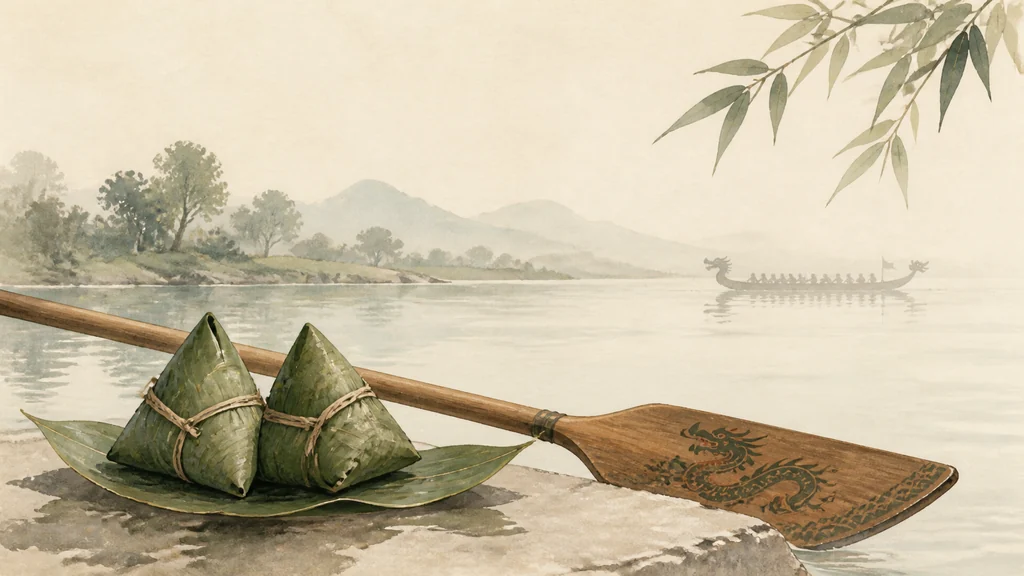
On the fifth day of the fifth month in the Chinese calendar, drumbeats from long boats and the scent of leaf-wrapped sticky rice make the Dragon Boat Festival easy to recognise. The best-known explanation commemorates Qu Yuan, a poet of the ancient state of Chu. After he entered the Miluo River, people are said to have rowed out to find him and thrown rice into the water so that fish would not harm his body.
That story is enormously important to later festival memory, but it cannot by itself account for the whole history of Duanwu. Different places commemorate Wu Zixu, Cao E and other figures. Early-summer practices concerning illness, harmful forces, herbs and coloured thread also belong to the festival, as do local water rituals. The choice is not between believing that Qu Yuan “invented” everything and declaring him irrelevant. A layered festival can absorb a powerful commemorative story without beginning at one documented moment.
Why does the fifth day of the fifth month matter?
The Gregorian date moves each year, usually falling in late May or June. Traditional communities understood the beginning of summer as a period of increasing heat, insects and disease. Hanging mugwort and sweet flag, wearing scented sachets or five-coloured thread, cleaning, fumigating and praying for safety all reflect a seasonal concern with protection.
These activities combine experience, symbolism and religious ideas; they are not all modern medical measures. Realgar wine presents toxic risks and should not be consumed merely because historical accounts mention it. Modern observance can retain sachets and wishes for health while following current safety guidance.
In 2009, China’s Dragon Boat Festival was inscribed on UNESCO’s Representative List of the Intangible Cultural Heritage of Humanity. The nomination includes traditions from Qu Yuan’s home area in Zigui, the Xisai ceremonial boat festival in Huangshi, Miluo in Hunan and Suzhou in Jiangsu. That structure itself shows a family of local practices under a shared festival name, not one central programme copied throughout China.
What does the Qu Yuan story tell us?
Qu Yuan was a poet and political figure associated with the Warring States-era kingdom of Chu. Works linked to him, including Li Sao and Heavenly Questions, made him a central literary figure. Later accounts join his loyalty, exile and death to the fifth day of the fifth month, interpret boats as a rescue effort and explain rice offerings as protection for his body. In Zigui, memorial rites, river processions, racing and zongzi still form a living local tradition.
Historical evidence needs separating from later commemoration. The Records of the Grand Historian biography and the surviving Songs of Chu do not clearly date Qu Yuan’s death to the fifth day of the fifth month. Later texts make the connection between date, rice parcels and the poet more explicit. Research from Academia Sinica also questions how fully an elite Qu Yuan origin account entered popular collective memory during the Ming and Qing periods.
The search boats and fish-feeding rice are therefore best described as a widely transmitted memorial legend that has genuinely shaped festival practice, not the only verified origin. Lack of a contemporary record does not make the story culturally empty. It explains why later generations placed loyalty, political integrity and poetry inside Duanwu. It simply cannot erase earlier or parallel seasonal and local traditions.
Why race dragon boats?
A dragon boat combines a long hull, dragon decoration, drummer, steerer and rows of paddlers. The crew must apply power in time with the beat, making racing well suited to village, community and modern club participation. A contemporary event may include eye-dotting or water rituals, or it may primarily be timed sport and team training.
Several origin theories exist: dragon or water-deity rites, productive labour and military preparation, or commemoration of heroic dead. A cultural feature from China’s National Ethnic Affairs Commission presents these explanations side by side. Current evidence does not justify declaring one the universal source of every race.
Place matters. Water-rich regions can sustain boat traditions that are absent elsewhere. Some northern communities centre the festival on rice parcels, mugwort or sachets. Suzhou’s practices may connect with Wu Zixu, while parts of Zhejiang remember Cao E. Calling every boat a reenactment of rescuing Qu Yuan removes the histories of those communities.
Modern racing has expanded through Hong Kong, Britain and elsewhere as community celebration and competitive sport. Participants need not accept a single origin narrative to respect the activity’s Chinese sources and host community.
Why eat zongzi?
Zongzi wrap glutinous rice in leaves and bind the parcel before cooking. The leaf is packaging, not an edible wrapper, while sticky rice makes a compact food suited to carrying, giving and sharing. The parcel can serve memorial and ritual purposes as well as ordinary seasonal eating.
There is no national shape or flavour. Parcels may be triangular, four-cornered, long or pillow-like; leaves vary with local plants. Southern examples often include pork, salted egg yolk or beans, while many northern families favour dates, sweet bean paste or sugar. “South savoury, north sweet” is a rough shorthand, not a prediction for every region and home.
In the Qu Yuan legend, rice is thrown into the river for fish, then protected in leaves, giving rise to zongzi. The account supplies a powerful memorial meaning, but the history of wrapped grain foods, offerings and seasonal parcels is more complicated. Families now make them at home or buy chilled, frozen and vacuum-packed versions; restaurants create new fillings. Change does not automatically remove the festival identity.
What else happens at Duanwu?
Mugwort, sweet flag, sachets, five-coloured thread, herbal bathing, children’s ornaments and local rites can all appear. Beijing Folk Museum material has contrasted spectacular southern racing with quieter northern observance and documented objects connected to expelling illness or harmful forces. The most photogenic boat does not encompass the whole festival.
Some customs have changed function. Sachets may now be crafts rather than medical protection, and public cultural centres teach wrapping and thread work. Learning about older health beliefs should not turn a sachet into a vaccine, realgar into a safe drink or untested herbs into a substitute for medical care.
For many people, the holiday is simply a family message, a parcel of food or a day off. Some race; some only eat zongzi; others do not observe it. No one activity defines how all Chinese people celebrate.
How can you take part in Britain?
At a race, read the organiser’s account. Some events foreground Duanwu culture; others are year-round sport. Respect opening rites, team names and restricted areas rather than treating the dragon head or drum as a casual prop. Racers require training, life jackets and obedience to the steerer, drummer and water-safety team. Swimming ability does not replace organised rescue procedure.
Check whether purchased zongzi are cooked, chilled, frozen or shelf-stable and follow heating instructions. Remove string and leaves. Glutinous rice is dense and sticky, so older people, small children and anyone with swallowing difficulty should eat small pieces slowly. Pork, egg yolk, nuts, peanuts and alcohol-based seasoning may raise medical, allergy or religious concerns.
Before giving them, ask about savoury or sweet preferences and dietary requirements. A small, clearly labelled selection is kinder than assuming one filling is universally authentic. You can tell the Qu Yuan story while adding that it is one major memorial narrative within a festival with broader seasonal, local and historical layers.
Sources and further reading
- UNESCO: Dragon Boat festival
- Academia Sinica: Dragon-boat Festival Celebrations in Ming-Qing China
- National Ethnic Affairs Commission: Why dragon boats spread across China
- Hunan Provincial Government: Dragon Boat Festival culture
- Zhoukou Commerce Bureau: Origins and customs of Duanwu
- Hubei Intangible Cultural Heritage: Duanwu customs in Qu Yuan’s home area