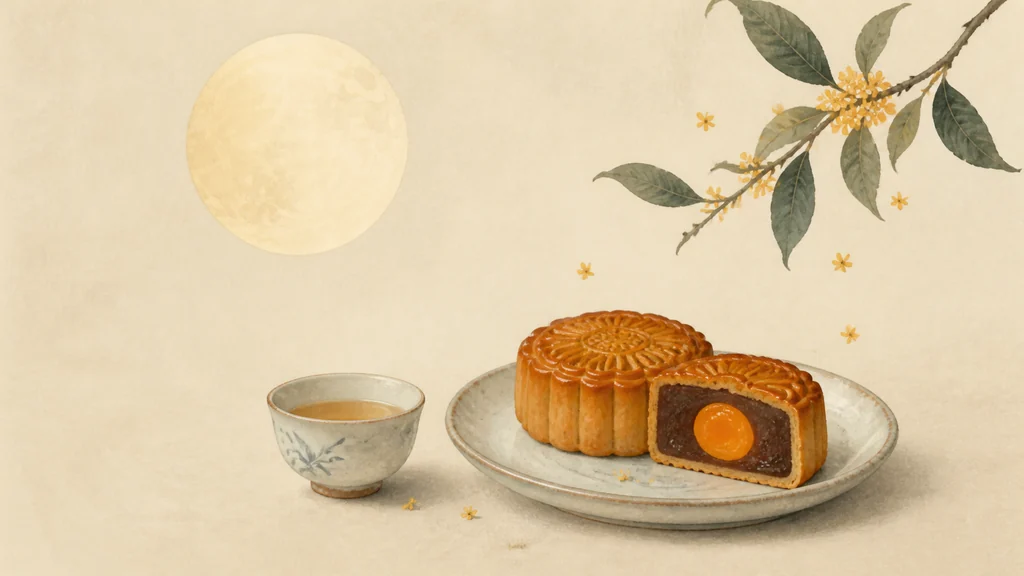
When boxed mooncakes appear in British shops in early autumn, it is easy to imagine that Mid-Autumn Festival is simply a mooncake festival. The cake is certainly its most portable symbol, but the occasion is larger: it connects an autumn moon with family reunion, gift giving and thoughts of relatives who may be far away.
One household may organise a large dinner and take children to see lanterns. Another may share one cake after work. Someone living abroad may only call their parents. These are not incomplete versions of a single official ritual. Region, family history, work and migration all shape what the festival looks like.
When is Mid-Autumn Festival?
Mid-Autumn Festival falls on the fifteenth day of the eighth month in the Chinese calendar. Its Gregorian date therefore moves from year to year, usually landing in September or October. The name places the festival around the middle of autumn, while the nearly full moon provides its most recognisable natural image.
Popular descriptions sometimes call it the night of the year’s biggest or roundest moon. That is festive language rather than a rule that is astronomically exact every year. The precise full-moon moment may fall before or after the calendar date, and the Moon’s distance from Earth varies. The cultural point does not depend on breaking a celestial record. A bright autumn moon offers a visible object that many separated people can look towards on the same evening.
Why does the round moon suggest reunion?
In Chinese, roundness readily supports ideas of completeness and reunion. A moon without an apparent missing section, people seated around a table, and a round cake divided among them reinforce one another. Hong Kong’s government yearbook records adults and children gathering under the full moon with lanterns and exchanging mooncakes, fruit and wine. Family meals, moon viewing and messages to distant relatives remain familiar practices.
Reunion, however, is an aspiration rather than an attendance requirement. Work, study, migration, illness and caring duties often keep relatives apart. That distance can make the festival more meaningful: looking at the same moon, sending food or making a video call becomes a way to confirm that a relationship continues. Some Chinese people do not celebrate at all, or treat the date mainly as a public holiday. Ethnicity does not prescribe a personal timetable.
Why do people eat mooncakes?
A mooncake works well as festival food because it can be boxed, carried, given and divided. Its round form also accommodates the language of reunion. Hong Kong Education Bureau material describes mooncakes as symbols of harmony and unity and records friends or relatives sharing them with tea or wine. Cutting one rich cake into wedges for several people suits this social function better than assuming each guest should finish a whole one.
There is no single national mooncake recipe. Cantonese-style versions commonly contain lotus-seed paste, red-bean paste, salted egg yolks or mixed nuts. Other regional traditions include flaky pastry and savoury fillings. Snow-skin mooncakes became popular in Hong Kong, while custard, fruit, chocolate and ice-cream versions show how a seasonal food changes with refrigeration, urban tastes and commercial design.
The differences matter in practice. Mooncakes can be high in sugar and fat, while salted yolks add sodium. Check the label, allergens and storage instructions before serving. Chilled snow-skin products should not be treated like shelf-stable baked cakes. Diabetes, nut allergies, vegetarian diets and halal requirements are more important than forcing someone to accept a supposedly traditional flavour.
What happens besides eating cakes?
Moon viewing, family dinners, seasonal fruit and lanterns are all familiar. Traditional flower lanterns can be made with bamboo strips, paper and cloth. Battery-powered children’s lanterns and large contemporary installations now exist beside those crafts. Hong Kong’s Leisure and Cultural Services Department continues to organise public lantern carnivals that incorporate traditional lantern-making elements.
Hong Kong is a useful documented example, not a stand-in for all of China. One place may emphasise a lantern fair; another may centre a family meal, a local pastry or a regional performance. Overseas families adapt to the working week, climate and available community spaces. The festival has shared motifs but not a compulsory national programme.
Are Chang’e and the secret mooncake messages historical?
Stories of Chang’e flying to the Moon, the Jade Rabbit and Wu Gang give the lunar landscape characters and drama. They are myths and legends that have been retold in many versions, not events established by modern historical evidence. Enjoying them as cultural memory does not require presenting them as factual reports.
Another famous story says that rebels near the end of the Yuan dynasty hid messages about an uprising inside mooncakes. Even the Hong Kong Education Bureau’s popular history material labels this a folk tale. It is memorable, but evidence does not establish it as the single origin of either mooncakes or Mid-Autumn Festival. Autumn observances, moon worship, moon viewing, festival dates and seasonal pastries developed through more complicated histories.
The distinction is useful. A legend can explain how later generations imagined solidarity or secret communication without serving as a dated receipt for the first mooncake. Good cultural history does not have to discard the story; it simply tells readers what kind of evidence they are hearing.
How can you join a celebration in Britain?
If you are invited to a Mid-Autumn gathering, follow the host’s lead. You do not need to perform an imagined Chinese ceremony. Tea, fruit, a shareable local speciality or another food the host likes can be an appropriate contribution. Before buying mooncakes, ask about flavours and dietary restrictions. A small, clearly labelled selection is often more useful than a costly oversized box.
When someone gives you a mooncake, it is natural to slice it into small wedges and offer it around. You can ask the host how their family usually serves it. That question also works for the festival as a whole: “How does your family celebrate?” is better than announcing what all Chinese families must do.
Do not be surprised if a friend celebrates quietly or calls relatives instead of attending an event. The festival’s central idea can survive a change of setting. The moon provides a common reference, the lantern makes the night public, and the cake turns roundness into something that can be given and shared. Mid-Autumn Festival endures not because everyone repeats identical actions, but because those actions help people recognise who remains connected to them.