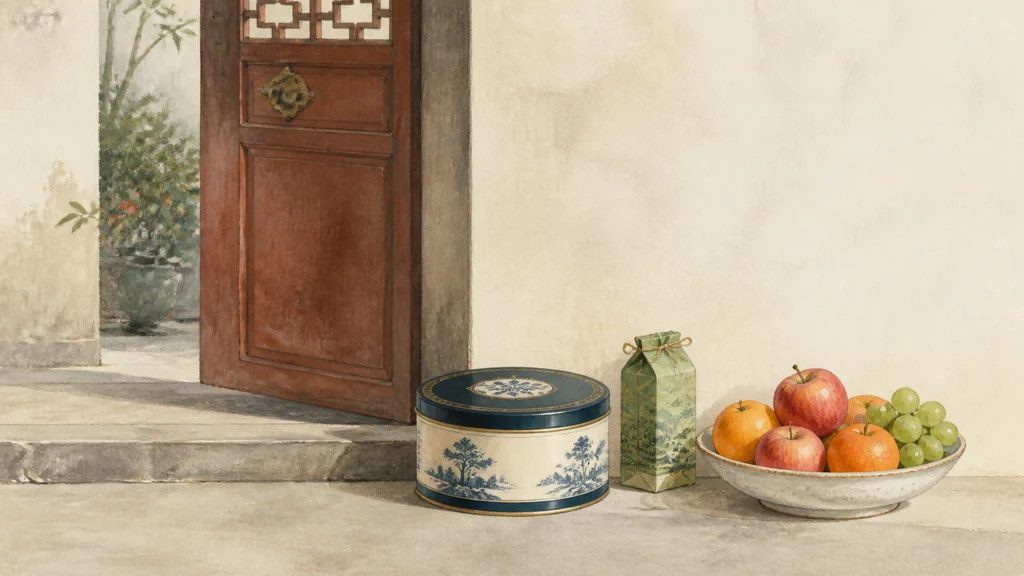
For a first visit to a Chinese friend’s home, especially when meeting a partner’s parents, British guests sometimes turn the present into a cultural examination. Is the tea authentic enough? Must the fruit come in pairs? Could the wrapping colour be unlucky?
A useful gift has a simpler job. It thanks the host, suits the household and does not create pressure to repay an equal price. A guide to living and working in China published by the US National Academies recommends taking a small gift when invited to a Chinese home. That makes it a safe common practice, not proof that arriving empty-handed is always an offence or that every household expects the same list.
Start with the kind of visit
A casual dinner with friends, a first meeting with a partner’s parents, Lunar New Year visiting, a hospital visit and a housewarming call for different choices. A box of food to share may be enough for dinner. Meeting older relatives can justify a neatly presented local speciality. A patient’s diet and hospital rules need checking first. A small home may not welcome a large decorative object.
When uncertain, ask the person who invited you: “Does anyone avoid nuts, alcohol or sugar?” This does not spoil the thought. It prevents a well-wrapped burden. If you are meeting a partner’s parents, your partner can tell you what the family actually drinks, whether they enjoy sweet food and whether they prefer a modest visit.
Shareable food is often the safest choice
Fruit, biscuits, chocolate, tea and regional British specialities recur in visitor advice because a household can share them. Yorkshire biscuits, local preserves or clearly labelled chocolate have a story you can explain in one sentence. They do not need a mysterious Chinese quality to become appropriate.
For fruit, prioritise freshness, good condition and a quantity the family can use. A pear can evoke separation through wordplay in some formal gift settings, but its presence in an ordinary fruit bowl is not automatically offensive. If you are meeting a very traditional older relative for the first time, apples, oranges or other seasonal fruit remove the uncertainty.
Tea is only a good present if it is reliable, stored properly and likely to be drunk. Do not buy an expensive product you cannot identify merely because “Chinese people drink tea”. British tea, coffee or a caffeine-free drink can be equally thoughtful when it suits the recipient. A genuine connection to your home region is often better than imitating an imagined tradition.
Alcohol is not a default
Wine or spirits can suit adults whom you already know to drink. China’s size and diversity make nationality a poor guide to alcohol. A Muslim household, someone taking medication, a pregnant guest, a person in recovery or simply somebody who dislikes alcohol may be present. Unless the inviter confirms it, shareable food or a non-alcoholic drink is safer.
Keep ingredient and use-by information with any food. Nuts, dairy, eggs, pork gelatine and alcohol may determine whether someone can eat it. Tell the host immediately if cream cakes or another item must be refrigerated. Respect for delayed gift opening does not justify allowing food to become unsafe.
Moderate value is more considerate than luxury
Gift exchange can carry expectations of reciprocity. Academic research discusses lishang wanglai, renqing and relationship distance, but these ideas are not a mechanical ledger in which every pound must be repaid. Even so, an excessively expensive present can create pressure. The host may worry about returning the favour or wonder whether the giver expects something else.
A first home visit does not require jewellery, a designer bag or costly electronics. Neat packaging, an appropriate quantity and a clear reason for the choice matter more. If the family is wealthier than you, there is no need to compete. A taste from your region, a handwritten card or food selected for everyone can still show care.
Professional relationships require additional caution. A private dinner does not automatically remove a teacher’s, doctor’s, public employee’s or client’s institutional obligations. Check gift and conflict-of-interest rules when there is a decision or service between you. A note of thanks or an approved modest item may be safer, but only if the organisation permits it.
How should you hand it over?
After entering and greeting everyone, offer the gift with a short explanation: “These are biscuits from our town for everyone to share.” Using both hands can look respectful at a relatively formal first meeting, but it need not become a staged ritual. If the host puts the parcel aside, that usually does not signal dislike. Explain immediately only when storage, allergens or fragility require attention.
There is no national rule about shoes. Look for indoor slippers and follow what the host says. Do not insist on walking through the home in shoes, but do not remove them and go barefoot without checking. Arrive on time rather than very early, which may interrupt preparation. If delayed, send a message. Do not tour bedrooms, studies or cupboards unless invited.
At the table, follow the host rather than a checklist
Let the host indicate seating and when to begin. With an unfamiliar dish, take a small portion if you wish, but state allergies or dietary restrictions clearly. Respect does not require eating something unsafe. If repeatedly offered food after you are full, a warm but definite “Thank you, I’m full; that was delicious” is better than making yourself uncomfortable.
Leave at a reasonable time and thank the host. Chinese social-etiquette guidance published by the Pu’er procuratorate stresses arranging a visit in advance, punctuality, following the host’s lead and not staying too long. Those principles are more useful than memorising dozens of claims about colours and numbers. A brief thank-you message the next day completes the visit gracefully.
The best present is not the object that looks most Chinese. It is something this household can use, something you can explain, and something that does not create a burden. Ask about restrictions, choose a moderate shareable item, communicate practical information and let the host set the pace for opening, shoes and dinner. That shows attention to real people rather than obedience to a cultural quiz.
Sources and further reading
- National Academies Press: China Bound, Revised
- Pu’er People’s Procuratorate: Social etiquette
- Columbia Asia for Educators: Lunar New Year background
- Humanities and Social Sciences Communications: Measuring following behaviour in gift giving
- Zhejiang University Journal: Reciprocity as a Social Norm or Gift Changing as a Social Norm