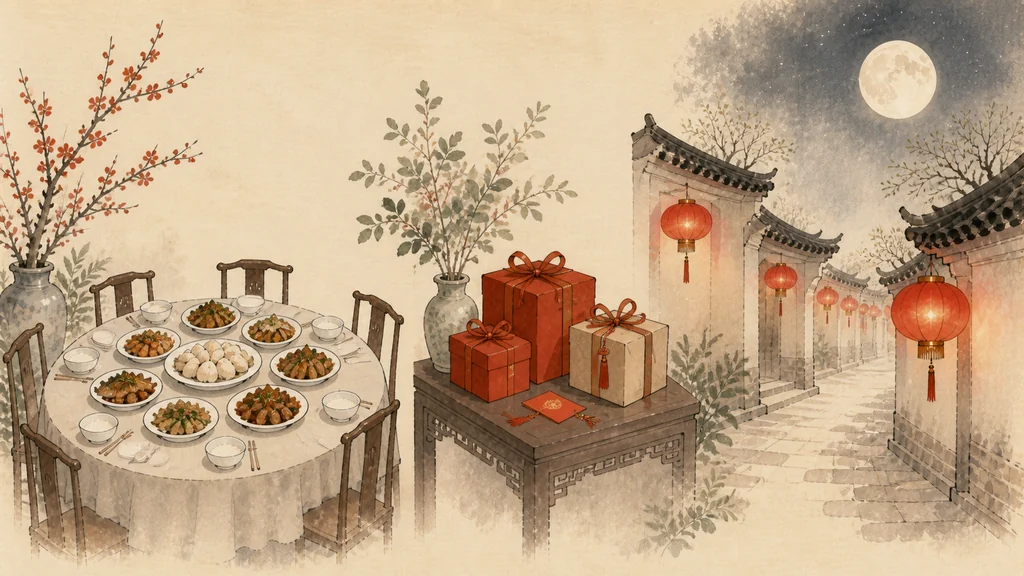
The shortest answer is the Lantern Festival, on the fifteenth day of the first month in the Chinese calendar. It is widely described as the last major occasion in the Spring Festival cycle. Yet that answer needs a qualification: a cultural season, a public holiday, a family's visiting schedule and a city's lantern programme do not necessarily end together.
“Chinese New Year lasts fifteen days” therefore describes a traditional framework. It does not mean that everyone has fifteen days off work or that every Chinese family follows the same daily ritual list. Before deciding whether New Year is “over”, ask which calendar is meant.
When does the new year actually begin?
UNESCO's 2024 inscription of “Spring festival, social practices of the Chinese people in celebration of traditional new year” identifies the first day of the first month as the beginning of the new year. Its record also makes clear that celebration begins before that date. People clean their homes, obtain provisions and prepare food; on New Year's Eve, families dine together and stay up to welcome the year.
These are three connected but distinct stages. Activities in the final lunar month prepare for the festival. New Year's Eve is the threshold between years. The first day begins the new calendar year. In everyday Chinese, guonian—“crossing the year”—can cover the entire process, so someone may say that New Year has started while preparations are still under way.
The Gregorian date changes annually because the festival follows the traditional Chinese calendar. A date from a previous year cannot simply be reused. Anyone planning travel, a school event or a public greeting should check that year's calendar.
Why is the Lantern Festival treated as the ending?
The Lantern Festival falls on the fifteenth day, the first full-moon night of the new year. Shanghai's official cultural guide calls it the final important occasion of Spring Festival, while China's government portal describes it as marking the end of Chinese New Year celebrations. Lantern viewing, riddles and glutinous-rice balls called yuanxiao or tangyuan are among its best-known customs.
It provides a convincing public finale. New Year's Eve centres heavily on reunion inside the home; lantern events take celebration into streets, parks, temple fairs and shopping districts. The full moon, round lanterns and round foods can all evoke completeness and reunion. The fifteenth night is therefore another climax rather than a day on which enthusiasm merely fades out.
This does not create a compulsory closing ceremony. One household may eat tangyuan without attending a lantern show. Another may join a large municipal event. A third may do very little. Names, fillings and methods for yuanxiao and tangyuan also vary regionally; they should not be presented as one uniform dish.
Why does the public holiday end earlier?
A festival cycle and an administrative holiday answer different questions. Tradition asks which occasions belong to the New Year season. A holiday notice determines when offices close. Schools, factories, restaurants, transport providers and individual employers have their own operational calendars, and most cannot all remain closed until the fifteenth day.
Returning to work does not erase the remaining festival period. Colleagues may exchange greetings on their first day back, families may postpone a visit until the next weekend, and communities may retain a lantern programme after normal business has resumed. Retail and hospitality workers may work throughout the busiest celebrations, while relatives abroad join a reunion by video.
When people say that the “New Year atmosphere” has weakened, they may simply mean that ordinary schedules have resumed. Family meals, visits to elders, community performances and the Lantern Festival can occupy separate dates without becoming inauthentic.
Does every one of the fifteen days have a fixed rule?
Online guides often assign a single custom or prohibition to every date from day one to day fifteen. Some entries reflect genuine local traditions, occupational practices or popular sayings. The problem comes when a regional list is presented as a timetable obeyed by all Chinese people.
The appropriate day for a married daughter to visit her parents, a business to reopen, a household to honour ancestors or a community to welcome a deity varies. Religion, migration, family structure and working life all change practice. Some households observe detailed prohibitions; others retain only the reunion dinner, greetings and red envelopes.
A useful question is not “Do Chinese people do this?” but “Who does this, where, and in what setting?” A host family's explanation is more relevant to a visitor than a supposedly national checklist found on social media.
How late can you give greetings or a red envelope?
Before the Lantern Festival, a New Year greeting is normally easy to understand, especially when meeting someone for the first time that year. After the fifteenth day, a friendly “Happy New Year—we have only just met” is unlikely to cause offence, but an ordinary greeting is equally safe. There is no universal deadline that turns goodwill into a taboo.
Red envelopes depend more on relationship than on a countdown. Practices involving elders, children, married adults and employers differ by family and region. Do not assume that every child of Chinese heritage should receive one, or question somebody who does not give one. If invited to a household gathering, asking the host whether a gift would be useful is better than applying an internet rule.
The Lantern Festival also deserves to be understood on its own terms, not merely as “the last day”. Lanterns and riddles create public entertainment, while the foods carry local histories and techniques. Joining respectfully means following the actual event rather than trying to perform every custom at once.
Why might overseas celebrations use different dates?
Overseas parades and festivals must fit weekends, venue permits, weather, school calendars and performers' availability. A parade may occur before New Year's Day; a lantern installation may remain open after the fifteenth. A commercial district may combine several traditional moments into one accessible weekend programme.
That scheduling is not automatically a cultural mistake. A family's calendar, a temple observance and a municipal event can each follow a different timetable. What should be avoided is presenting one community's practical arrangement as the sole worldwide tradition, or treating every East and Southeast Asian lunar new year as interchangeable. Vietnamese and Korean celebrations, among others, have their own names and histories.
Chinese New Year consequently has no single ending that answers every question. For time off, consult the year's official holiday calendar. For returning to work, follow the organisation concerned. For the traditional festival cycle, the Lantern Festival on the fifteenth day is the usual conclusion. For a particular family, listen to its members. Separating these calendars is more accurate than treating “fifteen days” as a rigid national rule.
Sources and further reading
- UNESCO: Spring festival, social practices of the Chinese people
- The State Council of China: How do Chinese people celebrate Spring Festival?
- Shanghai Municipal Government: Lantern Festival
- Hong Kong Public Libraries: Festivals & Customs in Hong Kong
- The State Council of China: Traditional activities held across China to celebrate Lantern Festival