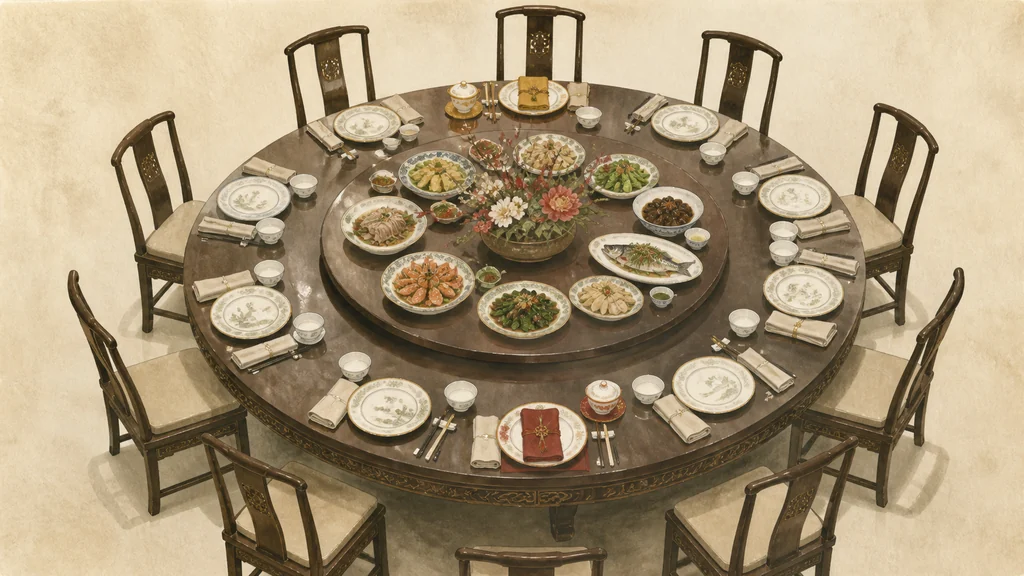
At a Chinese round-table banquet, the safest answer is simple: wait for the host to indicate a seat, then wait for the host, guest of honour or senior relative to signal that eating has begun. Do not claim an “honour seat” from an online diagram, and do not perform endless self-effacing refusals. A formal business dinner, wedding banquet, New Year family meal and supper among friends operate at very different levels of formality.
Common principles help you read the room, but they are not geometry. Doors, views, service routes, stages, host roles and place cards can all alter the arrangement. Good guests observe and ask instead of insisting that their etiquette chart is more correct than the host.
Is there really a highest seat at a round table?
Formal Chinese entertaining commonly distinguishes a host's seat, guest of honour and supporting hosts. Xiamen University's diplomatic-etiquette material explains that the first position may be set by the entrance, room orientation or visual centre; large banquets often remove uncertainty with place cards. The principal host generally occupies the host position and the main guest is often seated to the host's right.
“Facing the door” is a useful clue. A position looking towards the entrance with a solid wall behind it is conspicuous and allows the host to see arrivals. In a room with a major view, stage or unusual layout, the centre may shift. A seat near the service route may be kept for a co-host who communicates with staff.
Guests need not decide who has the greatest rank. Pause beside the table; a host will usually say, “Please sit here.” If two elders politely yield the place to each other, follow the person responsible for seating rather than joining a prolonged contest. Names, staff guidance and the host's gesture outrank theory.
How do weddings, business dinners and family meals differ?
A large wedding assigns tables before it assigns individual chairs. Hong Kong vocational material on banquet service describes entrance seating plans, table numbers and a principal family table that may use distinct cloth or settings. Find the correct table first; an empty family table is not an invitation to sit there.
Business and diplomatic banquets are more likely to arrange people by office, host–guest relation and interpreting needs. An interpreter may sit beside the guest of honour, and hosts may alternate with guests so colleagues do not talk only among themselves. Swapping seats casually can disrupt interpretation and service.
A home meal or dinner with friends is usually looser. An elder may receive the comfortable chair, children sit near parents and a person with limited mobility stays close to an exit. Some small restaurant rooms have no meaningful highest seat. Importing diplomatic protocol into every meal makes hospitality harder rather than more respectful.
When should you begin eating?
A formal meal often begins after a welcome, introductions or an opening toast. Cold dishes may already be on the table, but wait until the host invites everyone to eat or the guest of honour or senior person begins. Formal reception guides likewise place the host's opening before general service.
At home the signal may be a quiet “Eat while it is hot”, or the host may begin serving soup. Watch the table. If you remain uncertain, ask the person beside you, “Can we start?” That is more natural than remaining hungry for a ceremony that does not exist.
Whether to wait for a late guest is the host's decision. A twenty-person banquet may serve on schedule. If you arrive late, apologise briefly and take the indicated seat; do not require the entire table to repeat every toast.
How should you use a lazy Susan and serving chopsticks?
A rotating centre allows a table to share dishes. Before turning it, check whether somebody is serving food or whether a hot pot sits near the edge. Move it slowly, take a modest portion and release the dish. Do not park a favourite plate before yourself or reach across another guest.
Where communal chopsticks or spoons are provided, use them to transfer food to your plate before eating with personal utensils. Modern China Daily guidance also recommends serving chopsticks. If none appear, asking the waiter for a pair is a reasonable hygiene request.
Putting food into a guest's bowl has been a sign of hospitality, but diners may have allergies, religious restrictions or different hygiene preferences. Ask first, or position the dish so the person can choose. A guest who cannot eat an offered item may explain politely rather than risk health for face.
Whole fish or poultry sometimes carries local rules about the direction of the head. Variation is substantial. A visitor should not rotate a platter to “correct” it. Follow the host and service staff.
Must you finish alcohol in a toast?
No. A formal dinner may open with one host toast and later allow informal exchanges. Ganbei literally evokes an empty cup, but actual drinking depends on the beverage, relationship and occasion. Culture does not require anyone to consume baijiu.
State the boundary early: “I don't drink alcohol; I'll toast you with tea.” Health, religion, driving, medication and simple preference are sufficient. With tea, juice or water you can still stand, touch cups and offer good wishes. You do not need to invent an illness, and “only one glass” must not become repeated pressure.
People sometimes lower their rim to show deference, but several diners competing to hold the lowest glass becomes awkward and spills drinks. Natural eye contact and a gentle touch of cups communicate respect better than measuring centimetres.
When can you leave?
At a formal diplomatic banquet, the host and guest of honour conventionally close proceedings, after which others depart. If you must leave early, tell the host or reception contact privately and choose a pause between courses rather than crossing the room during a speech.
Weddings may include table visits, photographs or a farewell line. Check the programme and avoid leaving just before the couple reaches your table. At a large event where individual goodbyes are impractical, tell the table contact and send thanks later.
With family and friends, departure is more direct, but finishing food and vanishing immediately feels abrupt. Whether to help clear depends on venue. Carrying dishes at a hotel may obstruct staff; in a home, “Can I help?” is usually welcome even if the offer is declined.
Chinese banquet etiquette is less about memorising coordinates than enabling a host to care for guests and making significant relationships visible. Waiting for a seat, recognising the opening signal, using serving utensils, respecting alcohol boundaries and notifying the host before departure cover most situations. When the actual room contradicts an online diagram, trust the room.