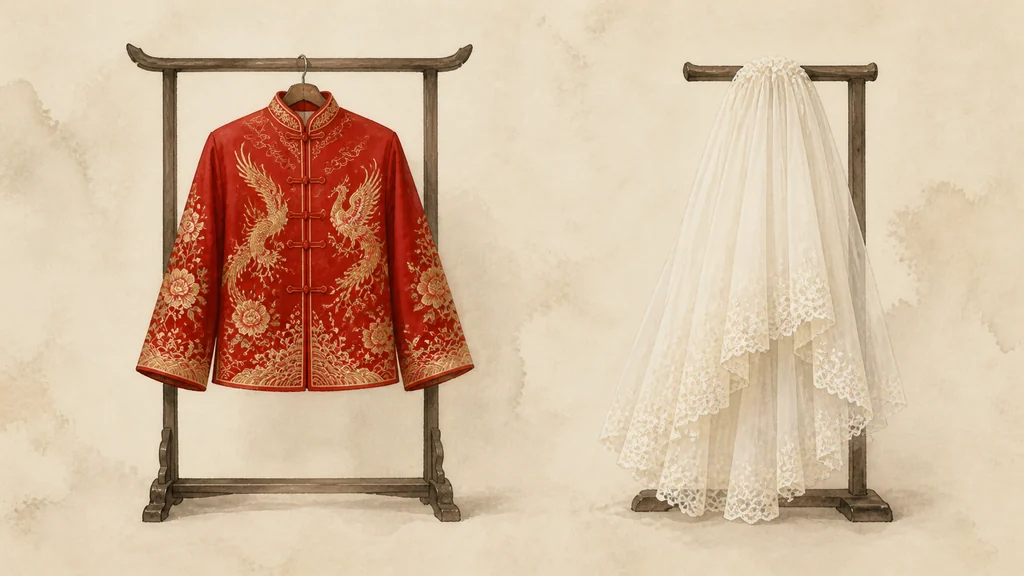
Red is highly visible at Chinese weddings, but “Chinese brides wear red, not white” is no longer an accurate rule. A contemporary wedding may include a white gown, a red Chinese-style outfit and a lighter evening dress for greeting tables. Another bride may choose only one outfit. Red represents a powerful wedding tradition, not the only colour permitted across every period, region and family.
Three histories need to be separated: the celebratory role of red in Chinese ritual, the real diversity of historical wedding clothes, and the rise and global circulation of the white wedding gown after the nineteenth century.
Why does red suit a wedding?
A wedding turns a family transition into a public celebration. Bright red is conspicuous on clothing, doors, sedan chairs, gift boxes and paper decorations. In these settings it has long been associated with festivity, flourishing life and good wishes. It tells guests immediately that the household is marking an auspicious event.
This meaning does not come from an eternal colour dictionary. Red also appears in religious ritual, children's clothing and other festivals. At a wedding, surrounding motifs, words, objects and actions focus its meaning. Explaining it only as a device to “ward off evil”, or merely as a “lucky colour”, misses its social role in making joy visible and shared.
A modern red envelope in the British Museum combines a gold Double Happiness character with wedding imagery. That object cannot prove an ancient origin by itself, but it documents the continuing association of red, gold and marriage in present-day material culture.
Did every historical bride wear bright red?
No. Wedding dress depended on period, status, wealth, region and available clothing. A museum object can demonstrate that one form genuinely existed; it cannot stand for every bride in China.
A V&A exhibition with the Palace Museum recorded a red dragon-and-phoenix wedding robe worn by Yehe Nara Jingfen when she married the Guangxu emperor in 1889. It is a precisely dated example from the late Qing court. It confirms the importance of red ceremonial dress in that setting, but does not mean ordinary families wore an imperial robe.
Research published by the Metropolitan Museum of Art shows that late Ming clothing practice often departed from formal rank regulations. Civilian weddings could borrow the appearance of officials' robes. Marriage allowed unusually splendid dress, yet local fashion and family resources still shaped what people could use. The uniform “ancient red wedding” seen in screen drama compresses a complex history into an immediately recognisable type.
Are dragons, phoenixes and Double Happiness a fixed set?
Dragons and phoenixes can evoke pairing, high status and harmonious relations. The Double Happiness character joins two instances of xi, “joy”, into an unmistakable marriage emblem. Gold thread, peonies, pomegranates, bats and other auspicious motifs may also appear. There is no national checklist requiring all of them.
Meaning depends on object and date. Dragons and phoenixes on a court robe participate in systems of rank and exceptional craftsmanship. Similar creatures on a household textile or paper decoration may serve a more direct congratulatory purpose. A phoenix does not automatically identify a garment as bridal, and theatrical costume should not be mistaken for documentary wedding clothing.
Nor are the xiuhefu, dragon-and-phoenix jacket and skirt, qipao, Han-style revival dress and the wedding clothes of China's ethnic groups interchangeable. They have different cuts, histories and modern transformations. “Red Chinese dress” is a visual category, not a precise garment name.
How did the white gown become popular?
The white wedding gown has a history too. It was not the timeless Western choice. The V&A notes that before Queen Victoria's influential 1840 wedding, European brides commonly wore red, pink, blue, brown and even black. Her white satin and lace outfit attracted enormous attention. Newspapers, fashion plates, advertising and commerce then repeated the image, and by the late nineteenth century white had become the expected ideal for many brides.
Queen Victoria did not invent the white wedding dress; her wedding accelerated its broad popularity. Twentieth-century photography, film and the bridal industry subsequently carried that image across borders.
A bride in China who chooses white today usually participates in a global visual language of romantic marriage. She is not automatically rejecting Chinese culture. White has particular associations in some mourning contexts, but colour meanings depend on garments and situations. A recognisable white bridal gown in a wedding hall is not confused with funeral dress.
Why might one wedding use several outfits?
Multiple outfits allow different ceremonies and aesthetics to occupy the same day. A bride may wear red for a door game or tea ceremony, white for a civil, hotel or church-style entrance, and a lighter dress while greeting guests. Another couple may hold the events on separate days. There is no universal order.
Changing clothes is also practical. A long train photographs dramatically but makes table-to-table greetings difficult. A heavy embroidered jacket or close-fitting qipao can also restrict movement. Rental businesses, photography packages, parents' expectations and social media all influence the programme. Treating every change as an ancient rite gives too much credit to “tradition” and too little to the modern wedding industry.
Some brides wear only white; some only red; others choose gold, green, pink or an ordinary suit. Intercultural marriages may allocate clothing important to each family to different moments. The meaningful question is how the couple negotiates these choices, not whether outsiders consider them traditional enough.
What should a guest wear?
Read the invitation and ask the hosts. If it specifies Chinese dress, formal evening wear or a colour theme, follow that guidance. Without instructions, neat and appropriately formal clothing matters more than guessing a universal Chinese taboo.
Guests often avoid appearing to copy the bride's principal outfit, especially a full white bridal gown or elaborate red dragon-and-phoenix ensemble. That does not make every red dress or white shirt forbidden. Cut, accessories and the family's expectations change the effect. Black is not automatically banned either. A short message to the couple is better than anxious folklore.
Gift and red-envelope amounts likewise depend on region, relationship and the kind of reception. No number works for every Chinese community. Courtesy means replying on time, respecting the couple's plan and not turning their wedding into a test of cultural purity.
Red remains powerful because it marks marriage as visible celebration and carries family hopes. White became widespread because modern media and the bridal industry built it into a global romantic ideal. Contemporary Chinese weddings often let both languages coexist. The colours are not opposing civilisations; they are tools with which couples arrange history, taste and family relationships.