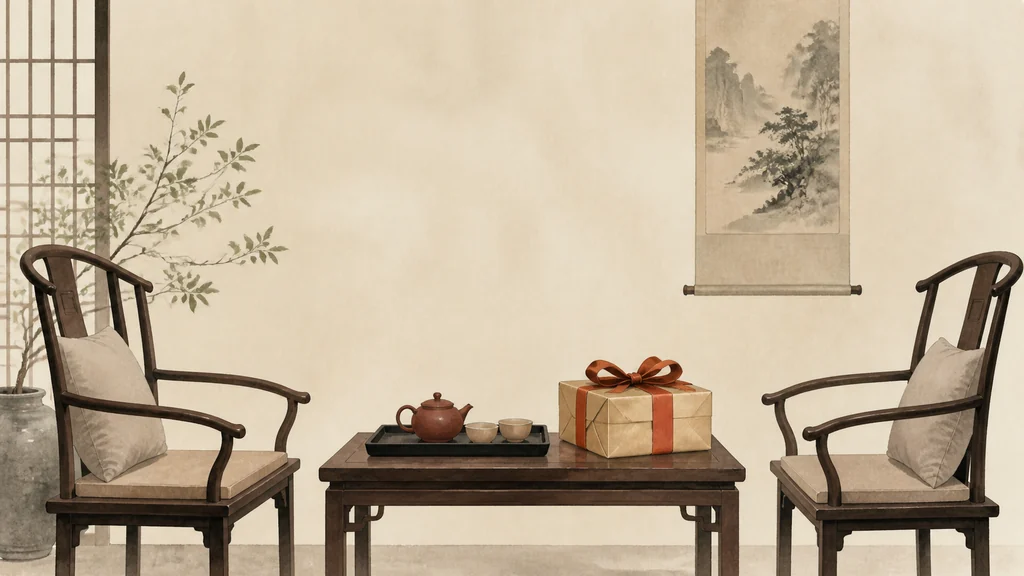
In Britain, a host often opens a birthday or visiting gift immediately, shows pleasure and comments on it while the giver is present. If a Chinese host says thank you and places the parcel to one side, a British guest may wonder whether something has gone wrong.
Usually, delayed opening does not mean rejection. It can express restraint, prevent prices and brands from becoming the centre of attention, or simply allow the visit to continue. It is not, however, a rule followed by every Chinese household. Some people open gifts at once, some wait, and some ask what the giver would prefer.
The visit may matter more than the reveal
At a home visit, the main event is the meeting: welcoming the guest, offering tea, introducing relatives and talking. Accepting a present, thanking the giver and putting it somewhere safe can keep that interaction moving. The host is not necessarily treating the gift casually; they may be declining to turn their reaction into a performance.
Etiquette material published by the Beijing municipal civilisation office gives several familiar explanations. Opening later can avoid embarrassment if the recipient does not like the item, and it can prevent comparison when several people have brought gifts of different value. The same guidance says contemporary practice is no longer rigid and that opening a well-presented gift in suitable circumstances can also be polite.
Those are explanations of a recognisable convention, not proof of an individual host’s thoughts. The host may be serving dinner, waiting for a child to return, or planning to organise the parcels after everyone leaves. What they say and how they respond later are better evidence than a national stereotype attached to one gesture.
Restraint can protect both people
Opening a gift immediately creates a moment in which the recipient is expected to perform an appropriate response. If the item is expensive, unsuitable, duplicated or unfamiliar, even a brief hesitation may embarrass the giver. Waiting gives both people room: the intention has been acknowledged, while appraisal of the object can happen privately.
A gift may also raise the question of future reciprocity. Scholarship on Chinese social relations cautions that reciprocity, renqing and guanxi are not a single mechanical code. Nevertheless, receiving something can create a sense of obligation. Public attention to price or luxury may increase that pressure. A quiet acceptance can therefore keep the relationship more balanced than exaggerated excitement.
Chinese families do not all behave alike
Close friends, younger households and people accustomed to British birthday or Christmas routines may readily open presents in front of everyone. Children’s parties may make opening part of the entertainment. Delayed opening can feel more natural at a formal visit, when several guests have brought parcels, or when giver and recipient do not know one another well.
Region, occasion and family habit all matter. Etiquette guides describe norms that people may recognise; they are not population surveys and do not establish a rule for every home. Watch what this household does. If all the parcels remain together on a side table, yours has probably entered the same routine rather than been singled out.
Red envelopes are a distinct case
A red envelope contains money, so privacy and comparison are especially direct concerns. Hong Kong Talent Engage advises recipients not to open lai see immediately in front of the giver during Lunar New Year. That is useful evidence for red envelopes, but it does not establish that every wrapped household gift must remain closed.
The object itself can also change the correct timing. Tell the host immediately if food needs refrigeration, contains nuts or alcohol, or is fragile. If the gift is a board game intended for that evening, flowers needing water or an object relevant to the gathering, you can say, “If it is useful now, please feel free to open it.” That supplies information without demanding a reaction.
What should a British guest do?
Give a short explanation: “These are biscuits from our area for everyone to share,” or “I thought you might enjoy this book.” There is no need to announce the price. If the parcel is put aside, continue the conversation rather than repeatedly asking why it has not been opened.
If you need to remove uncertainty, leave the choice with the host: “You can open it now or later, whichever is easier.” If they open it, respond naturally. If they do not, a later message, photograph or specific comment may be their complete thank-you. Some people prefer to inspect a gift properly after guests have left and then contact the giver individually.
A present should not demand an immediate emotional return. Its success depends on whether it suits the relationship and occasion, not on producing a visible surprise. If an object has a story, explain it briefly; then allow the recipient to set the pace.
When a refusal must be taken literally
Research in the Journal of Pragmatics, based on 71 observed instances, treats Chinese gift offering and acceptance as a sequence rather than a single action. An offer, a modest refusal, renewed offering and eventual acceptance can form part of private interaction. That does not mean every “no” should be overridden.
If someone clearly says they cannot accept, returns the item or cites workplace rules, respect the refusal. Gifts in companies, schools, hospitals and government settings may be restricted by value limits and conflict-of-interest policies. A household convention about modesty cannot cancel those rules. A shared, modest food item, an approved souvenir or a written note may be safer, but only if the institution permits it.
Your host’s unopened parcel is therefore rarely a verdict on your taste. Delayed opening may keep attention on the guest, avoid comparison or give both parties privacy; it may also be nothing more than personal habit. Explain anything the recipient needs to know, hand the gift over sincerely, and let the host choose the time. Clear words and later behaviour are more reliable than demanding an instant performance.