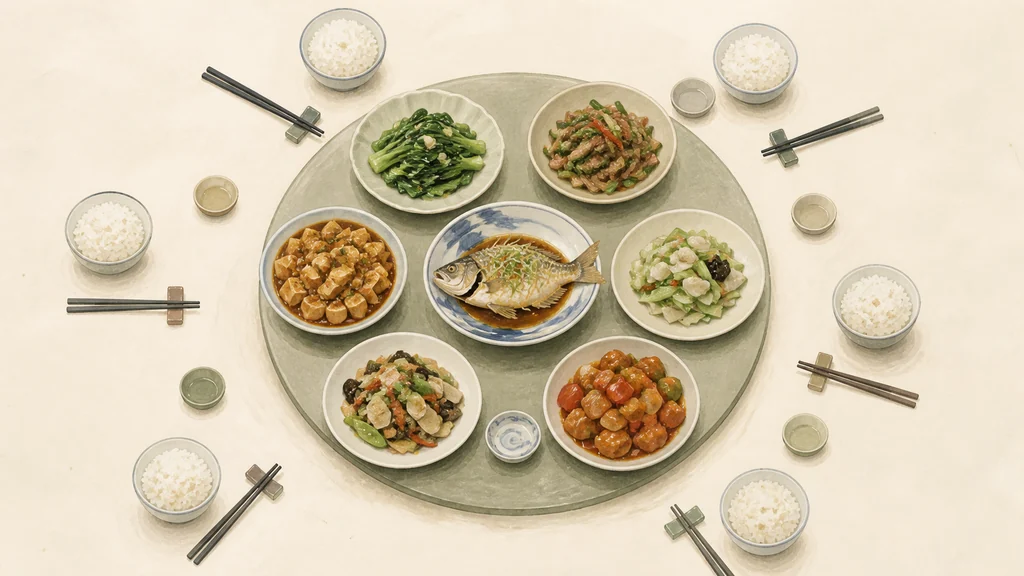
In a British restaurant, each diner usually chooses a main course and may share a starter. At many Chinese family meals and banquets, several dishes arrive in the centre. Each person has a small bowl, rice bowl and drink, but everyone selects food from the same menu on the table. The organising unit is not one diner plus one main course; it is one table plus a collection of dishes.
This arrangement is common, but it is not the only form of Chinese eating. Noodles, rice bowls, dumplings, set meals, fast food and individual hotpots can all be personal portions. Urban solo dining, working lunches and dietary needs are encouraging restaurants to offer smaller dishes and meals for one. Sharing is an important format, not a purity test for whether food is authentically Chinese.
Personal bowls and communal plates
A mixed-method study of solo dining in Macao describes a traditional setting in which each diner has an individual bowl of rice while the group shares cài—dishes served on communal plates. Rice or another staple supplies a base. Diners add small amounts of different dishes throughout the meal rather than receiving one complete plated course at once.
The boundary is usually visible. Large central plates, soup tureens and steamers are commonly shared. Small bowls, cups, drinks and clearly portioned dishes normally belong to one person. A restaurant may display a whole fish, duck or soup and then have staff divide it. If uncertain, asking “Is this for everyone?” is entirely reasonable.
Sharing does not mean every diner must eat every dish. You may skip something you dislike or cannot eat and choose from suitable plates. A communal menu increases choice; it does not cancel individual decisions about the body.
How several dishes become one meal
Communal dining changes ordering from a set of personal preferences into a composition. The person ordering considers group size, appetite, vegetables, protein, staples, soup, textures and cooking methods. A formal banquet may also consider season, sequence and visual effect. Regional practices differ, and there is no national formula prescribing a fixed number of meat and vegetable dishes.
The format allows everyone to sample several preparations. It also accommodates food cooked whole or in a large vessel—a fish, roast duck or pot of soup—without turning it into separate individual entrées. A rotating table makes dishes accessible around a large round table.
Yet the shared menu can conceal unequal provision. If a table decides that “one vegetable dish is enough” while a vegetarian must rely on it for the entire meal, other diners may empty it quickly. Ordering should provide enough complete food for people with restrictions, not treat them as guests who will merely taste the available side dish.
What does sharing communicate?
Communal eating keeps diners attentive to the same food. Someone turns the table, another explains a regional preparation, and somebody may place a suitable dish nearer an older relative. Scholarship on commensality and reunion argues that sharing food can help establish and confirm relationships. A reunion meal matters not only because of its ingredients but because people complete the meal from a common table.
That does not prove Chinese people are naturally collectivist while Westerners are naturally individualist. Britain has family-style dishes and shared Sunday roasts; China has abundant individual meals. Table formats also reflect cookware, restaurant economics, family size and working schedules. Sharing may express intimacy, but it may simply be the most practical service style in that restaurant.
Serving chopsticks make sharing safer
Shanghai’s official table-etiquette guide says personal chopsticks should not be used to serve food when dishes are shared. Jiangmen’s official standard defines serving chopsticks and spoons as utensils used by two or more diners to divide food without touching anyone’s mouth. Changzhou has also adopted a formal decision promoting these utensils and encouraging individual portioning.
Use the communal utensil to move food into your bowl, then eat with your personal chopsticks. Serving chopsticks may differ in colour, length or placement; ask staff if it is unclear. Soup, sauce and large shared casseroles particularly need communal spoons. Hong Kong’s Centre for Food Safety specifically advises communal chopsticks when serving poon choi.
Serving utensils are not evidence of distrust and do not reject tradition. They separate shared food from saliva, protecting older people, children and those with weaker immune systems. The pandemic intensified public discussion, but the hygiene case is not limited to an emergency.
How should you use a rotating table?
Take small portions and return for more rather than piling your plate with a favourite dish. Do not search through a serving plate for the largest piece or leave personal chopsticks hovering over the food. If one portion remains, ask whether anybody else would like it.
Before turning the table, check that nobody is serving food or soup and that glasses or phones are not resting against its edge. Rotate slowly and stop the dish where it can be reached. If someone is introducing a dish, do not immediately spin it away. Children can be served into their own bowls with clean communal utensils.
In some families, a host placing food in a guest’s bowl still communicates care. Hygiene expectations and personal boundaries are changing this practice. If you prefer to serve yourself or are full, say warmly, “Thank you, I’ll help myself.” Hospitality should respect that answer rather than force another mouthful.
Allergies need more than avoiding one plate
Cross-contact is the most important practical risk. The same serving chopsticks may touch a peanut dish and then a plate that appears nut-free. A ladle may move between soups, or sauce may spill on the rotating table. Someone with a severe allergy cannot depend solely on refusing the obvious dish.
Tell the restaurant about the allergen, severity and need for separate cookware and utensils when booking and ordering. Vegetarian, vegan, halal and pork-free diners should ask about stock, sauces and animal fat. If the kitchen cannot control cross-contact, select a restaurant with clearer processes or individually prepared food.
Not everything must join the communal system. A diner can have a separate dish and dedicated utensils, or the entire table can use individual portions. Modern Chinese public-health policy explicitly promotes both serving utensils and divided meals. Protecting health or religious practice does not weaken the meaning of eating together.
At a shared Chinese meal, first identify what belongs to the table. Use serving utensils, take modest portions and watch other diners before turning the table. State dietary requirements before ordering. You need not taste every dish or accept everything placed in your bowl. The value of sharing is a menu that several people can explore together—not the removal of anyone’s safety, boundaries or taste.
Sources and further reading
- Solo dining in Chinese restaurants: A mixed-method study in Macao
- Shanghai Municipal Government: Guide to table etiquette in China
- Jiangmen: Standard guidelines for serving chopsticks and spoons
- Changzhou People’s Congress: Decision on promoting serving chopsticks and spoons
- Hong Kong Centre for Food Safety: Guidelines for safe production of poon choi
- Cambridge University Press: Commensality as reunion