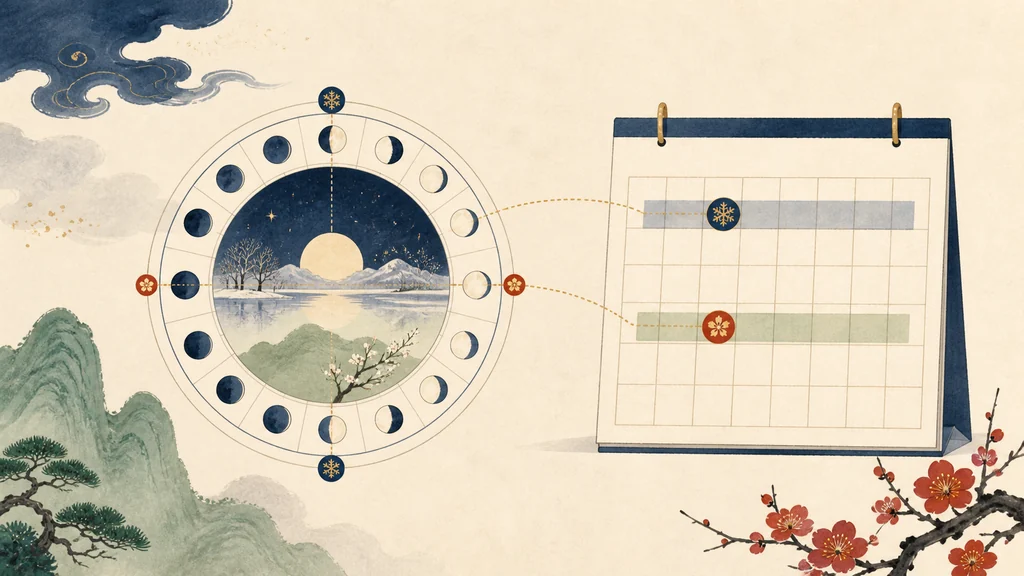
Chinese New Year is not assigned a fresh date every year. In the traditional Chinese calendar it always begins on the first day of the first month. What changes is the result when that day is converted into the Gregorian calendar used for everyday life in Britain.
The reason is that the two calendars organise months and years differently. The traditional Chinese calendar lets its months follow the phases of the Moon, while also keeping the year aligned with the Sun and the seasons. It is a **lunisolar** calendar, not a purely lunar one.
Two calendars measure different relationships
The civil calendar used in Britain is primarily solar. A normal Gregorian year contains 365 days and a leap year 366, while the lengths of its named months are fixed by calendar rules. Christmas therefore remains on 25 December and New Year’s Day on 1 January.
Months in the traditional Chinese calendar have an astronomical connection. The Hong Kong Observatory explains that a month begins on the civil day on which a new moon occurs—technically, when the Moon and Sun have the same ecliptic longitude. The average interval from one new moon to the next, called a synodic month, is about 29.5306 days. A civil calendar cannot contain half a date, so a Chinese-calendar month has either twenty-nine or thirty days.
This arrangement keeps the months close to the lunar phases, but it creates a mismatch with the solar year. Twelve average synodic months total about 354.3672 days. A tropical year, measured from one vernal equinox to the next, lasts about 365.2422 days. The difference is more than ten days.
Why the festival often moves earlier
In a Chinese-calendar year with twelve months, the calendar year is shorter than the solar year. When the next first day of the first month is converted to a Gregorian date, Chinese New Year will commonly appear ten, eleven or twelve days earlier than it did the previous year.
This produces a recognisable sequence on a British wall calendar: a festival in the middle of February may be followed the next year by one in early February and then by one in late January. The shift is not always exactly eleven days. The precise moment of each new moon, and whether particular months contain twenty-nine or thirty days, changes the interval.
If twelve lunar months were simply repeated forever, the festival would gradually travel through all the seasons. That is what happens in a purely lunar calendar. The traditional Chinese calendar prevents this long-term drift because it also observes the solar year.
How a leap month restores the seasons
The twenty-four solar terms mark positions of the Sun through the year. Twelve of them are “major solar terms” used in determining how lunar months fit into the solar cycle. The Hong Kong Observatory states that a lunar month without a major solar term is designated as a leap version of the preceding month.
Some Chinese-calendar years therefore have thirteen months rather than twelve. This is not equivalent to the extra day added to February in a Gregorian leap year: an entire lunar month is inserted. Across nineteen tropical years there are roughly seven such leap months, allowing 235 lunar months to remain coordinated with 228 major solar terms.
After a leap month has been inserted, the following Chinese New Year does not continue its annual move towards an earlier Gregorian date. It jumps noticeably later instead. The broad pattern is therefore several earlier shifts followed by a later reset. This is evidence of the lunisolar system doing its job, not an irregularity in the festival.
The position of a leap month is not chosen simply to push New Year back to a preferred date, nor does it rotate mechanically through the calendar. It follows the astronomical relationship between new moons and major solar terms. Official conversion tables are safer than trying to extrapolate a repeating cycle.
Is it the second new moon after the winter solstice?
English explanations often say that Chinese New Year falls on the second new moon after the winter solstice. In many ordinary years this is a useful shortcut. It gives readers a sense of why the festival normally occurs a little more than a month after the December solstice.
It should not be treated as the complete rule. Unusual calendar structures, including rare leap eleventh or twelfth months, require the full rules governing month numbering and major solar terms. The robust definition is that Chinese New Year is the first day of the first Chinese-calendar month; the calendar system determines which month is the first.
Chinese New Year is also not identical to **Lìchūn**, the solar term translated as “Spring Commences”. Lìchūn is fixed by the Sun’s position and normally occurs in early February. The first day of the first lunar month is fixed by the month sequence. They may be close, but they are different calendar concepts.
Why British websites may show nearby dates
A new moon is an astronomical instant, while “the first day” is a civil date. Time zones decide which civil day contains that instant. If a relevant new moon or solar term occurs close to midnight, calculations prepared for different locations can appear to place a boundary on neighbouring dates. Long-range tables may also be revised when a predicted astronomical event lies exceptionally close to midnight.
There is a more ordinary source of confusion in Britain: public celebrations are often held on the nearest convenient weekend. A London parade, museum family day or school event may not occur on the first day of the Chinese-calendar year. That is an event schedule, not an alternative calculation of New Year. Check whether a listing means the festival date or the celebration date.
How to check the date in practice
For a visit, meal or greeting, consult a reliable Gregorian–Chinese calendar conversion table for the relevant year and follow the date published by the family, community or event organiser. The Hong Kong Observatory publishes official conversion tables rather than asking readers to reproduce the astronomical calculation.
For a classroom or news explanation, one sentence is normally enough: “Chinese New Year begins on the first day of the first month in a lunisolar calendar, so its Gregorian date changes.” You can then explain the lunar months and leap-month correction without presenting a convenient shortcut as a law without exceptions.
Do not plan a journey several years ahead by subtracting eleven days for every new year. A leap month will interrupt that pattern. Use a published calendar for the actual year and location.
What remains fixed is the festival’s place in its own calendar: the first day of the first month. Lunar phases give months their rhythm; the solar cycle and solar terms keep those months connected to the seasons; leap months reconcile the two. The changing date on a British calendar is the visible result of two coherent calendars being converted, not evidence that Chinese New Year lacks a rule.