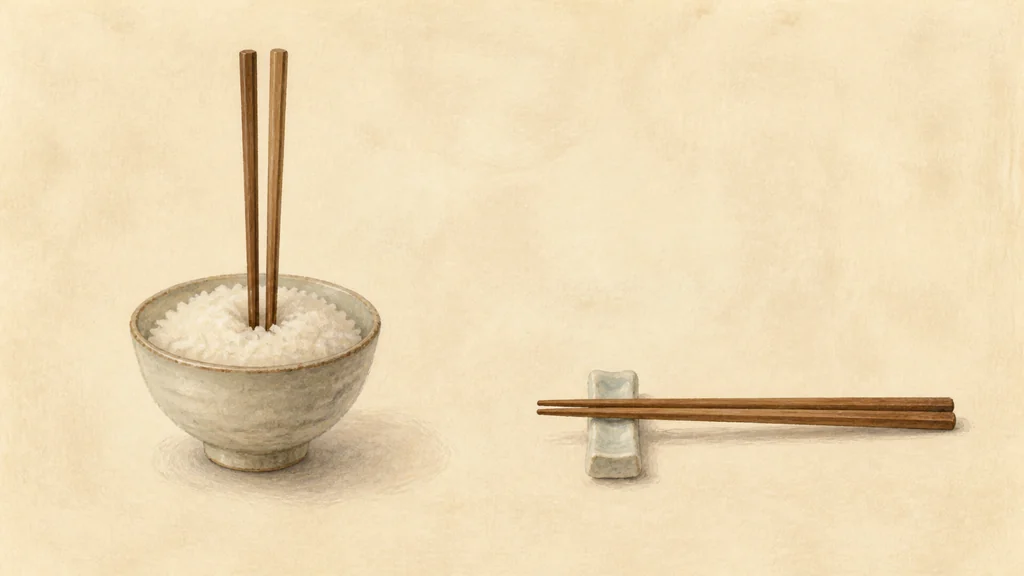
Leaving chopsticks upright in a bowl of rice may seem like a convenient way to free your hands. The resulting picture, however, can be immediately uncomfortable to many Chinese diners. Two thin sticks rising vertically from white rice resemble incense placed at an offering, while the bowl itself resembles food presented in a ritual setting. An everyday meal is made to look like something associated with ancestors or the dead.
If you do this accidentally in a British Chinese restaurant or family home, there is no need to panic. Lift the chopsticks out and rest them horizontally on a chopstick rest, your small plate or the place provided. The mistake takes seconds to correct and need not become a major apology.
The visual arrangement carries the association
Chopsticks are not forbidden from touching rice, and no special force appears simply because they are vertical. The issue is the relationship between the objects: a pair of long, narrow sticks standing in a bowl of food.
The form of Chinese ancestral, funerary and religious rites varies by place, family and belief. Incense burners and food offerings nevertheless have a documented place in ritual material culture. A Southern Song Longquan celadon incense burner in the British Museum, for example, is described as an object used for burning incense on an altar and linked by its vessel form to food offerings for deceased ancestors. A Ming textile in the Metropolitan Museum’s collection represents the Five Offerings and includes both incense and food among the offerings.
Those museum records do not dictate modern dining manners. They establish the material background that makes the comparison understandable: incense and food can occupy the same ritual environment.
Modern etiquette sources make the dining connection explicit. A chopstick-etiquette page published by Changzhi municipal government describes the Beijing expression “offering incense in public” for chopsticks inserted in rice, explaining that the shape resembles incense offered to the dead. University folklore archives at USC and Dartmouth preserve family accounts in which parents taught the same visual comparison to children.
Together, these sources demonstrate a widely transmitted explanation. They do not prove that one lawgiver invented the rule at a known moment in antiquity, and they should not be stretched into that sort of origin story.
“Unlucky” does not mean an automatic curse
At an ordinary table, diners expect food, conversation and hospitality. An altar or memorial table has a different function. Making the first scene look like the second can feel like bringing imagery of death or mourning into a social meal.
Families often compress that discomfort into the phrase “It is unlucky.” This is practical household language: do not reproduce a funerary or offering-like image during dinner. It need not be interpreted as a claim that upright chopsticks will literally cause a death, nor as a superstition test imposed on foreign visitors.
Some older relatives will react strongly and immediately correct a child. Some younger diners simply find the arrangement ugly or disrespectful. Others may barely notice. Variation in intensity does not erase the convention. It means that a visitor should treat it as common enough to avoid without assuming that every Chinese person holds an identical belief.
Where to put chopsticks when you pause
If a chopstick rest is provided, lay the chopsticks across it, keeping the used tips off the table. Without a rest, your own small plate is often a suitable temporary place. A restaurant may provide a paper sleeve or have an established setting; follow what the host or other diners do.
Resting chopsticks across the top of a rice bowl is accepted in some households but interpreted as “finished” or untidy in others. The lowest-risk order is to use the chopstick rest first, your own plate second, and local observation third.
Do not solve the problem by planting the chopsticks in a shared dish, cup or another piece of food. Avoid leaving them projecting beyond the table where they can be knocked to the floor. A stable horizontal placement prevents the ritual association and is also cleaner and safer.
Shared dining adds practical etiquette
Chinese meals commonly place dishes in the centre for everyone to share. When serving chopsticks or spoons are provided, use them to move food to your own bowl or plate before eating with your personal chopsticks. If no serving utensils are present, follow the host and restaurant’s practice rather than searching through a communal dish with the end that has been in your mouth.
Pointing at a person with chopsticks, hovering indecisively over several dishes, drumming on bowls or using chopsticks to move non-food objects can also appear rude. Unlike the ritual symbolism of upright chopsticks, these actions have immediate effects involving hygiene, noise, fairness and the comfort of other diners.
A British guest does not need to memorise a sensational list of twelve or twenty “chopstick taboos”. Three high-value habits cover most situations: rest chopsticks horizontally; do not point or drum with them; and use communal serving utensils when they are available.
What to do after an accidental mistake
If the chopsticks are already standing in the rice, remove them and lay them flat. If someone has just corrected you, “Sorry—I didn’t realise” is enough. There is no reason to discard the bowl of rice or repeat an apology throughout the meal.
Most hosts distinguish unfamiliarity from deliberate mockery. A prompt correction communicates respect more effectively than a long explanation. A host explaining the rule can say, “We normally rest them flat because upright chopsticks look like incense at an offering.” That image is easier to remember than an unexplained warning that the arrangement is “very bad luck”.
A sharp correction directed at a child may reflect years of family teaching rather than anger at every person around the table. Recognising this generational dimension helps a visitor avoid treating a brief household reaction as a personal rejection.
The taboo is not uniquely Chinese
Related conventions occur in Japan, Korea, Vietnam and other societies that use chopsticks. Upright chopsticks may evoke funerals, offerings or death in those settings as well. The ritual objects, food offerings, acceptable resting places and explanations are not identical, however.
It is accurate to say that upright chopsticks are a widely recognised taboo at Chinese tables and that related visual taboos occur elsewhere in East and Southeast Asia. It is inaccurate to collapse them into one timeless “Asian rule” or to claim that the association belongs exclusively to China.
The most useful principle is visual rather than mystical: do not make an everyday bowl of rice look like a ritual offering. Rest the chopsticks securely and horizontally, pay attention to hygiene at a shared meal, and correct an accidental mistake without drama. That small amount of context is more useful than a long catalogue of prohibitions.