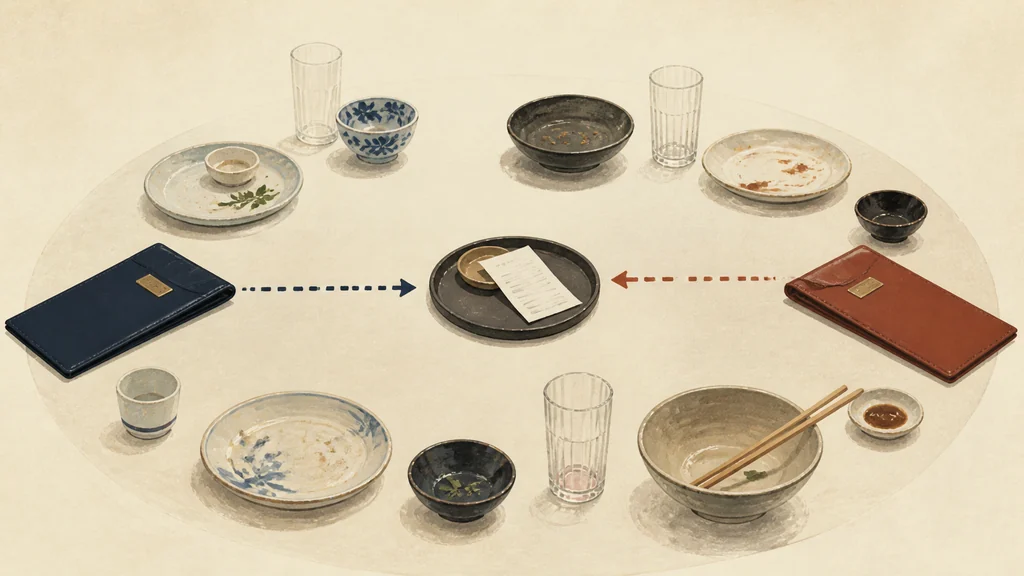
As a meal ends, a British guest may be preparing to calculate each person’s share while several Chinese diners head towards the till and compete to scan the payment code. The exchange can sound like an argument. What is being negotiated, however, is often more than money: who issued the invitation, who is acting as host, and how the relationship will continue next time.
This does not happen at every Chinese meal. Students, colleagues and younger friends commonly use split payment or instant transfers. A family elder treating younger relatives, a birthday invitation, an informal lunch and a business banquet are different situations. Instead of memorising “Chinese people always fight to pay”, identify who organised the meal, what the invitation said and how this group usually settles bills.
“I’m treating” normally includes the bill
The Chinese expression qǐngkè means inviting and entertaining guests and commonly includes paying. If someone chooses the restaurant and says jīntiān wǒ qǐng—“today it’s my treat”—the guests can reasonably understand that person to be the host. Shanghai’s official international service site similarly advises that guests may offer to pay, while the host will usually insist on covering the bill.
This differs from an English suggestion such as “shall we get dinner?”, which may only arrange a meeting. Cross-cultural confusion often begins with an ambiguous invitation. One person thinks they have announced a treat; the other assumes everyone will split. If the wording is unclear, asking “How shall we handle the bill?” before the meal is easier than guessing at the till.
Why do guests still offer to pay?
An offer can show gratitude and demonstrate that the guest does not take hospitality for granted. If the same person repeatedly pays, friends may also worry about remaining indebted. Competing for the bill can therefore contain both sincerity and convention: several people genuinely are willing to pay, while also knowing that the original host may refuse.
It is too simple to call every offer a performance of “face”. Paying may sometimes demonstrate means, seniority or host status, but it can also provide practical care. A local friend may welcome a visitor from far away; an established older relative may treat a student; somebody may be thanking a group for past help. The relationship and previous exchanges explain more than the gesture alone.
Prolonging the contest is not necessarily more polite. Pulling at a bill, grabbing phones or inconveniencing restaurant staff turns symbolic resistance into a real conflict. When someone clearly says, “I invited you this time,” one sincere offer to contribute, followed by acceptance and thanks, can be enough.
One payer does not mean everyone else eats free forever
Some circles do not divide each meal precisely. They alternate over several meetings: one friend pays today, another chooses the restaurant and pays next time. A local person hosts a visitor, who later returns the invitation in their own city. Reciprocity unfolds across a relationship rather than being completed at the till.
Research on lishang wanglai, renqing and reciprocity warns against treating them as a mechanical account book. The timing, value and form of a return depend on closeness and ability. Coffee next week, a local food brought from a journey or useful help can all acknowledge generosity. Exact monetary equality is not always the point.
Long-term reciprocity can still create difficulties. New acquaintances may not know whether there will be a next time, and unequal incomes can make alternating expensive restaurants unfair. Discussing budget and payment does not destroy friendship. Consideration includes choosing an arrangement everyone can afford.
Splitting the bill is also contemporary Chinese life
The expression AA zhì—the AA system—is ordinary Chinese vocabulary for splitting costs. Friends arranging a quick meal, colleagues at lunch, students and frequently meeting groups may divide the total or pay for their own orders. Mobile payment makes it easy for one person to settle the restaurant bill and receive transfers immediately.
Xiamen University teaching material advises discussing how to split a restaurant bill beforehand. Clear agreement can therefore be polite, not a rejection of culture. Splitting is neither “unchinese” nor evidence that an older custom has disappeared. It is one practical method for frequent, budget-sensitive or relatively equal relationships.
Conversely, do not force an instant transfer on a host who has clearly invited you without first asking. They may understand it as refusing their hospitality or reducing a continuing relationship to a closed transaction. “You treat this time; may I invite you next time?” can fit better. If the group’s established practice is immediate transfer, follow it.
What should a British guest do?
Listen to the invitation. “I’d like to treat you” or wǒ qǐngkè normally identifies the payer. At the end, you can make a genuine offer: “May I contribute?” When the host clearly refuses, thank them and stop turning courtesy into combat. Shanghai’s guide recommends expressing gratitude and offering to host a future meal.
For a vague arrangement among friends, ask before ordering: “Are we splitting this, or is somebody hosting?” Mention budget if the restaurant is expensive. Chinese companions will not necessarily find financial clarity offensive.
Avoid secretly paying while pretending to visit the toilet unless you know the group well and know they welcome that tactic. With new acquaintances, pre-empting the bill may take the host role away from the inviter. Do not film a payment dispute as amusing evidence of “how Chinese people behave”; it is a private negotiation, not a tourist performance.
Family, dates and business need separate judgement
Parents or older relatives often offer to pay at family meals, while adult children may seek to pay as an expression of care. At a first dinner with a partner’s parents, offer once but do not use a physical contest to prove sincerity. If the elders insist, thank them and find a suitable future opportunity to reciprocate.
Dates have no national rule. Inviter-pays, alternating, male-pays and splitting all exist. Culture should not be used to decide for another person, and paying never purchases affection or entitlement. A brief conversation is more reliable than a gender stereotype.
Business hospitality requires company policy, expense rules and conflict-of-interest checks. When suppliers, clients, public employees or decision-makers are involved, the identity of the payer may have compliance consequences. Private courtesy cannot override anti-bribery obligations. Separate payment, an approved corporate process or declining the invitation may be necessary.
The contest over a Chinese restaurant bill often communicates hosting, gratitude and future reciprocity; it is not evidence that anyone has forgotten arithmetic. It may be lively, or it may never occur. Identify the inviter, observe the group and ask when the arrangement is unclear. Offer sincerely, then respect a clear answer. The bill settles one meal; the larger aim is a relationship in which another meeting remains easy.
Sources and further reading
- Shanghai Municipal Government: Guide to table etiquette in China
- Xiamen University cross-cultural case library: Paying for a group meal
- Xiamen University: Table Manners teaching material
- Zhejiang University Journal: Reciprocity as a Social Norm or Gift Changing as a Social Norm
- Oxford University Press: Reciprocity in Chinese Traditions