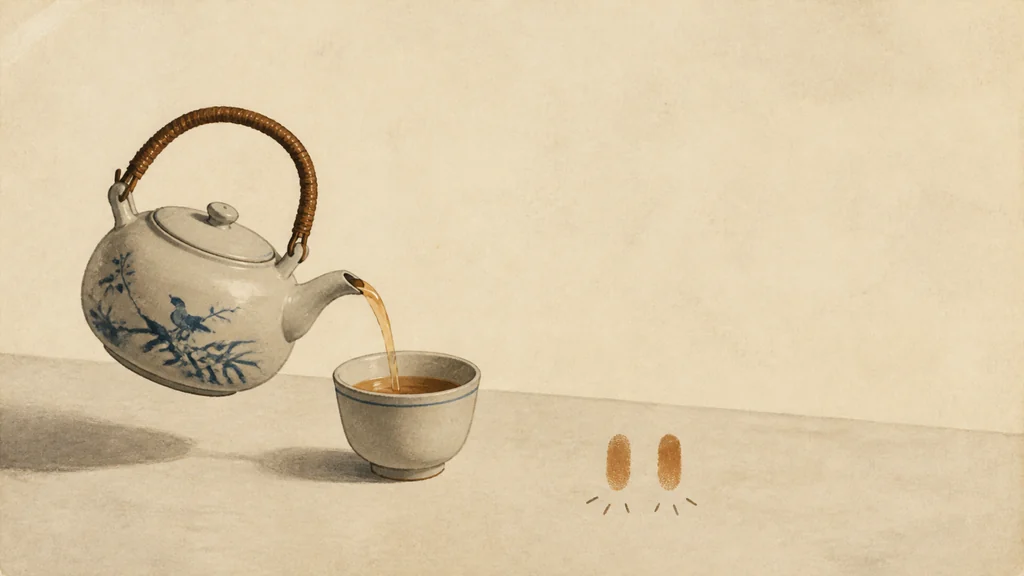
At a Hong Kong teahouse, a Cantonese dim sum meal or an overseas yum cha table, you may notice a small gesture. Someone is talking while another person refills their tea. Instead of interrupting with a spoken thank-you, the recipient taps two fingers lightly beside the cup.
The tap is not a demand for faster service. It is a quiet “thank you”. It is variously called finger-tapping tea etiquette, kou zhi cha li or a “finger kowtow”. Families tell different stories and use slightly different forms, but the practical version is simple. Tap lightly when tea is poured. If you do not know the gesture, a smile, nod or spoken thanks is equally acceptable.
How is the gesture made?
The most familiar form places the index and middle fingers together and taps the tabletop one to three times, using the fingertips or bent knuckles. The movement should be brief and quiet, near your cup without striking the cup or teapot. A review of Cantonese morning tea in the Journal of Ethnic Foods describes tapping with the middle and index fingers to thank the person refilling a cup.
An English-language Chinese government culture page says yum cha has no strict set of conduct rules, but guests commonly tap with the index and middle fingers when the host refills tea. Guangdong University of Foreign Studies describes three gentle taps. The variation makes the real point clear: the gesture is a visible acknowledgement, not a test of counting.
Timing gives the tap its meaning. Used as someone pours or immediately afterwards, it reads as thanks. Repeated tapping beside an empty cup could look like impatience. Asking for more water, changing the tea or raising a problem requires the restaurant’s normal signal or speech; a thank-you gesture is not a universal command.
Why not simply say thank you?
A busy teahouse can be noisy, and a table may be in continuous conversation. Tea is refilled frequently. If every pour stops the discussion, the exchange becomes fragmented. A finger tap tells the pourer that their attention has been noticed while allowing the speaker and listeners to continue.
That does not make spoken thanks wrong. If a server changes the pot, warns that it is hot, or you are not in the middle of a conversation, saying thank you is natural. The silent gesture is convenient, not a more authentic or superior form of manners.
Nor should silence conceal necessary information. Say clearly if the tea is too hot, you have had enough, there is an allergy concern, or boiling water presents a risk to a child. Etiquette should make people easier to care for, not suppress safety messages.
Is this custom used throughout China?
Finger tapping is particularly associated with Guangdong, Hong Kong and Cantonese tea-drinking culture. Yum cha is more than breakfast: tea, dim sum, friends, relatives and the teahouse create a recurring social occasion. As Cantonese restaurants and communities spread to Britain, Australia, North America and elsewhere, the gesture travelled with them.
People in other parts of China may recognise or use it, but that does not make it a compulsory national custom. A northern family, modern café or formal tea ceremony may not use it. A foreign guest does not need to tap whenever a teapot appears. Watch the table, or give an ordinary thank-you.
Practice also varies within Cantonese communities. Some diners tap for every cup, others use it only when speaking, and some never do it. Failing to tap is not evidence that a person lacks manners or cultural knowledge.
Did the custom begin with the Qianlong Emperor?
The best-known origin story concerns the Qing emperor Qianlong travelling incognito. In a teahouse, he pours tea for his attendants. Their rank would normally require them to kneel in thanks, but doing so would expose the emperor’s identity. They therefore bend their fingers and tap the table, substituting a miniature finger kowtow for the formal act.
The story vividly explains why bent fingers might represent kneeling. It gives an everyday gesture a memorable origin, and the Journal of Ethnic Foods review and numerous modern culture guides repeat it. Repetition, however, is not historical proof.
A University of California repository study of yum cha in the Cantonese diaspora explicitly notes that the folklore is not substantiated by historical records. Stories of Qianlong travelling in disguise have many variants, while early documentation of the tap is insufficient to establish one inventor, date and teahouse. The accurate description is therefore “a popular legend used to explain the custom”, not a verified account of its origin.
The legend still has cultural value. It shows how later users understand the gesture: pouring tea is care worthy of acknowledgement, and a tap compresses a formal sign of respect. Cultural history can preserve that interpretation while being honest about evidence.
Do different fingers encode rank?
Some etiquette guides provide an elaborate system. A fist or several bent fingers thanks an elder; two fingers are used among peers; one finger acknowledges tea poured by a younger person. These explanations borrow images of prostration, a clasped-hand salute and a nod to build a hierarchy into the hand.
Everyday practice is less consistent. Many people use two fingers regardless of age, and others tap only once. A British visitor trying to memorise a rank code may produce an exaggerated gesture at the wrong moment. Two light taps, or spoken thanks, are safe. Being sincere and understood matters more than perfectly reproducing one guide’s taxonomy.
An elder, friend and server all deserve acknowledgement. With service staff, a tap without eye contact may occasionally seem remote; a nod or spoken thanks can be clearer. Treat the gesture as a tool for avoiding interruption, not an examination of status.
How do you ask for more tea—or stop it?
The tap means “thank you for pouring”, not “please pour again”. If you have had enough, place a hand near the cup and say, “Thank you, that’s enough.” Do not wait until it overflows and then object. Warn clearly about hot water when children or crowded tableware are involved.
Cantonese teahouses also have a tradition of offsetting or lifting a teapot lid to request a refill, discussed in the Journal of Ethnic Foods review as jie gai xu shui. Restaurants differ: some use call buttons and others have circulating staff. Observe local procedure and do not place a lid where it may be contaminated or fall.
For a first dim sum meal, remember one principle: acknowledge the person who pours. Two light taps, a nod or a spoken thank-you can all achieve that. Do not pound the table, use the gesture to summon staff, or present the Qianlong tale as established fact. The small movement works because it lets both tea service and conversation continue naturally.
Sources and further reading
- Journal of Ethnic Foods: Cantonese morning tea (Yum Cha)
- Chinese government culture portal: Yum Cha
- Guangdong University of Foreign Studies: Traditional Etiquette in Cantonese Brunch
- University of California eScholarship: The Impacts and Significance of Yum Cha for the Cantonese Diaspora
- Guangdong provincial standards material: Cantonese tea customs