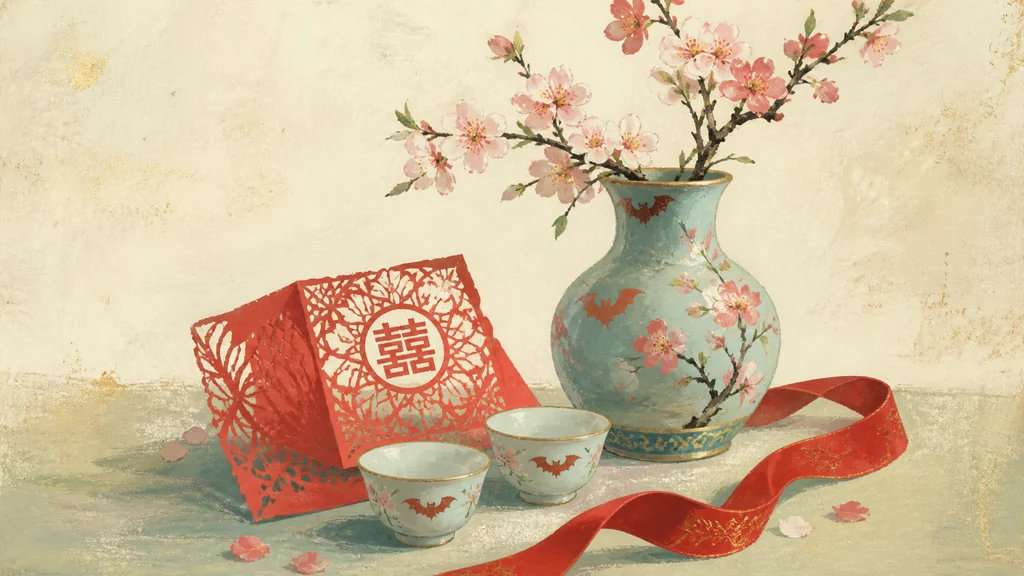
The red character 囍 seen at Chinese weddings is read shuāngxǐ, or “double happiness.” Its shape joins two copies of 喜, the character for joy. The pairing brings the happiness of the two people—and traditionally their two families—into one wedding emblem.
Two forms of joy become a wedding emblem
The single character 喜 can mean joy or pleasure and appears in everyday words. 囍 has a much narrower use. Put it on an invitation, a wedding-room decoration, or a gift box, and it immediately signals marriage.
A late Qing design in the Palace Museum places a gold 囍 on a yellow ground among colourful butterflies. Notes written beside it list bowls, plates, dishes, and tea wares to be made from the design. The service was prepared for the wedding of the Tongzhi Emperor. The museum describes 囍 here as an auspicious design expressing the shared joy of a new marriage.
Phones and computers can now type 囍 as a single encoded character. That does not make it an everyday substitute for 喜. A Chinese speaker would not replace the 喜 in 喜欢, “to like,” or 惊喜, “a pleasant surprise,” with 囍. In ordinary use, it behaves more like a wedding emblem made from written characters.
From red paper to wedding vessels and bedding
Double Happiness was not confined to red paper pasted on doors and windows. Palace Museum accounts of Qing imperial weddings include a gold dragon-and-phoenix wine pot with the symbol and bedding decorated with gold forms of 喜. A wedding ruyi sceptre carries 囍 at its centre, surrounded by five bats, with the wish 宜子宜孙—hopes for many descendants—engraved on its handle. Marriage, good fortune, and family continuity meet on one object.
The Metropolitan Museum of Art holds a Daoguang-period porcelain vase that places 囍 among bats, peaches, and flowering vines. The museum reads Double Happiness as a wish for marital harmony. The bats and peaches add happiness and longevity. 囍 identifies the marital setting; the surrounding motifs make the blessing more specific.
The Wang Anshi origin story remains a legend
The best-known story about the symbol credits the Song statesman Wang Anshi. According to the tale, he encountered an unfinished matching couplet while travelling to take the civil-service examination. He later both passed the examination and completed a marriage match, so he wrote two forms of 喜 together to celebrate the two happy events.
The story is memorable, but it does not prove that Wang Anshi invented the design. The Palace Museum introduces the attribution with the equivalent of “according to legend,” not as a documented origin. It belongs in the symbol’s folklore, not in a firm historical date.
Today, 囍 remains most at home at weddings, in a newlyweds’ room, and on marriage gifts. For happiness unrelated to marriage, the single character 喜 is normally the more natural choice.
Surrounding motifs continue the blessing
Double Happiness establishes a marital context; bats, peaches, butterflies or a dragon-phoenix pair can then add fortune, longevity, festivity and an image of the couple. The Metropolitan vase cannot be read through its central character alone. Form, motif combination and production date create the complete statement. After identifying elements separately, interpretation must return them to the object.
Colour often helps recognition. Red grounds and gold characters are conspicuous today, yet the Tongzhi wedding design uses gold Double Happiness and coloured butterflies on yellow. Red is a powerful convention, not a requirement for an authentic 囍. The joined form and documented wedding use provide firmer identification than one palette.
The joined character works through visual doubling
Two 喜 forms share one symmetrical space, making the design effective in paper cutting, embroidery, ceramics and architectural decoration. It can be encoded as one Unicode character while remaining culturally intelligible as doubled joy. Encoding answers how a computer stores it, not why a wedding uses it.
Ordinary 喜 participates in words and sentences; 囍 mainly behaves as an emblem. That distinction explains why the joined form can dominate the centre of a composition but rarely appears inside running prose.
Origin claims must separate legend from objects
The Wang Anshi tale gives “two happy events” a memorable plot, but no cited contemporary record confirms him as inventor. Responsible writing labels it a legend and uses datable Qing court designs, wedding equipment and museum objects as evidence for actual practice.
An unknown first inventor does not prevent us from explaining surviving material. Cultural symbols often accumulate documented uses before a famous origin story attaches to them. Making the evidence levels visible is more useful than offering a falsely precise birthday.
Sources and further reading
- Palace Museum, [Design for a yellow-ground bowl with gold Double Happiness and butterflies](https://www.dpm.org.cn/ancient/special/180739.html)
- Palace Museum, [Dragon and Phoenix in Harmony: Qing Imperial Weddings](https://www.dpm.org.cn/learing_detail/256014.html)
- Metropolitan Museum of Art, [Vase with bats, peaches, and Double Happiness](https://www.metmuseum.org/art/collection/search/51138)
- Palace Museum, [Gold ruyi sceptre with Double Happiness and “May You Have Many Descendants”](https://ggzl.dpm.org.cn/pages/exhibit_works/details?id=9111)