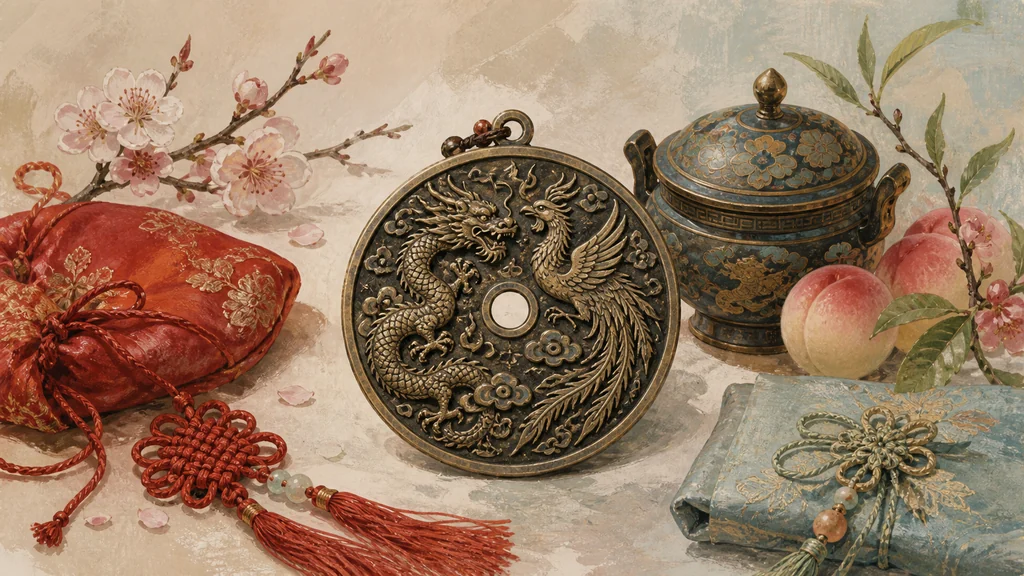
The British Museum holds a Qing-dynasty bronze charm shaped like a coin. One side imitates the inscription of a circulating coin; the other shows a dragon and a phoenix. In its catalogue entry, the museum interprets the pair as male and female joined in harmony and suggests that the charm was probably connected with a marriage.
This is the meaning many people now recognise first. In wedding art, the dragon and phoenix can celebrate a well-matched couple and wish them a harmonious life together. Yet the pairing is not a permanent label for husband and wife. Both creatures had long, separate histories in Chinese art, and their meaning together changes with the object and the occasion.
A wedding object that states its message
The Palace Museum in Beijing preserves a small object made from red satin and embroidered with fine gold thread. Its four prominent characters read 龍鳳呈祥, now usually written 龙凤呈祥 in simplified Chinese. Coloured clouds fill the spaces around the inscription.
The museum classifies it as a huoji, a broad Qing court term for small practical objects such as pouches, mirror cases and fan cases. Its catalogue entry places it within the customs surrounding an imperial wedding.
There is little ambiguity here. Red satin, a wedding setting and the written phrase all point in the same direction. The object adds an auspicious blessing to the emperor's marriage and expresses the hope of harmony after the ceremony.
The last two characters, 呈祥, literally concern the appearance of an auspicious sign. A word-for-word English rendering such as “the dragon and phoenix present auspiciousness” sounds stiff and explains little. In this wedding context, a more natural paraphrase is: **the dragon and phoenix bless a harmonious marriage**.
The pair also appears in popular prints
The National Museum of China holds a colour woodblock New Year print titled Dragon and Phoenix Bringing Auspiciousness. Two children ride the creatures, one on the dragon and the other on the phoenix. The print lacks the gold thread and courtly setting of the Palace Museum object, but it uses the same pair within an openly festive image. The museum describes its message simply as auspicious.
These two objects do not prove a neat route by which the design travelled from the palace to ordinary homes. Their catalogue records do not supply that history. What they do show is that the dragon-and-phoenix pairing worked in more than one social setting: it belonged to Qing imperial wedding objects and also to the visual language of popular prints.
A second charm changes the occasion
Another British Museum charm provides a useful warning. It was made in 1713 and also bears a dragon and phoenix, but it is associated with the Kangxi Emperor's sixtieth birthday. This was a birthday commemoration, not a wedding.
The same two creatures therefore cannot be decoded by a single formula. On a marriage object, they may stand for a harmonious union. On an imperial birthday object, their presence can contribute to a broader language of favourable omens and royal order.
When you encounter a dragon and phoenix on an older textile, ceramic or charm, begin with the object rather than the motif alone. Ask when it was made, how it was used, whether it carries an inscription and what its museum record says. A wedding connection makes the idea of marital harmony persuasive. Without that evidence, it remains only one possibility.
Dragon-and-phoenix decoration remains familiar at Chinese-style weddings today, and that use has genuine historical roots. In a museum, however, the pair may be celebrating something else. What fixes its meaning is not merely the fact that the two creatures appear together, but the particular object on which they meet.
Pairing does not erase the two creatures' other roles
The dragon and phoenix do not function as permanent labels for “husband” and “wife” wherever they appear. On a documented wedding object, paired placement, inscriptions, colour, and use can support that reading. On an imperial birthday charm or court furnishing, the same creatures may instead emphasize auspicious rule, rank, or celebration.
This is why the object matters more than a modern symbol chart. Check whether the pair faces one another, surrounds a Double Happiness character, appears on bridal clothing, or belongs to a dated court event. Those details identify the occasion. The two animals provide a prestigious auspicious pair; the surrounding evidence tells us what kind of good fortune the maker intended.
Sources and further reading
- Palace Museum, “Red Satin Embroidered *Dragon and Phoenix Bringing Auspiciousness* Huoji.” https://www.dpm.org.cn/collection/embroider/232017.html
- National Museum of China, “Dragon and Phoenix Bringing Auspiciousness New Year Print.” https://www.chnmuseum.cn/zp/zpml/201812/t20181218_26930.shtml
- British Museum, coin-shaped charm with dragon and phoenix, museum no. 1999,0802.377. https://www.britishmuseum.org/collection/object/C_1999-0802-377
- British Museum, dragon-and-phoenix charm associated with the Kangxi Emperor's sixtieth birthday, museum no. 1868,1244.273.b. https://www.britishmuseum.org/collection/object/C_1868-1244-273-b
- Palace Museum, Ren Wanping, *Dragon and Phoenix Bringing Auspiciousness: Qing Imperial Weddings*. https://www.dpm.org.cn/journal_detail/259742.html