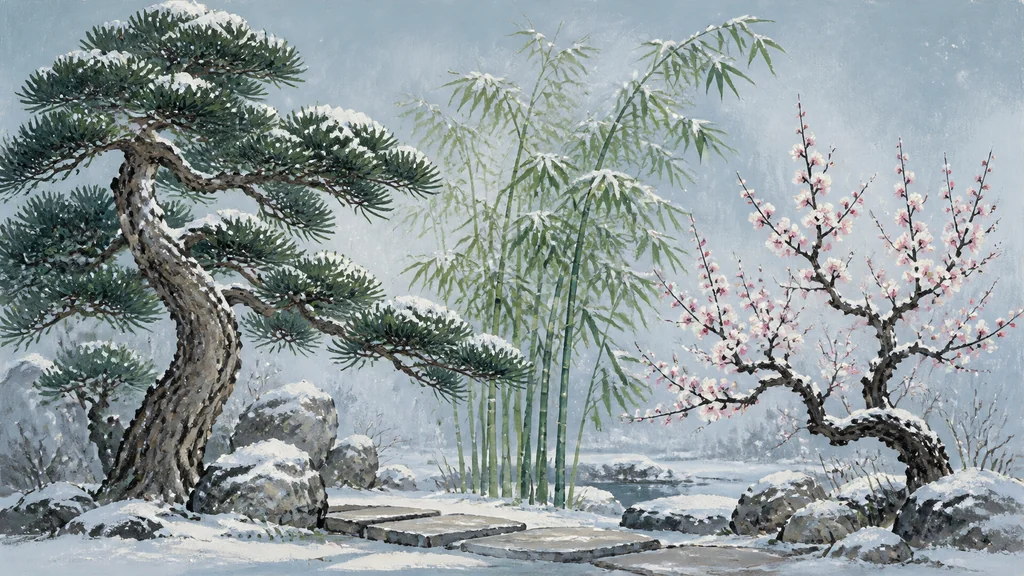
The Three Friends of Winter are pine, bamboo and plum. The Palace Museum explains their friendship through what remains alive in the cold: pine and bamboo keep their green foliage, while plum blossoms open during winter or at the first approach of spring. When much of the garden has withered, these three are still present.
“Friends” is not a botanical category. Chinese writers and artists grouped the plants because each meets the same harsh season with a different kind of resilience.
How pine, bamboo and plum meet the cold
Pine is evergreen and can live for many years. A thick, twisted trunk makes age visible, so the tree became associated with endurance, stability and long life.
Bamboo also remains green. Its stems bend under pressure but do not readily break. Their straight growth, hollow centre and regular joints encouraged further comparisons with modesty, integrity and the cultivated gentleman. A British Museum label for a Xuande-period bowl emphasises precisely this ability to bend without breaking in adversity.
Plum blossoms appear in cold weather, often before abundant leaves. Their arrival signals that the next seasonal cycle is near. Plum can therefore suggest purity and perseverance while also carrying the possibility of renewal.
These meanings overlap and shift with the object. A picture of the Three Friends is not a chart that requires every viewer to recite one fixed virtue for each plant.
A round dish and a porcelain bowl rearrange the plants
A sixteenth- to early-seventeenth-century carved lacquer dish in the Metropolitan Museum of Art packs pine needles, bamboo leaves and plum blossoms into its circular centre. The Met interprets the group as an image of a lofty person persevering in the harshest surroundings.
On a Xuande blue-and-white bowl in the British Museum, the plants move around a curved vessel wall. The museum describes pine as stable and long-lived, bamboo as a model for the Confucian gentleman, and plum as pure and first to flower at the New Year.
A Jiajing-period dish in the National Museum of China places pine, bamboo and plum under the moon. The museum also calls that composition “clear breeze and bright moon,” a phrase that adds the atmosphere of clear, upright character.
All three objects contain the same botanical group, but they do not share a fixed layout. To identify the Three Friends, confirm that the three plants are present and check the object’s title. There is no required order.
The theme can shape an entire room
The Qianlong Garden in the Forbidden City contains the Three Friends Bower, built in 1774. Its doors, windows, furnishings and interior decoration follow the pine-bamboo-plum theme. In a retirement garden, the motif became an environment that a person could enter rather than a picture viewed from outside.
The Metropolitan Museum describes the bower’s three plants as emblems of renewal, longevity, moral purity and survival in adversity. Their presence also suited an emperor imagining his future retirement and cultivated leisure.
A Qing jade armrest in the National Museum of China brings the group into the scholar’s studio. The object imitates bamboo in its form and carries carved pine and plum decoration. Used beneath the arm during writing, it joined practical comfort with the owner’s aspiration to gentlemanly character.
The Four Gentlemen are a different group
The Four Gentlemen are plum, orchid, bamboo and chrysanthemum. That set shares plum and bamboo with the Three Friends, but adds orchid and chrysanthemum and omits pine. The two names should not be exchanged.
Pine, bamboo and plum are also widely used together in Japan, including New Year decoration, gifts and rank labels. Those practices have historical connections with Chinese culture, but a modern Japanese use should not be treated as evidence for the meaning of a Chinese object.
When all three plants appear in a winter composition, “Three Friends of Winter” is usually a well-supported identification. If only one or two appear, a title, inscription or museum record must supply what the image does not. A single bamboo stalk or plum branch cannot be made into three friends by assumption.
The safest identification therefore begins with the complete trio. Pine, bamboo, and plum together support the conventional name; one or two of them require a title, inscription, or catalogue record before the missing plant is supplied by interpretation.
Sources and further reading
- Palace Museum, “Three Friends of Winter.” https://www.dpm.org.cn/lemmas/244613.html
- The Metropolitan Museum of Art, Dish with the Three Friends of Winter, 2015.500.1.38. https://www.metmuseum.org/art/collection/search/40223
- British Museum, Xuande bowl with the Three Friends of Winter, PDF,B.619. https://www.britishmuseum.org/collection/object/A_PDF-B-619
- National Museum of China, blue-and-white dish with pine, bamboo and plum. https://www.chnmuseum.cn/zp/zpml/201812/t20181218_23818.shtml
- Palace Museum, Three Friends Bower. https://www.dpm.org.cn/explore/building/236474.html
- National Museum of China, jade armrest with pine, bamboo and plum. https://www.chnmuseum.cn/zp/zpml/201812/t20181218_24662.shtml