A tenth-century Chinese textile fragment at The Metropolitan Museum of Art places small boys inside pomegranates. Birds and flowers fill the fruits above them; boys and flowers occupy those below. This is no ordinary botanical pattern. The museum cautiously suggests that the boys may refer to offspring.
The connection begins with what a ripe pomegranate reveals. Once its skin splits, dozens of seeds become visible at the same time. The Chinese words 籽 (zǐ, seed) and 子 (zǐ, son or child) are pronounced alike in modern Mandarin. A fruit containing many seeds could therefore be read as a family blessed with many descendants.
Why the fruit is often shown open
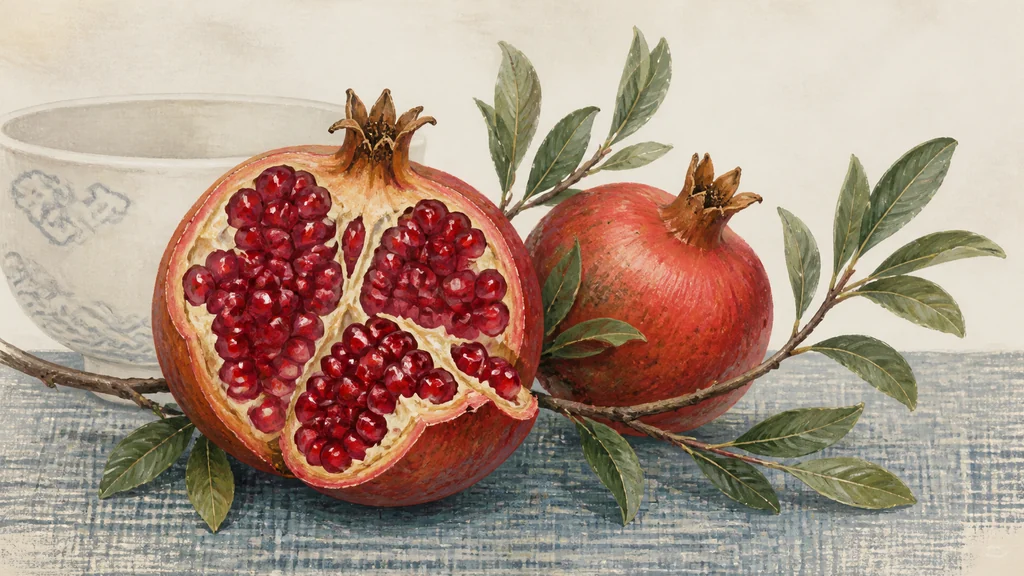
A closed pomegranate has a rounded silhouette and a crown-shaped calyx, but its abundance remains hidden. An open fruit gives an artist a much clearer image: tightly packed seeds can occupy the center of a painting, print, carving, or textile.
An eighteenth-century Chinese agate ornament in The Met’s collection turns a cluster of pomegranates into a hardstone display object. The museum connects the fruit’s many seeds with the wish for multiple sons who would continue the family line. A Suzhou color woodblock print made around 1735–50, now at the British Museum, makes the visual point even more plainly: its fruit plate is crowded with open pomegranates.
The symbolism is not produced by sound alone. Even a viewer who does not speak Chinese can see that one fruit contains a remarkable number of seeds. The wordplay gives that visible abundance a more specific direction.
English museum labels sometimes simplify the relationship by saying that “seed” and “son” use the same Chinese character. In modern written Chinese, however, 籽 and 子 are different characters with the same pronunciation. Historical inscriptions must be checked object by object rather than folded into one universal spelling rule.
Artists could also make the pun explicit in writing. Qi Baishi’s 1947 painting Pomegranates carries a seal-script inscription that The Met says can be read as either “many seeds” or “many sons.” It is a clear modern example of a deliberately reinforced double meaning, not proof that every earlier pomegranate image carried an inscription or followed exactly the same formula.
Boys inside the fruit
The tenth-century textile is especially useful because it does not leave the idea of descendants entirely to a verbal explanation. The boys are physically enclosed by the fruit. The Met dates the painted complex-gauze fragment to the late Tang or early Song period and describes the association with offspring as a possibility, not a certainty.
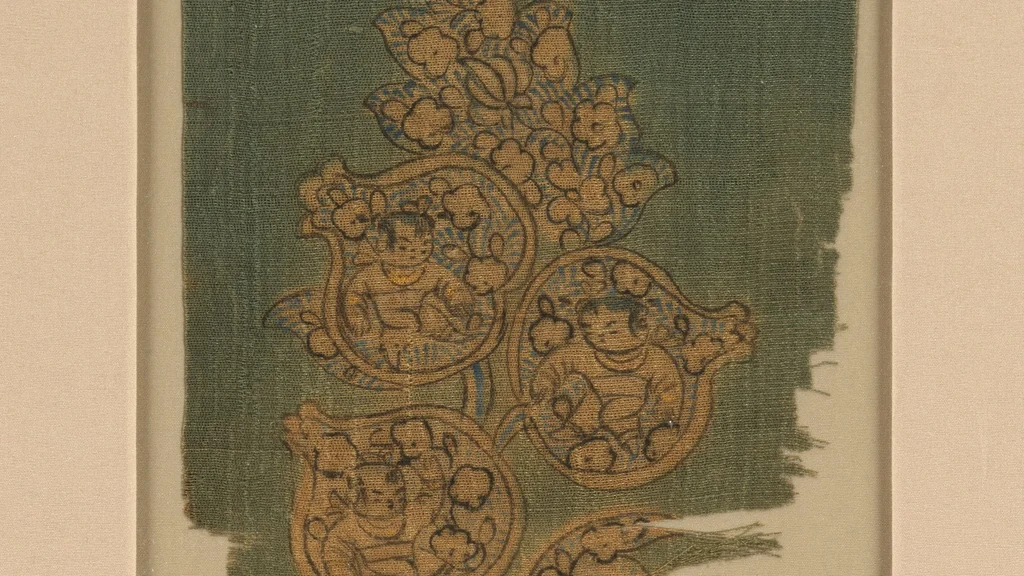
The object shows that a pomegranate-and-descendants image existed by the tenth century. It does not establish the first appearance of the motif, identify an inventor, or supply a single origin date.
Pomegranates then appear across very different media. The Palace Museum in Beijing holds a Northern Song Ding-ware bowl impressed with scrolling pomegranate decoration. Its curatorial description says that the fruit acquired an auspicious meaning because its many seeds answered wishes for many children and grandchildren, and that the motif became widespread in decorative art.
By the Qing dynasty, the open fruit appeared in Suzhou prints, while boys in textile scenes could carry large pomegranates bursting with seeds. Repetition across silk, porcelain, prints, clothing, and display objects helped make the meaning familiar. No single medium owned it.
That Ding bowl also supplies an important limit. Its museum record does not identify it as wedding ware. Pomegranates could certainly enter marriage and fertility contexts, but a bowl, vase, or textile bearing the fruit should not automatically be labeled a wedding gift. Object type, accompanying images, inscription, and documented use still matter.
Why museum labels often say “many sons”
Many collection records use the phrase many sons, not the broader many children. That wording preserves an important part of the motif’s historical setting.
In patrilineal family systems, sons commonly carried the family name, inherited property, and performed responsibilities connected with ancestral rites. The wish encoded in “many descendants” was therefore often gendered. A nineteenth-century Chinese woman’s semiformal robe at the Asian Art Museum in San Francisco depicts the Hundred Boys theme. One boy carries a large open pomegranate, which the museum identifies as a wish for many male descendants.
This preference belongs to particular historical family structures. It should not be presented as the belief of every family in the past, still less as the preference of all Chinese families today. In contemporary decoration, a pomegranate may be read more broadly as family flourishing, fruitfulness, or continuity between generations. When interpreting an older object, however, replacing “sons” silently with a fully gender-neutral meaning would erase part of its original social context.
How surrounding motifs change the reading
An open fruit with prominent seeds provides the strongest visual cue. Boys, babies at play, or a Hundred Boys scene make the connection with descendants more explicit.
Other fruit can narrow the meaning in another way. When a pomegranate appears with a peach and a Buddha’s-hand citron, the three form the Three Abundances motif. The citron represents abundant blessings, the peach long life, and the pomegranate many descendants. The pomegranate contributes only the last part; all three fruits do not mean fertility.
A pomegranate paired with grapes, gourds, or other seed-rich plants may reinforce ideas of fecundity and plenty. A flowering branch or a closed fruit in a botanical painting leaves more room for seasonal, naturalistic, or purely decorative readings. A pomegranate blossom on a ceramic bowl and a split fruit beside boys on a wedding textile do not necessarily describe the same occasion.
The motif placed hopes for family continuity on objects that could be worn, displayed, used, or given. It did not promise pregnancy, a particular number of children, or a child’s sex, and it is not a medical or feng-shui method. Its meaning rests on three things that worked together: the visible abundance of a split fruit, the shared pronunciation of 籽 and 子, and the value historical families placed on descendants.
Sources and further reading
- The Metropolitan Museum of Art: Textile fragment with boys and birds in pomegranates
- The Metropolitan Museum of Art: Qing-dynasty agate pomegranates
- The Metropolitan Museum of Art: Qi Baishi, Pomegranates
- British Museum: Fruit Plate, Suzhou woodblock print
- The Palace Museum: Ding-ware bowl with scrolling pomegranate decoration
- The Palace Museum: Three Abundances motif
- Asian Art Museum: Woman’s semiformal robe with scenes of boys at play