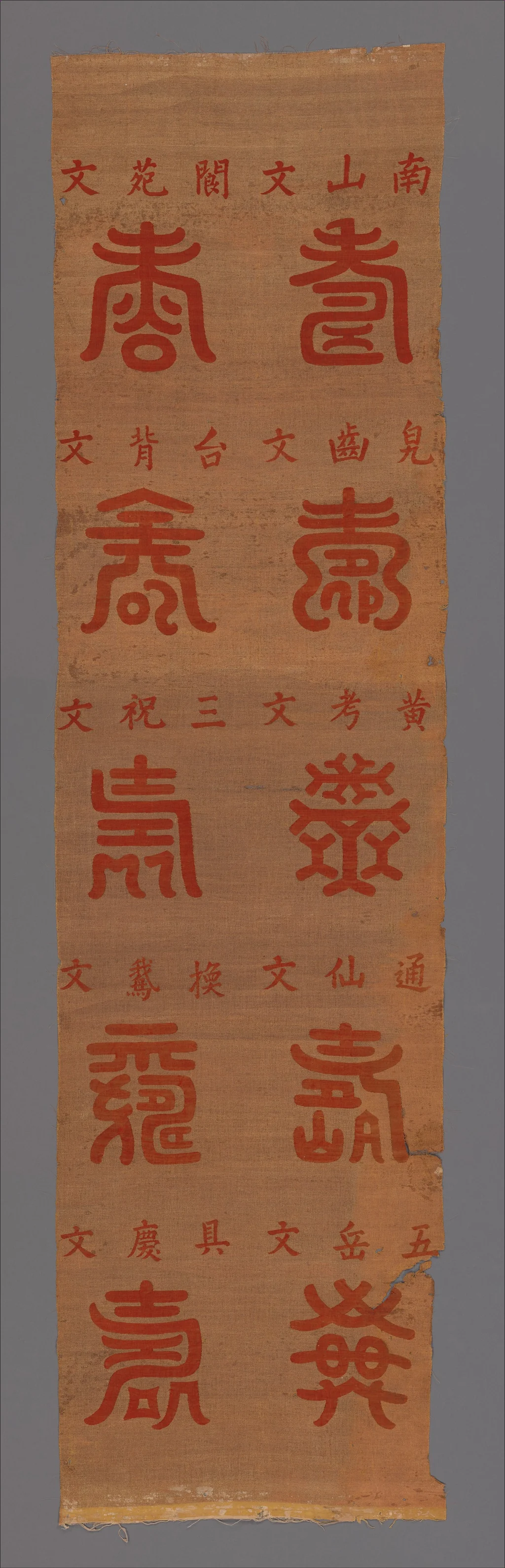
A nineteenth-century Chinese tapestry panel at the Metropolitan Museum of Art contains ten large characters woven in silk and metal thread. They look strikingly different, yet every one is a form of 壽, shòu, the character for longevity. Small inscriptions above them name their supposed calligraphic sources. The museum suggests that the panel may once have belonged to a set of ten hangings displaying one hundred forms.
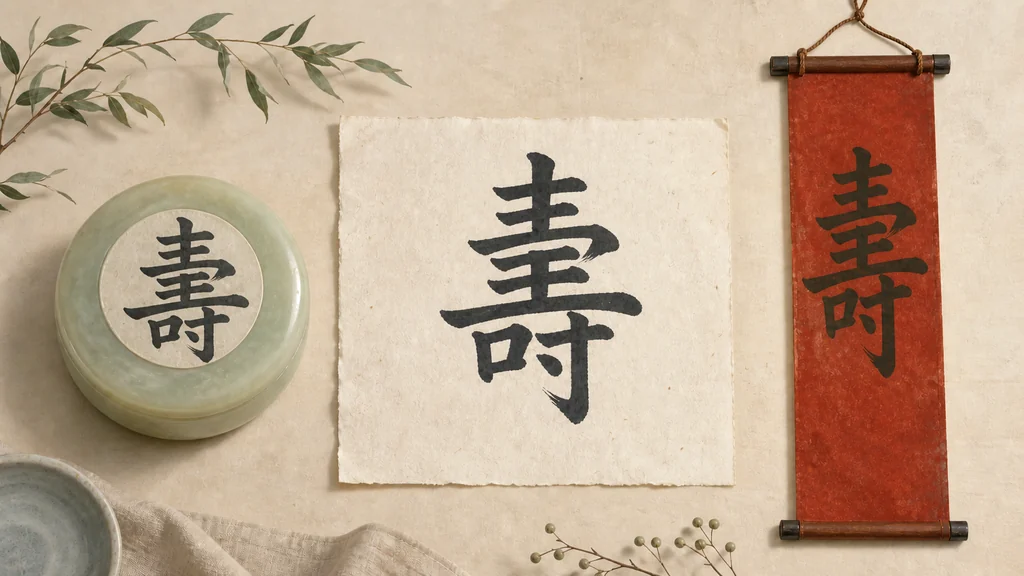
The variety comes from more than one kind of change. 壽 and 寿 are traditional and simplified forms of the standard written character. Calligraphers can reorganize its strokes in different scripts. Decorative artists can then compress, lengthen, repeat, or combine those forms to fit a box lid, dish, garment, hanging, or vase. The results share a wish for long life; they are not separate characters with separate powers.
壽, 寿, and decorative forms belong to different layers
The Mandarin reading is shòu. The word can refer to long life or age, and it also appears in language connected with birthdays and birthday congratulations. 壽 is the traditional form commonly seen on historical objects and in traditional-character writing. 寿 is its modern simplified form. Neither is a mistaken version of the other.
Historical decoration offers many more shapes than this traditional–simplified pair. Seal, clerical, regular, running, and cursive writing organize the strokes differently. Weavers, potters, jade carvers, and lacquer artists also turn writing into pattern. Some forms retain an obvious relationship to a calligraphic script; others become highly geometric. They still refer to shou, but they are not necessarily separate standard characters that can be typed from a modern keyboard.
Context matters when the form becomes extremely abstract. A museum title, an inscription, neighboring motifs, and recognizable parts of the character can support an identification. A circular key-fret pattern is not automatically a longevity character simply because it looks auspicious.
Round shou fills a medallion; elongated shou fills a vertical space
Palace Museum research describes an elongated single-character design as “long shou” and a circular one as “round shou” or “medallion shou.” These labels first describe shape. In a round form, the strokes are drawn inward to occupy a dish center, box lid, or textile roundel. An elongated form extends vertically through a narrow vessel or hanging.
The National Palace Museum in Taipei owns a jade round box dated broadly from the Ming to Qing dynasties. Its diameter is only 5.6 centimeters, and a round shou is carved on the lid. The circle of the lid supplies a firm boundary, so the character becomes a compact medallion. A Chengdu Museum explanation also distinguishes elongated, round, and more pictorially ornamented forms.
Object shape is one influence, not a complete formula. Period, script, craft technique, maker, and surrounding design can all alter the result. Museum records do not rank round and elongated forms by auspicious strength, nor do they assign them to fixed birthday ages.
A Hundred Shou design turns variation into the birthday wish
The Met panel arranges ten forms in a vertical sequence. If it belonged to the proposed set of ten panels, the complete display would have contained one hundred. The museum also points to a surviving stone carving in Guangxi dated 1229 as an early example of the Hundred Shou tradition. Repetition and visual difference become part of the birthday display while the underlying wish stays the same.
The format also moved beyond hanging calligraphy. The National Museum of China has a blue-and-white Hundred Shou jar from the Wanli period of the Ming dynasty. Scrollwork supports the shou characters across its outer wall. The museum associates the design with wishes for health and long life and traces this type of ceramic decoration to the Jiajing period.
“Hundred Shou” does not define a closed historical list of exactly one hundred authorized forms. Sets can be incomplete, and each object still has to be read from its surviving design. The small labels on the Met panel give purported sources for the forms; the museum’s wording stops short of treating every attribution as proven. The many characters gather one longevity wish rather than dividing health, wealth, marriage, and other benefits into one hundred fixed meanings.
For a highly stylized example, identification rests on more than a vague resemblance to an auspicious geometric pattern. The character’s structure, its position, its companions, and the object record work together.
Sources and further reading
- Ministry of Education, Taiwan: 壽
- Chinese University of Hong Kong: 壽 character database
- Palace Museum Journal: longevity-character decoration
- The Met: Panel with Longevity (Shou) Characters
- National Palace Museum: Jade round box with shou
- National Museum of China: Blue-and-white Hundred Shou jar
- Chengdu Museum: longevity-character forms
- The Met: Longevity in Chinese Art