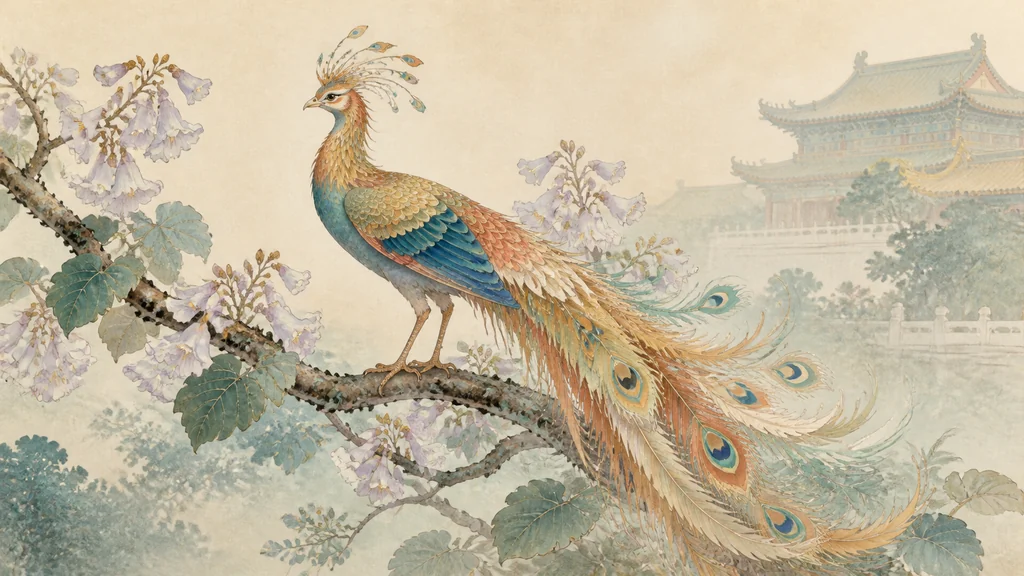
When English readers hear “phoenix,” they often picture a bird consumed by fire and reborn from its ashes. That story belongs to the phoenix of Western tradition. It is not a standard episode in Chinese accounts of the fenghuang (凤凰). English has long used the same name for both birds, but their histories and associations are different.
In Chinese art, the fenghuang is linked with peace, virtuous rule and auspicious times. It is also described as the ruler of all birds. The Metropolitan Museum of Art makes the distinction explicit in its record for an eighteenth-century tapestry showing five fenghuang. Although the creature is commonly translated as “phoenix,” the museum notes that it is a separate mythical species, traditionally said to appear during times of peace and prosperity. This made it especially suitable for imperial art.
Feng and huang did not keep one fixed gender formula
Early texts sometimes distinguished feng and huang as male and female birds. Later, feng could stand for the whole creature. As imperial ritual and decorative conventions developed, the dragon became increasingly associated with the emperor, while the fenghuang acquired stronger links with empresses, imperial women and femininity.
Those historical changes make a simple rule unreliable. A late imperial image cannot be decoded merely by repeating “feng is male and huang is female.” The period, object and surrounding motifs matter.
A dragon changes the immediate context
When dragon and fenghuang appear together on court objects, they can represent the imperial couple and the order of the palace. On wedding goods and later celebratory designs, the pair commonly suggests marital harmony. This pairing strengthens the bird’s feminine associations, but the fenghuang is not simply a female dragon. Shown alone, it can still signal auspicious rule, nobility, peace or prosperity.
The modern Chinese expression fenghuang niepan (凤凰涅槃), “the fenghuang reborn through nirvana,” gives the image of renewal after destruction. Translation and modern literature helped form this mixed usage. It should not be projected backwards onto every phoenix-shaped bird on an older ceramic, textile or building. Many such images have nothing to do with fire, ashes or rebirth.
In English, the clearest first reference is fenghuang (often translated as the Chinese phoenix). The article can then continue with fenghuang. Reserve phoenix for the Western bird when its death and rebirth from ashes are part of the subject. Keeping the names distinct lets readers know which story they are being told.
Begin with relationships inside the object
A lone bird, a group of five, a bird paired with a dragon, and a bird among flowering trees do not create identical contexts. Five fenghuang on a court textile can evoke peaceful rule and imperial order. A dragon-fenghuang pair more readily activates imperial-couple or wedding associations. A bird in a painting still requires its title, recipient and date. One modern dictionary label cannot replace those observations.
The motif also changes with medium. Weaving can elaborate plumage through colour and repeated threads; ceramic decoration must adapt the body and panels of a vessel; dress motifs are constrained by the status of the wearer. A shared name covers many poses and combinations without proving one unchanging visual code for every dynasty.
Ruler of birds and rebirth answer different questions
Chinese sources describe the fenghuang as ruler of the birds and associate its appearance with virtuous government, peace and auspicious order. This concerns the creature’s position in a well-governed world. The Western phoenix’s death in flame and return from ashes centres on the life cycle of an individual marvellous bird. Both can inspire modern language about hope, but that overlap does not give them a common narrative origin.
The phrase fenghuang niepan needs particular care. Nirvana is a Buddhist term, while fiery rebirth derives from Western phoenix traditions. Their combination has a real history in modern Chinese expression, yet it should not become the default key for reading an ancient or late-imperial fenghuang motif.
Translation can preserve the distinction
On first mention, retain the transliteration fenghuang and offer “Chinese phoenix” as an orientation for readers. Subsequent references can use fenghuang consistently. If an object record supplies no flames, ashes or rebirth narrative, the English word phoenix is not permission to add them.
A responsible caption should identify date, medium, accompanying motifs and the institution or text supporting the interpretation. Readers can then understand why the conventional translation persists while recognising that the Chinese bird has its own textual, ritual and artistic history.
Sources and further reading
- The Metropolitan Museum of Art, “Panel with five phoenixes in a garden.” https://www.metmuseum.org/art/collection/search/50498
- Palace Museum, “On the fenghuang and phoenix designs on ceramics.” https://www.dpm.org.cn/Uploads/pdf/1520/T00029_00.pdf
- Key Concepts in Chinese Thought and Culture, “Fenghuang.” https://www.chinesethought.cn/EN/shuyu_show.aspx?shuyu_id=4525
- Lyujie Zhu, “Fenghuang and Phoenix: Translation of Culture.” https://www.ijlll.org/vol6/263-IL006.pdf
- *The Phoenix*, “Royal Bird of China.” https://doi.org/10.7208/chicago/9780226195520.003.0003