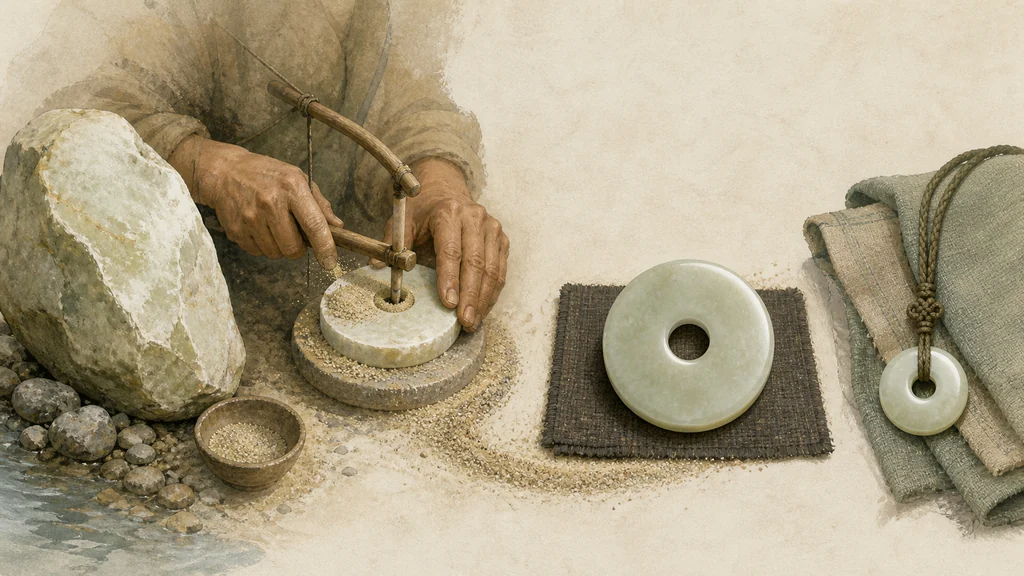
A Neolithic jade disk may look minimal: a smooth circle with a hole through its centre. Making one was anything but simple. Jade could not be split and shaped like an ordinary soft stone. Craftspeople had to saw, drill, grind and polish it with abrasive materials such as quartz and sand.
The Metropolitan Museum of Art's guide to ritual jade disks explains that this labour-intensive material was placed in elite burials, sometimes in substantial numbers. The importance of jade therefore begins with an observable choice. Communities invested scarce time, skilled work and significant funerary placement in a material that resisted the maker at every stage.
A difficult material could preserve skilled work
Modern gemology distinguishes hardness from toughness. Hardness describes resistance to scratching; toughness describes resistance to breaking or chipping. Nephrite is made of densely interlocking mineral fibres and is exceptionally tough. It is laborious to shape, but a finished object can preserve thin edges, polished surfaces and a stable form.
The material both slowed production and protected its result. Smooth touch, muted lustre, resonant sound and visible polish made the work perceptible long after the maker had finished.
Jade entered ritual, burial and rank
The Met identifies Neolithic bi disks as ritual objects. In high-status burials, disks could be placed on the chest, above the head or around the body, together with jade ornaments and pottery. A Liangzhu-culture disk in the British Museum, 1937,0416.142, dates to about 2500 BCE. The museum notes that disks and square-sectioned cong tubes occur in large numbers in Liangzhu burials.
Placement and quantity reveal ritual and social importance, but they do not supply a complete statement of belief. The British Museum describes the precise purpose of that disk as unknown, while allowing that it may have had ceremonial and protective functions.
Later writers associated the circular bi with heaven and the square outer form of the cong with earth. A British Museum record for a cong explicitly cautions that there is no evidence proving this was the original Liangzhu meaning. Later interpretation is part of jade's long history, but it cannot be used as a transcript of Neolithic thought.
Jade's physical qualities became moral language
Once jade was embedded in ritual and elite life, its material properties also became a way to describe people. The Met's exhibition material stresses that Chinese jade traditions linked physical qualities to human values. Its ritual-disk guide connects jade's clear sound when struck with purity and moral rectitude.
Soft-looking lustre, a surface pleasant to touch, a structure resistant to fracture and a form revealed only through sustained polishing all lend themselves to ethical comparison. Jade could express an ideal of character cultivated through discipline.
This is what a careful account of “jade as virtue” can establish: people used a material to think and speak about moral formation. It does not mean that wearing jade automatically improves character, cures illness or changes fortune.
Wearing jade carried old associations into new settings
Jade did not remain confined to prehistoric burials. A seventeenth- or eighteenth-century archaistic bi in the British Museum shows how later makers and collectors revisited old forms. The museum notes that disks were used in pendant sets indicating rank and were known in texts as precious gifts exchanged among noble or official families.
Burial equipment, bodily ornament, elite gift and antiquarian collectible are not the same institution. What connects them is repeated reuse: later societies drew on jade's material prestige and ancient associations, adapting them to new forms of status, dress and collecting. This explains continuity without pretending that jade held one unchanged meaning for five thousand years.
Ancient jade was not simply green jadeite
The English word jade is a material umbrella. The Gemological Institute of America explains that modern gemologists apply it chiefly to nephrite and jadeite, and under specified conditions to green omphacite. These materials are not limited to green. Nephrite also occurs in white, grey, yellow, brown and black, as well as multiple greens.
China's early and long-running jade tradition centred primarily on nephrite. GIA's historical account places nephrite in Chinese jade culture for more than five thousand years and notes that jadeite arrived in China only about two hundred to two hundred and fifty years ago. Bright green jadeite later became extremely important, but it cannot stand in for a Liangzhu, Shang, Zhou or Han object.
Jade matters in Chinese culture because material, labour, ritual, rank, moral language and adornment accumulated around it. When looking at a specific object, ask first when it was made and what material it uses. Then ask whether it belonged to burial, ritual, dress, gift exchange or collecting. That sequence is more reliable than beginning with a generic promise of luck, health or wealth.
Sources and further reading
- The Metropolitan Museum of Art: Ritual Object (Bi)
- The Metropolitan Museum of Art: A Lasting Legacy—Chinese Jades
- British Museum: jade bi 1937,0416.142
- British Museum: jade cong OA+.112
- British Museum: jade bi 1945,1017.107
- Gemological Institute of America: Jade Description
- Gemological Institute of America: The Nephrite Jade Road