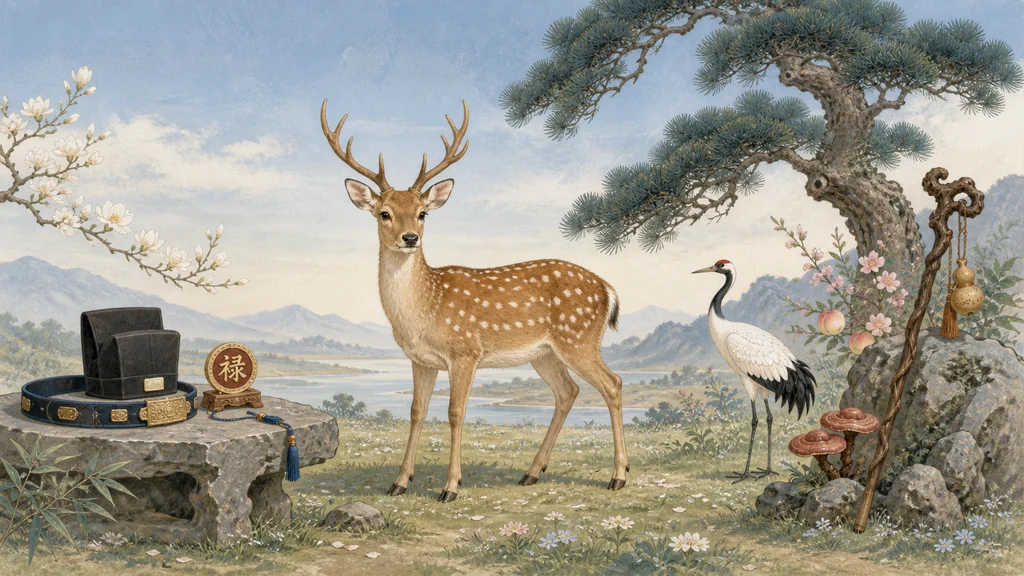
**A deer can signal the rewards of office through wordplay, or help build a realm of longevity beside Shoulao, Magu, cranes, pines, and magic fungus. The surrounding figures and the object's occasion decide which layer comes forward.**
In the Palace Museum painting Three Abundances, a robed official represents the Star of Emolument, and two spotted deer stand nearby. The museum explains that the deer contribute “abundant emolument” because <strong>鹿</strong> (lù, deer) sounds exactly like <strong>禄</strong> (lù, official salary or emolument). A Qing jade carving at The Metropolitan Museum of Art places a deer beside Shoulao, the God of Longevity. The animal is the same; its company changes the emphasis.
Deer and lu: more specific than “luck”
The historical meaning of lù began with an official salary and extended to income, status, and rewards attached to a career in office. Translating every deer simply as “luck” makes this relationship too vague. Beside an official, in a career wish, or on an object titled “One Hundred Deer,” official rewards or career emoluments are closer to the Chinese idea.
An eighteenth-century One Hundred Deer vase at The Met fills a fantastic pine forest with a large herd. Its curators read the deer–lù homophone as the many social and economic benefits a man could acquire during his career. Yet the towering pines and otherworldly landscape also suggest a supernatural realm. Career rewards and longevity do not have to cancel one another.
The deer becomes a companion of Shoulao and Magu
The Met's study of longevity art notes that Shoulao is sometimes accompanied by a deer and sometimes rides down from heaven on a crane. Neither animal is a compulsory identification tag. Shoulao's high domed forehead, long beard, peaches, staff, or longevity characters can also establish who he is. In these scenes, the deer belongs to the immortal world around him.
An early twentieth-century Dehua porcelain group puts a deer beside Magu, another immortal associated with birthday wishes. Magu holds a <em>lingzhi</em> fungus, while the deer carries a basket of auspicious flowers and fruit. The Met records that such figures were popular birthday gifts among privileged people. Here the deer does not primarily announce an office; immortal, fungus, fruit, and gift occasion build a longevity scene together.
Why deer and cranes share the same spring
The Palace Museum explains the phrase <strong>鹤鹿同春</strong> (hè lù tóng chūn, “crane and deer share the spring”) simply: cranes and deer were both associated with long life, so the pairing became a birthday wish. That evidence is enough. Every deer-and-crane image does not need to be forced into a separate pun on “the six directions.”
A Jiajing-period gourd-shaped bottle at The Met combines deer and cranes with plum, bamboo, and pine. The museum identifies the animals as longevity emblems, while the Three Friends of Winter add endurance, long life, and the return of spring. Several motifs create an auspicious environment; they do not spell one mandatory sentence word by word. The fuller history of the bird and tree belongs to pine-and-crane longevity art.
One deer can carry both longevity and official reward
The herd on the One Hundred Deer vase calls up many lù benefits while moving through a pine-filled immortal landscape. Beside Shoulao, the deer first helps establish longevity, but the deer–lù wordplay does not necessarily vanish. Chinese auspicious art often layers good wishes on one object rather than assigning each creature a single permanent definition.
Title, companions, plants, inscription, and use shift the balance. An official figure or explicit career wording brings emolument forward. Shoulao, Magu, lingzhi, peaches, pines, cranes, or a documented birthday gift bring longevity forward. Deer in Buddhist Deer Park scenes, hunts, landscapes, or natural studies can belong to entirely different narratives.
How to read an unfamiliar deer image
Start with the deer's companions. Shoulao, Magu, peaches, lingzhi, cranes, or pines pull the scene toward longevity. Court dress, officials, or a “hundred deer” composition can bring the lù pun and the rewards of office into view. A natural landscape without those cues may simply feature an admired animal.
Then check the object's date, title, and intended use. A retirement gift and a birthday gift can share longevity imagery while addressing different moments in a life. The deer is flexible enough to carry more than one favorable association; that flexibility is precisely why an isolated dictionary-style answer is weaker than the evidence of a complete composition.
Sources and further reading
- Palace Museum: Yu Zhiding, *Three Abundances after Zhao Qianli*
- Palace Museum: “Crane and Deer Share the Spring”
- The Metropolitan Museum of Art: *God of Longevity (Shoulao) and a Deer*
- The Metropolitan Museum of Art: Longevity in Chinese Art
- The Metropolitan Museum of Art: *The Immortal Magu with a Deer*
- The Metropolitan Museum of Art: *Vase with the “One Hundred Deer” Motif*
- The Metropolitan Museum of Art: *Gourd-Shaped Bottle with Deer and Crane in Landscape*