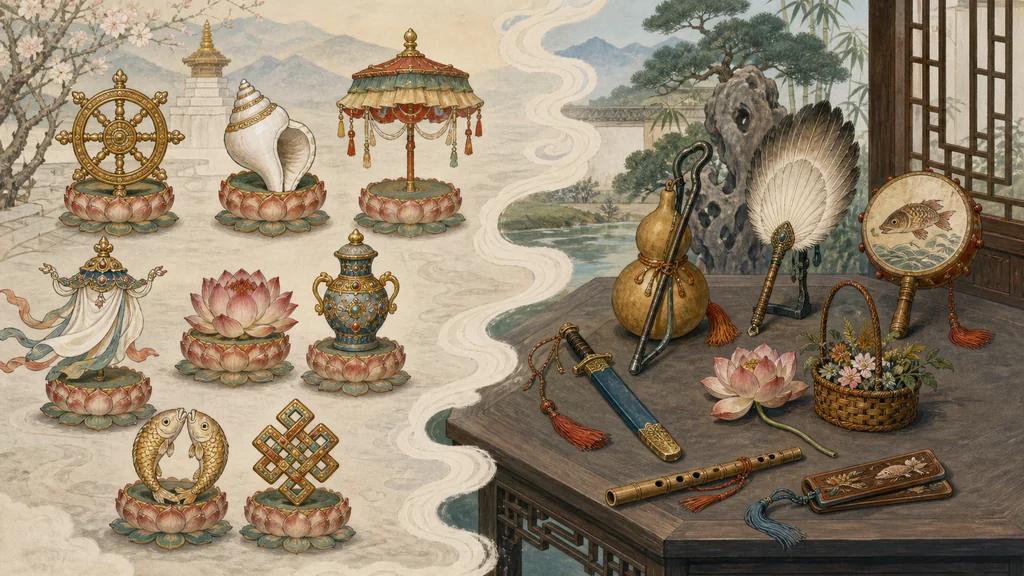
A Qing court saddlecloth studied by the National Museum of China carries two different groups of auspicious emblems. One is the Buddhist Eight Auspicious Symbols. The other is the Dark Eight Immortals, a set of objects that stands in for the eight Daoist immortals. Both groups contain eight items, and both are sometimes loosely called the “Eight Treasures.” That shared label is the source of much confusion.
The quickest way to tell them apart is to look at the whole set. Ritual emblems such as a wheel, conch and endless knot point towards the Buddhist group. Portable objects such as a gourd, fan, sword and flute are more likely to represent the immortals.
The Buddhist Eight Auspicious Symbols
The Palace Museum lists the Buddhist group as the Dharma wheel, conch shell, parasol, white canopy, lotus, treasure vase, paired fish and endless knot. Chinese catalogues may call the group babao, “Eight Treasures,” or bajixiang, “Eight Auspicious Symbols.”
Each emblem has its own religious associations. The Dharma wheel evokes the teaching and spread of Buddhist doctrine. The conch suggests the far-reaching sound of that teaching. The parasol and canopy offer protection. The lotus grows from mud without being stained by it. The treasure vase suggests abundance and the fullness of wisdom. Paired fish are associated with freedom and good fortune. The continuous line of the endless knot has no visible beginning or end.
A Qianlong-period famille rose set in the Palace Museum turns the eight motifs into separate offerings, each raised on a lotus pedestal. The museum notes that such objects were normally placed before a Buddhist image. On porcelain, textiles and painted architecture, the same forms can become small decorative motifs arranged around a border or central medallion.
English names vary between catalogues. The white canopy may be translated as a canopy or victory banner, while the interlaced motif may be called an endless knot or glorious knot. The object record and the visible shape are more reliable than forcing every catalogue into one vocabulary.
The Dark Eight Immortals leave the people out
The Eight Immortals are Tieguai Li, Zhongli Quan, Zhang Guolao, Lü Dongbin, He Xiangu, Lan Caihe, Han Xiangzi and Cao Guojiu. In figure paintings, clothing, posture and attributes help identify them. In a Dark Eight Immortals design, the figures disappear and their familiar possessions take their place. “Dark” here means concealed, not sinister.
Common pairings include Tieguai Li’s gourd and iron crutch, Zhongli Quan’s fan, Zhang Guolao’s fish drum, Lü Dongbin’s sword, He Xiangu’s lotus, Lan Caihe’s flower basket, Han Xiangzi’s flute, and Cao Guojiu’s castanets or court tablet.
These pairings are conventions rather than an unchanging code. Regional workshops and different periods could vary them. The Metropolitan Museum of Art, for example, identifies immortals on a tray through objects including a flute, staff, sword, flower and gourd. Its catalogue does not treat one modern attribute chart as the only valid version.
Read the objects as a group
A wheel, conch, paired fish, lotus, treasure vase and continuous knot appearing together usually belong to the Buddhist Eight Auspicious Symbols. Lotus pedestals, ribbons and a ritual setting strengthen that identification.
A cluster of a gourd, fan, sword, fish drum, flute and flower basket looks more like the Dark Eight Immortals. These are things a legendary person might carry, play or use. They work as traces of absent figures.
One lotus or vase cannot settle the question. Both appear in many other religious and decorative contexts. The number of emblems, their companions, the object’s date and its original setting matter more than any isolated shape.
Historical objects do not always obey modern lists
A Ming lacquer tray in the British Museum combines dragons, phoenixes and numerous auspicious signs. The museum’s research notes that Buddhist treasures and Daoist symbols associated with the Eight Immortals appear mixed together, and that their number does not fit a tidy modern list.
This is not necessarily a mistake. Craftspeople and patrons could combine motifs from several traditions when decorating an object. Classification helps a modern viewer begin reading the design; it does not prove that every historical workshop followed a fixed chart.
When a museum record identifies a mixed Buddhist and Daoist programme, preserving that mixture is more accurate than forcing every emblem into one of two complete sets. Start with the whole group, then check the object’s date, use and catalogue history.