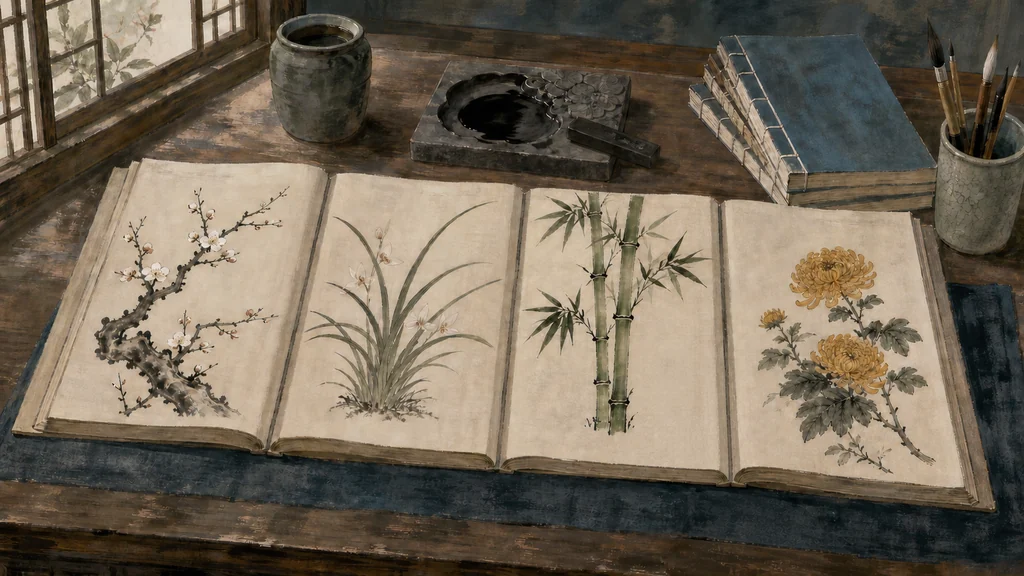
Imagine opening a painting manual in the Wanli era of the Ming dynasty. Plum branches occupy one book, orchids another, bamboo a third, and chrysanthemums a fourth. The plants do not belong to one botanical family, and they do not have to appear in a single composition. What joins them is the title attached to the set: the Four Gentlemen, or 四君子 (sì jūnzǐ).
The Palace Museum identifies a particularly useful point in this history. During the Wanli reign, the publisher Huang Fengchi compiled the Four Manuals of Plum, Bamboo, Orchid, and Chrysanthemum and called the plants the Four Gentlemen. This does not mean that their cultural associations began at that moment. It shows when four already established subjects were explicitly edited into one named group.
“Gentlemen” describes an ethical ideal, not a plant category
The Chinese word junzi has more weight than a modern English “gentleman” who merely has good manners. In classical thought, it names a cultivated person who disciplines the self and acts by principle. Plants cannot possess ethics, of course. Painters and poets made the comparison by attending to the way each plant looked, grew, and survived.
Plum blossoms emerge while cold weather still holds. New flowers on an old, angular trunk can suggest endurance, but also the return of spring. Orchids offer a less conspicuous image: their fragrance became a way to speak about worth that does not depend on public recognition. Bamboo has a hollow stem and articulated joints; it bends in wind without easily breaking. Chrysanthemums flower late in the year and carry the long literary memory of Tao Yuanming, the poet associated with withdrawal from public life.
These are recurring associations, not four permanent dictionary definitions. A plum can also mean renewal. A chrysanthemum can enter a longevity wish. Bamboo may simply be a material from which an object is made. Meaning becomes persuasive when the plant, the inscription, the artist, and the object's use point in the same direction.
The individual subjects are older than the group
Long before the Four Gentlemen became a standard set, a single flowering branch or a stand of bamboo could sustain an entire painting. Scholar-artists valued subjects that allowed brushwork to reveal the hand. Changes of speed, pressure, and ink tone were visible in a leaf or stem, while an accompanying poem could connect the plant to a friendship, a frustrated career, or a claim about the artist's own conduct.
The Metropolitan Museum of Art has noted that bamboo, orchid, chrysanthemum, and plum acquired special importance as expressions of scholarly values. That history helps establish the sequence: the plants first became meaningful subjects in their own right; the stable four-part label came later.
It also warns against reading backward. The Met's Southern Song album leaf Orchids by Ma Lin predates Huang Fengchi's manuals by centuries. Its delicate colors and controlled naturalism belong to the aesthetic world of the Southern Song court. Calling it an orchid painting is certain. Reducing it to a generic declaration of reclusion simply because orchids later belonged to the Four Gentlemen would erase the work's actual setting.
Painting manuals helped stabilize the list
Huang Fengchi's four manuals supplied a common name, but the story did not stop with one late-Ming publication. The Palace Museum's research notes that the second collection of the early-Qing Mustard Seed Garden Manual of Painting included manuals for orchid, bamboo, plum, and chrysanthemum. Its wide circulation helped give the Four Gentlemen a more settled place in painting culture.
A manual is not just a list of admired pictures. It is something a learner can use. One page demonstrates how a bamboo stem meets a joint; another shows the turn of an orchid leaf or the spacing of plum blossoms. As editions were printed and copied, they carried both the brush methods and the four-part syllabus onto new desks. Publication and repeated practice did as much to stabilize the group as praise of the plants' virtues.
The four do not have to share one sheet of paper
The Four Gentlemen may appear in one painting, but they are often divided among four hanging scrolls, album leaves, or sections of a manual. When identifying a historical set, count the plants first, then check the museum title, inscriptions, and original mounting. A lone orchid leaf should not be made into an incomplete Four Gentlemen set simply because the larger category is familiar.
Modern introductions often assign the plants to four seasons and give each one a single virtue. That is a useful memory aid, but not a universal key to historical art. Seasonal order and virtue labels vary, and individual works can redirect the symbolism. The Met's exhibition Noble Virtues makes the broader point: images of nature in Chinese art draw meaning from poetry, history, and cultural memory, but can also be decorative, celebratory, or politically charged.
The Four Gentlemen are not the Three Friends of Winter
The two plant groups overlap, which makes them easy to confuse. The Four Gentlemen are plum, orchid, bamboo, and chrysanthemum. The Three Friends of Winter are pine, bamboo, and plum. Both contain plum and bamboo, but they have different members and different histories. The Three Friends foreground life visible through winter; the Four Gentlemen were especially reinforced by painting practice and manuals.
For a closer look at one member, why bamboo became a model of the cultivated person explains the hollow stem, joints, brushwork, and artist inscriptions without turning those features into a universal code.
The most accurate answer, then, is not simply that four “good plants” stood for four good qualities. Poetry and painting first made each plant capable of speaking about human character. A late-Ming publisher explicitly gathered and named them. Qing manuals, copying, and grouped artworks then made the Four Gentlemen a durable part of how East Asian artists learned and looked.