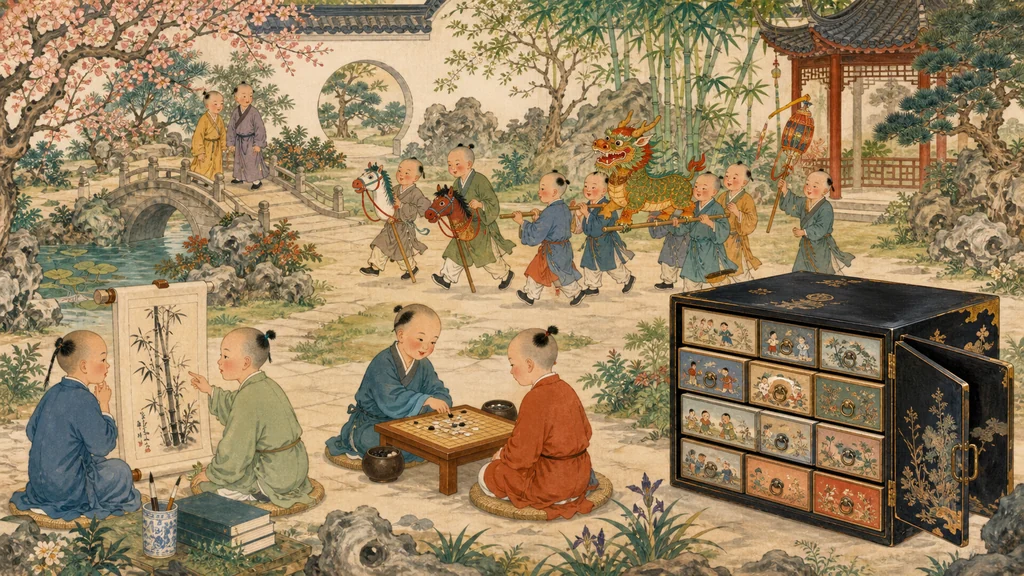
**Some works really do contain one hundred boys. In others, “Hundred Boys” is the established name of a crowded auspicious subject rather than a museum-issued head count. Either way, the multitude expresses hopes for descendants, family continuity, and successful futures.**
Treat a Hundred Boys picture as a counting game and sometimes the numbers work perfectly. A lacquered box from the early Qing dynasty in the Palace Museum distributes one hundred children across its outer faces and five drawers. A Qianlong-period carved-lacquer box also contains one hundred boys and bears the title “Precious Box of One Hundred Boys” inside. On both objects, the craftspeople made the number part of the design.
Move to paper, and counting is no longer the whole point. An eighteenth-century Suzhou print at The Metropolitan Museum of Art fills a garden with boys. The museum connects the subject with abundance, fecundity, and the prosperous continuation of the family line. Here “one hundred” also conveys multitude and flourishing. It does not require a real family to have one hundred sons, and the image promises no reproductive outcome.
The boys rehearse the futures adults wanted for them
The Suzhou print does not give every child the same generic pose. Boys ride hobby horses in procession; others carry a qilin parade representing three brothers who have won the highest three places in the civil examinations. A group studies a bamboo painting, while players sit at a game of weiqi. By imitating scholar-official life, the children connect numerous descendants with education, examination success, and cultivated adulthood.
A nineteenth-century semiformal robe in the Asian Art Museum packs other wishes into the games. Boys perform dragon and lion dances, play around a lotus pond, carry an open pomegranate, and gather osmanthus branches. The pomegranate belongs to a separate visual tradition linking many seeds with many descendants. Gathering osmanthus points toward examination honors.
The museum also relates the robe to the story that King Wen of Zhou had one hundred sons. That story supplied one traditional association for the theme. The available evidence does not make every Hundred Boys object an illustration of a single King Wen narrative.
Why the historical pictures usually show boys
Historical examples usually show boys rather than a gender-neutral group of children. In a patrilineal family system, sons were expected to continue the family name and carry family responsibilities. Translating the motif only as “many children” can hide its historical preference for male descendants. Explaining that preference describes the world of the object; it does not make the old ideal a standard for families today.
Double Happiness brought the boys into an imperial wedding room
In 1872, during preparations for the Tongzhi emperor's wedding, the Qing court commissioned works with titles including “Double Happiness and One Hundred Boys.” Palace Museum archival research identifies a set for the bridal chamber in the Palace of Earthly Tranquility in which boys follow the outline of a Double Happiness character. Double Happiness identifies the wedding setting, while the boys express a wish for the continuation of the imperial family. This was a documented court arrangement, not a rule followed at every Chinese wedding.
The subject also appears on porcelain, clothing, lacquerware, and prints. A Qing famille rose vase in the Palace Museum shows boys performing dragon and phoenix dances, playing music, and setting off firecrackers. Its catalogue calls the decoration a “Hundred Boys at Play” scene without publishing an individual count. The dense crowd, festival activities, object, and catalogue title establish the subject together.
The broader category of <strong>婴戏图</strong> (yīngxì tú, pictures of children at play) can include only a few children kicking a ball, flying kites, or playing games. Such scenes may record daily life or seasonal amusement. Hundred Boys emphasizes a multitude and an auspicious family wish. Some artists counted to one hundred; others used a conventional subject name. The presence of children alone does not make every scene Hundred Boys, while a visitor's failure to count one hundred does not overturn a well-supported museum identification.
“Hundred” can name abundance as well as an exact count
Some catalogued works carefully contain one hundred children, while others use the established subject name for a crowded scene without inviting a modern viewer to verify every figure. Counting is useful when the museum record makes the number part of the object's design; it is not the only test. Group activities, wedding or family context, inscriptions, pomegranates, cassia, and other wishes for descendants or achievement help identify the subject.
Sources and further reading
- Palace Museum: Black lacquer box with mother-of-pearl and gold children-at-play design
- Palace Museum: Carved red lacquer “One Hundred Boys” precious box
- Palace Museum: Famille rose vase with children at play
- The Metropolitan Museum of Art: *One Hundred Boys*, 2025.797.1
- Asian Art Museum: Woman’s semiformal robe with scenes of boys at play
- Palace Museum research on the Tongzhi wedding *Hundred Boys* pictures