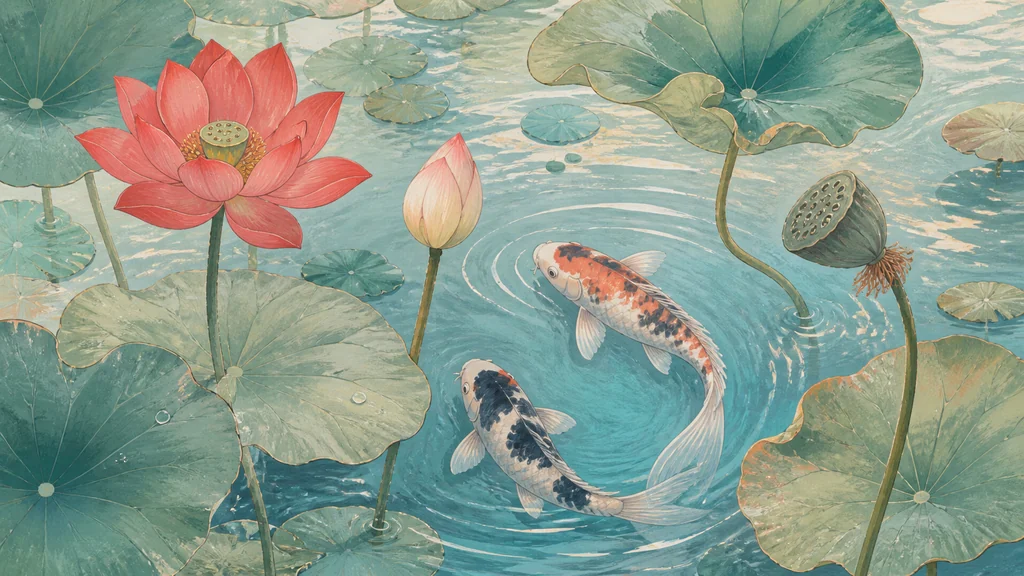
The Metropolitan Museum of Art holds a Qing-dynasty hanging scroll filled with red lotus flowers and fish moving through water plants. The museum describes it as more than a pond scene. Its subjects create a New Year wish: lotus suggests continuity, while fish supplies the idea of surplus. Together they produce the familiar phrase 年年有餘—“may there be abundance year after year.”
Here, abundance does not mean limitless wealth. The final character 餘 means that something remains after everyday needs have been met. At New Year, the phrase hopes that food, money and other necessities will be sufficient, with a little left over, in one year after another.
The lotus extends the wish through time
In modern Mandarin, fish 魚 and surplus 餘 are both pronounced yú. Lotus 蓮 is pronounced lián, while year 年 is nián. Those two words are close but not identical. Traditional explanations usually connect lotus with 連, “to continue,” and that sense of continuity leads into 連年, “year after year.”
A fish can therefore carry the idea of surplus on its own. Adding lotus makes the wish continuous. In the Met painting, the two subjects belong naturally to one watery setting, so the visual scene and the wordplay reinforce one another without requiring a written slogan.
English descriptions vary: “abundance year after year,” “continuous abundance,” and “may every year bring a surplus” all convey the sense better than a rigid word-for-word translation. The phrase concerns durable sufficiency, not simply the presence of fish.
The design moves between painting, porcelain and jade
A Xuande-period dish in the Palace Museum uses white decoration over a deep blue glaze. Two fish swim among lotus and water plants in the centre, while fish and lotus alternate around the outer wall. The museum includes “abundance year after year” among the established readings of fish decoration.
The circular dish cannot arrange its subjects like a tall hanging scroll. Its design turns around the centre and repeats along the vessel. This difference matters: an auspicious phrase does not require one fixed composition.
An early Ming jade fish in the National Museum of China is more compact still. The fish holds lotus root and reeds in its mouth, joining the subjects within a single carving. The museum explicitly explains the jade through fish/surplus and lotus/continuity and associates it with prosperity and sufficient food and clothing.
The painting, porcelain dish and jade ornament look very different. What connects them is not a copied layout, but the deliberate combination of subjects and the interpretation preserved in their museum records.
A lotus pond can carry another meaning
One Yuan-dynasty dish in the British Museum centres on a mandarin fish. Its catalogue explains that fish can serve as a rebus for abundance. In that case, the fish alone supplies the essential wordplay.
Another British Museum dish shows two kinds of fish among aquatic plants. Its catalogue records a different interpretation proposed by Chinese scholars: the particular species and plants may refer to the moral ideal “unsullied and incorruptible.” The same broad pond setting has not produced the same phrase.
This does not invalidate the reading “abundance year after year.” It shows why subject matter needs to be identified carefully. Fish species, plants, inscriptions, numbers, use and catalogue research can all affect an interpretation. Some works may primarily be observations of aquatic life rather than coded blessings.
When examining a lotus-and-fish design, first ask whether the two subjects have been deliberately paired. Then check how the object is titled and discussed by its museum. If the record explicitly gives the phrase, lotus and fish work together to complete it. If the evidence mentions only fish, stopping at the general idea of surplus is often the more accurate reading.
The phrase has more than one visual spelling
Artists do not need to arrange one lotus and one fish like letters in a fixed rebus. A fish may hold a lotus stem in its mouth, swim beneath several blossoms, or appear with lotus roots and water plants around the rim of a dish. Repetition can make the wish more abundant, but the number of fish is not a grammatical rule.
For identification, separate three questions. Is the image a plausible pond scene? Do lotus and fish appear as an intentional pair? Does the catalogue, inscription, or use of the object connect that pair to liánnián yǒuyú? The first two make the rebus possible; the third turns a plausible reading into a documented one.
Sources and further reading
- The Metropolitan Museum of Art, Tang Guang, *Red Lotus and Fish*, 2017.327.3. https://www.metmuseum.org/art/collection/search/754013
- Palace Museum, Blue-glazed dish with white fish-and-lotus decoration, 故00145581. https://www.dpm.org.cn/collection/ceramic/226842.html
- National Museum of China, Jade lotus and fish. https://www.chnmuseum.cn/zp/zpml/201812/t20181218_24627.shtml
- British Museum, blue-and-white dish with mandarin fish, 1968,0422.26. https://www.britishmuseum.org/collection/object/A_1968-0422-26
- British Museum, dish with fish and aquatic plants, 1954,0420.6. https://www.britishmuseum.org/collection/object/A_1954-0420-6