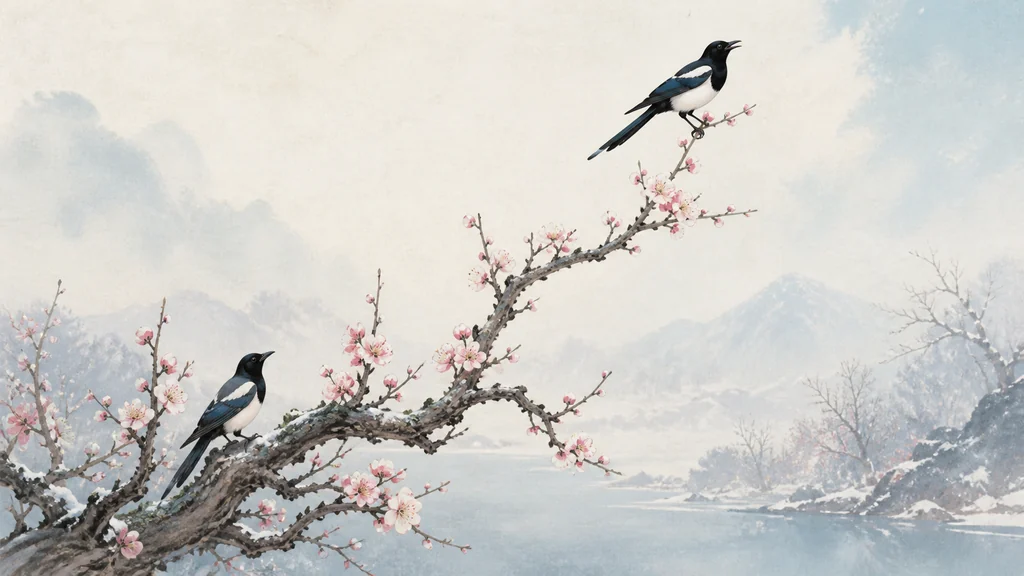
The Palace Museum preserves a late Qing design made for ceramic bowls. Several plum branches spread across a yellow ground while three magpies fly among the blossoms. The museum identifies the combination with the phrase 喜上眉梢, an idiom for happiness that is plainly visible in a person’s expression.
The design is more precise than “magpie plus plum blossom.” Where the bird appears in relation to the branch helps complete the phrase.
How four words become a picture
The Chinese word for magpie is 喜鵲, or 喜鹊 in simplified characters. Its first character, 喜, already means joy. Plum is 梅, pronounced méi, exactly like 眉, eyebrow, in modern Mandarin.
When the magpie perches on the upward tip of a plum branch, position supplies the rest. 上 means “on” or “to rise onto,” while 梢 is the end or tip of a branch. The visible scene is a magpie on the tip of a plum branch; the phrase heard through it is joy rising to the eyebrows.
This is not a case in which every word is a homophone. Joy comes directly from the bird’s name. Plum/eyebrow provides the sound substitution. “On” and “tip” emerge largely from the placement of the bird. Move it casually beneath the tree and the full phrase becomes much less legible.
In ordinary English, 喜上眉梢 is best explained as “happiness written all over one’s face” or “a face visibly lighting up with joy.” “Joy up to the eyebrows” preserves the visual joke, but needs that short explanation.
Lacquer, porcelain and print reshape the scene
An early seventeenth-century carved red-lacquer box in the Metropolitan Museum of Art shows a pair of magpies with plum blossoms. Its circular lid makes the branches follow a different path from those on the Palace Museum bowl design, and the number of birds changes. The Met confirms the auspicious character of the magpie but does not title this particular box with the four-word idiom.
A Chinese woodblock print in the British Museum also combines magpies and plum. Its catalogue explicitly notes that the subjects can mean “happiness up to your eyebrows.” These objects show that the motif does not require exactly one bird or one blossom. What matters for the full phrase is the recognisable relationship between magpie, plum and branch tip.
The magpie itself carried favourable associations before these later decorative formulas became widespread. The Palace Museum cites an account from the Tang period in which hearing a magpie was treated as a sign of coming happiness. Such traditions help explain why the bird’s ordinary name already sounded auspicious.
An older magpie-and-plum image may be a nature study
The Palace Museum’s Southern Song tapestry Magpie amid Plum Blossoms also brings the two subjects together. Its museum discussion emphasises closely observed birds and flowers, tapestry technique and the cultivated pleasure of finding feeling in nature. It does not label the work 喜上眉梢.
Without a title, use or catalogue interpretation that supports the later phrase, it would be risky to project a common Qing decorative name backwards onto every earlier flower-and-bird work.
Changing the surrounding objects can also change the blessing. A Yongzheng-period blue-and-white jar in the National Museum of China shows magpies with plum, bamboo, peony and garden rock. The museum connects rock 石, which sounds like time 時 in the relevant wordplay, with the joy of the magpie to suggest “good news at all times.” The bird has not changed; the larger composition has.
When looking at a magpie-and-plum design, identify the bird, the tree and the bird’s position before assigning the idiom. Then check the object’s title and museum record. Two species placed together establish a motif. Position and evidence determine whether the complete four-word phrase is really there.
Position helps complete the rebus
The phrase is easier to justify when the bird is perched high on a plum branch or moving toward its tip. Xǐ comes directly from the magpie's Chinese name, while plum supplies the homophone for eyebrow; the visible “up” and “tip” help the picture complete the four-character expression. A decorative label may still use the conventional name when the composition is loose, but an interpreter should describe what is actually visible.
This also distinguishes a rebus from a general bird-and-flower subject. Date, title, intended use, and catalogue evidence can show whether a work was made as an auspicious message or appreciated primarily as a study of winter blossoms and birds.
Sources and further reading
- Palace Museum, late Qing design for yellow-ground bowls with plum blossoms and magpies. https://www.dpm.org.cn/ancient/special/180908.html
- The Metropolitan Museum of Art, box with plum blossoms and birds, 2015.500.1.60a,b. https://www.metmuseum.org/art/collection/search/40265
- British Museum, Chinese print with magpies and plum, 1906,1128,0.9. https://www.britishmuseum.org/collection/object/A_1906-1128-0-9
- Palace Museum, Southern Song tapestry *Magpie amid Plum Blossoms*. https://www.dpm.org.cn/topic/zhongguo_keepgrowing.html
- National Museum of China, blue-and-white jar with birds and flowers. https://www.chnmuseum.cn/zp/zpml/201812/t20181218_23863.shtml