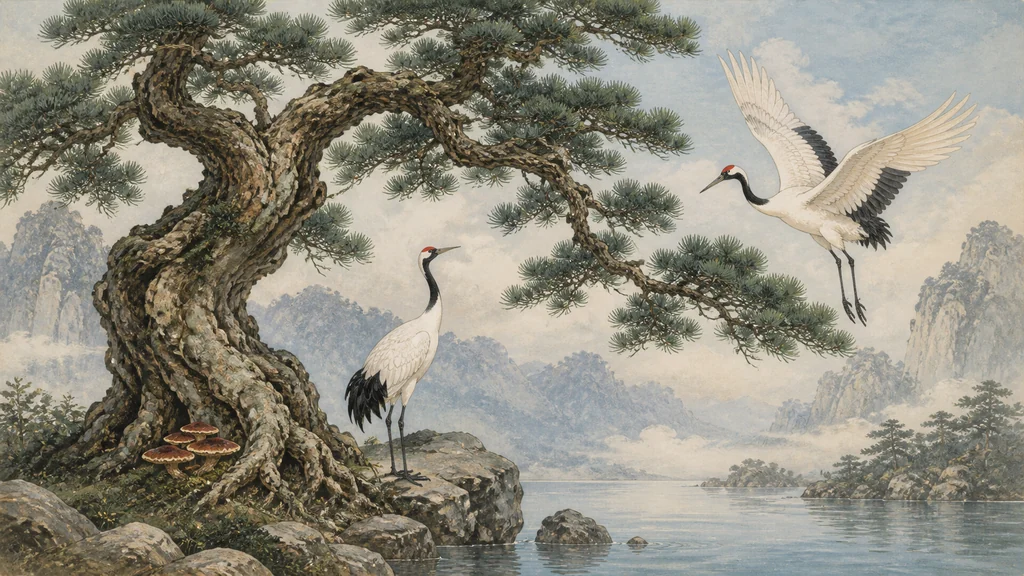
“Pine and crane prolong the years” sounds like the name of a rebus, but it is built differently from lotus-and-fish designs. Lotus and fish can call up other words through sound. Pine and crane already carried associations with long life. The Palace Museum summarises the motif plainly: because both were connected with longevity, they were often pictured together in birthday wishes.
Neither name has to be exchanged for a homophone. Placing two established longevity images in one composition concentrates the blessing.
An old pine makes time visible
Pines remain green through winter. As they age, their trunks become thick, twisted and visibly weathered. The Metropolitan Museum of Art identifies evergreen growth and long life as major reasons that the tree came to symbolise longevity. In painting, a gnarled trunk lets the viewer see years accumulated in wood.
The tree can also represent constancy and the character of a cultivated gentleman. Surviving the cold joins physical endurance to moral endurance. On a birthday gift, long life normally comes to the foreground; in a scholar’s painting, integrity may matter more.
Wu Hufan’s 1950 hanging scroll Pine Longevity makes this distinction concrete. He painted it for a friend’s eightieth birthday. An aged pine dominates the composition, with lingzhi fungus and rock reinforcing the wish. There is no crane, yet the title, inscription and occasion make the birthday meaning clear.
The crane brings the world of immortals
In Chinese myth and Daoist imagination, cranes accompany immortals and sometimes carry them as they rise beyond the human world. The Met’s study of longevity imagery also notes that white crane feathers could recall the white hair of old age. A pair of cranes might discreetly suggest an elderly couple.
These are cultural associations, not modern zoological claims. A responsible description says that cranes were regarded as long-lived, otherworldly birds. It need not repeat literal claims that an actual crane lives for a thousand years.
The bird’s meaning was never limited to lifespan. Cranes could also evoke freedom, dignity, reclusion or transcendence. In a scene of immortals, flight between worlds may be more important than a birthday wish.
A birthday object can layer several longevity motifs
A Palace Museum exhibition included a jade ruyi sceptre shaped like lingzhi and decorated with pine and cranes. The image appears on the surface while the fungus-like form extends the longevity theme into the entire gift.
A small enamelled glass water pot in the British Museum goes further. It carries a twisted pine, deer, crane, peony and lingzhi. The museum identifies pine, deer and crane as longevity emblems. The object does not spell out one sentence through sound; it accumulates several favourable images.
Such layering was useful on gifts. One subject might express long life, another good fortune, another high status or family continuity. The composition could offer a broad field of blessings rather than a single code with one answer.
Context still decides what the image is doing
A pine in a garden may be valued because it stays green through winter. In a scholar’s painting it may praise steadfast character. A crane in an immortal realm can signal ascent or distance from ordinary life. If an old work happens to contain both but has no birthday inscription, gift record or museum interpretation, it should not automatically be called a birthday picture.
Look for supporting evidence: the character 壽 or 寿, peaches, lingzhi, a birthday dedication, the form of the object and its documented use. Pine and crane certainly formed one of the best-known longevity pairings. The individual object still tells us whose longevity was being celebrated and on what occasion.
This is why the motif matters beyond a list of symbols. The old pine contributes visible endurance; the crane contributes an imagined passage into a realm where age has fewer limits. Together they offer a picture of life continuing with strength and grace.
The occasion confirms the wish
A title, inscription, dedication, or gift record can turn a likely interpretation into a secure one. Birthday and retirement objects often layer pine and crane with peaches, lingzhi, deer, or the character 寿. Without that evidence, the same plants and birds may belong to a landscape, a scholar's painting, or an image of reclusion. The combination strongly suggests longevity, but the specific recipient and occasion still come from the object's history.
Sources and further reading
- Palace Museum, “Pine and Crane Prolong the Years.” https://www.dpm.org.cn/lemmas/244785.html
- The Metropolitan Museum of Art, “Longevity in Chinese Art.” https://www.metmuseum.org/de/essays/longevity-in-chinese-art
- The Met, Wu Hufan, *Pine Longevity*, L.2022.15.7. https://www.metmuseum.org/art/collection/search/856016
- British Museum, enamelled glass water pot with longevity emblems, PDF.853. https://www.britishmuseum.org/collection/object/A_PDF-853
- Palace Museum, “Auspicious Ruyi” exhibition. https://www.dpm.org.cn/show/255220.html