A Wanli-period stem cup in the British Museum carries three copper-red fruits: a peach, a persimmon, and a pomegranate. The museum calls them the Three Abundances and reads them as long life, happiness, and children. The cup has no Buddha’s-hand citron—the fruit most often named in later descriptions of the motif.
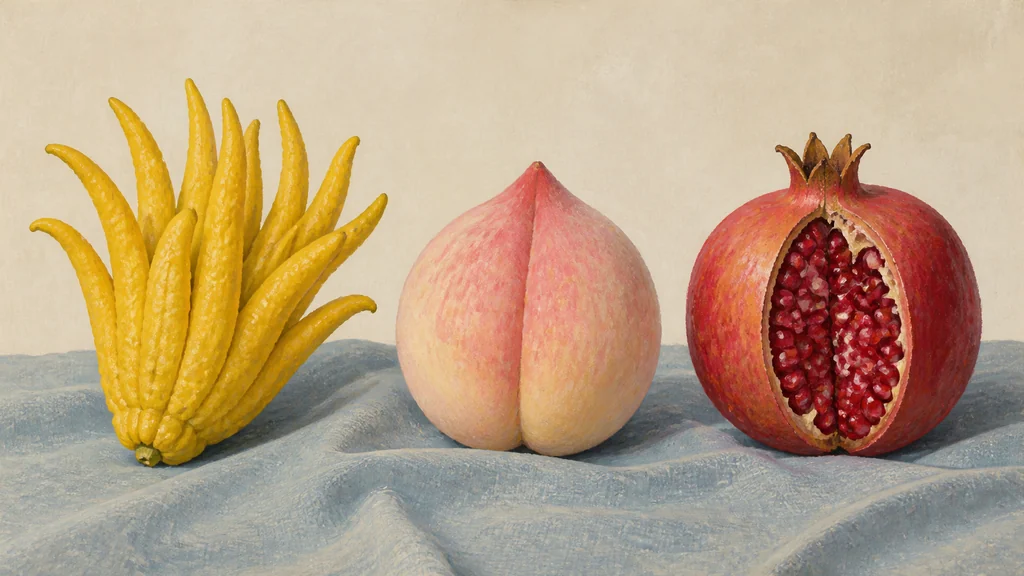
That difference reveals how the group works. The Three Abundances, or 三多 (sān duō), organize several wishes into one design. Fruits make those wishes visible. In the version most familiar from Qing decorative art, a Buddha’s hand, peach, and pomegranate represent abundant blessings, longevity, and descendants. Earlier or variant objects could assign one of those roles to a different fruit.
The familiar Qing trio
The Palace Museum’s definition of the Three Abundances identifies a common Qing-dynasty group: Buddha’s-hand citron for blessings, peach for long life, and pomegranate for many descendants. The three are not interchangeable repetitions of generic luck. Each contributes one part of a compound wish.
A Qianlong-marked underglaze-red meiping in the Palace Museum carries sprays of all three fruits. A late Qing hardwood couch bed distributes Buddha’s hands, longevity peaches, and pomegranates across surrounding panels. The museum records do not identify the meiping as a birthday gift or the bed as wedding furniture: a design can express wishes without preserving evidence of one particular occasion.
How to recognize the three fruits
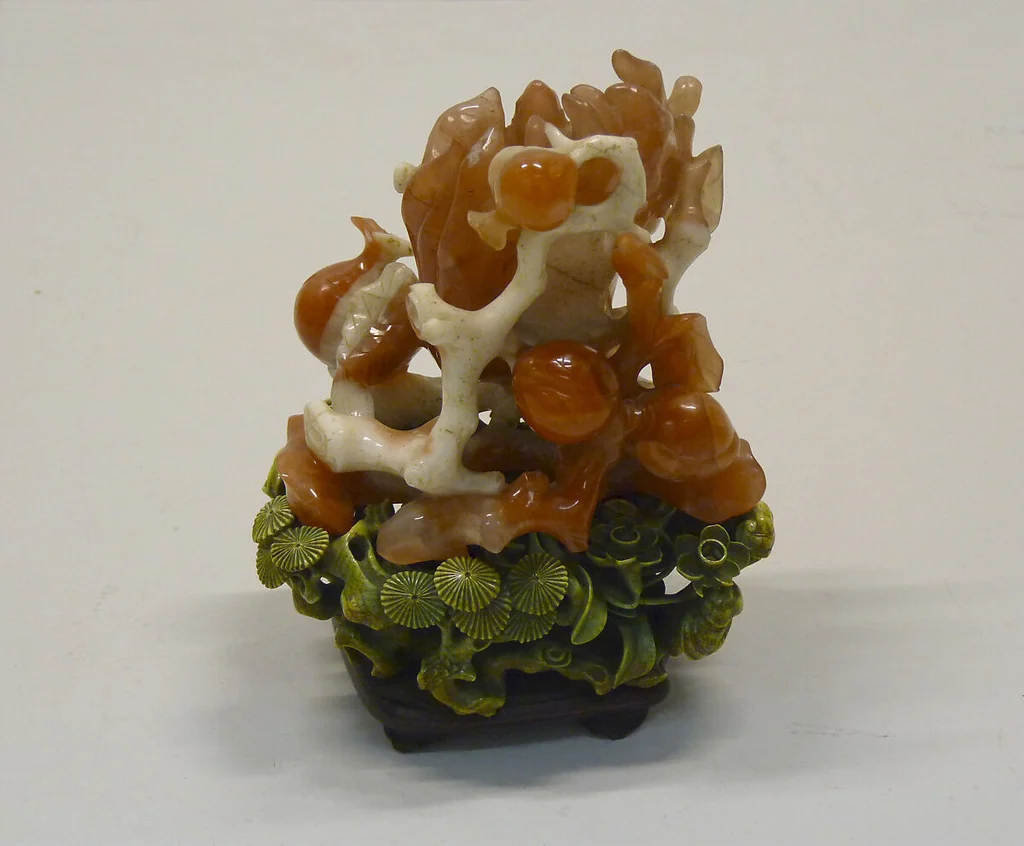
The Buddha’s hand is a fingered form of citron, not a sculpted Buddhist hand. Its yellow fruit divides into many long, curved sections. An eighteenth-century carnelian example at The Met preserves the finger-like silhouette. In Chinese, 佛手 (fóshǒu) begins with 佛 (fó), a near-homophone of 福 (fú, blessing or good fortune). Within the trio, it carries the wish for blessings.
A peach is usually rounded, with a pointed top and vertical seam that can give it a heart-like shape. It contributes longevity. A pomegranate has a crown-like calyx and, when shown open, a mass of seeds. It contributes descendants. The fuller evidence behind that reading is covered in Why Do Pomegranates Symbolize Many Children?
Color is not always available. On blue-and-white porcelain or monochrome carving, silhouette does the work: fingered citron, pointed and seamed peach, crowned or split pomegranate.
The Three Wishes in the Zhuangzi
The name also recalls an older group of three wishes. In the “Heaven and Earth” chapter of the Zhuangzi, a frontier warden at Hua offers Yao long life, wealth, and many sons. Yao declines each one, arguing that many sons bring fears, wealth brings affairs, and long life brings humiliations. The warden then answers his objections.
The episode is therefore a debate about desire and virtue, not three uncomplicated congratulations. It contains no Buddha’s hand, peach, or pomegranate, and surviving evidence does not identify an artist who converted this exact text into the fruit motif. The passage supplies a related language of three life wishes, not a documented invention date or design blueprint.
Why a Ming cup can use a persimmon
The British Museum owns two comparable Wanli stem cups, PDF,B.624 and PDF,C.639. Both show a peach, persimmon, and pomegranate. Their records identify the fruits with long life, happiness, and children and call the combination the Three Abundances.
The persimmon occupies the position held by the Buddha’s hand in the familiar Qing trio. The museum records do not state a specific persimmon pun, so one should not be invented. These reign-marked cups date to 1573–1620. Their actual painted fruit and collection records take priority over a later checklist: a persimmon on a documented object should not be relabeled as a Buddha’s hand merely to make the trio conform.
Three fruits within a larger design
The motif moved beyond cups and vases. A Qing jade Buddha’s-hand pendant turns one member into a wearable object. Late Qing skirt panels at the Asian Art Museum place the three fruits in dishes alongside peonies, a vase, and a ruyi sceptre. Those neighbors retain their own roles; sharing a textile does not make them parts of the Three Abundances.
The Three Abundances are also not a shortened form of the Five Blessings. The fruit trio commonly represents blessings, longevity, and descendants. The Five Blessings belong to a different five-part classical system, and the Hongfan list does not directly include many descendants.
Buddha’s-hand citron, peach, and pomegranate remain the most useful starting point for recognizing the common Qing motif. The Wanli persimmon cups preserve a documented variation. The wishes form the more stable structure; exact fruits, arrangement, and neighboring motifs must still be read from the object itself.
Sources and further reading
- Palace Museum: Three Abundances motif
- Palace Museum: Underglaze-red meiping with the three fruits
- Palace Museum: Hardwood couch bed carved with the Three Abundances
- British Museum: Wanli stem cup PDF,B.624
- Chinese Text Project: Zhuangzi, “Heaven and Earth”
- The Metropolitan Museum of Art: Hardstone group of the three fruits and fungus leaves
- Asian Art Museum: Panels from a lady’s skirt