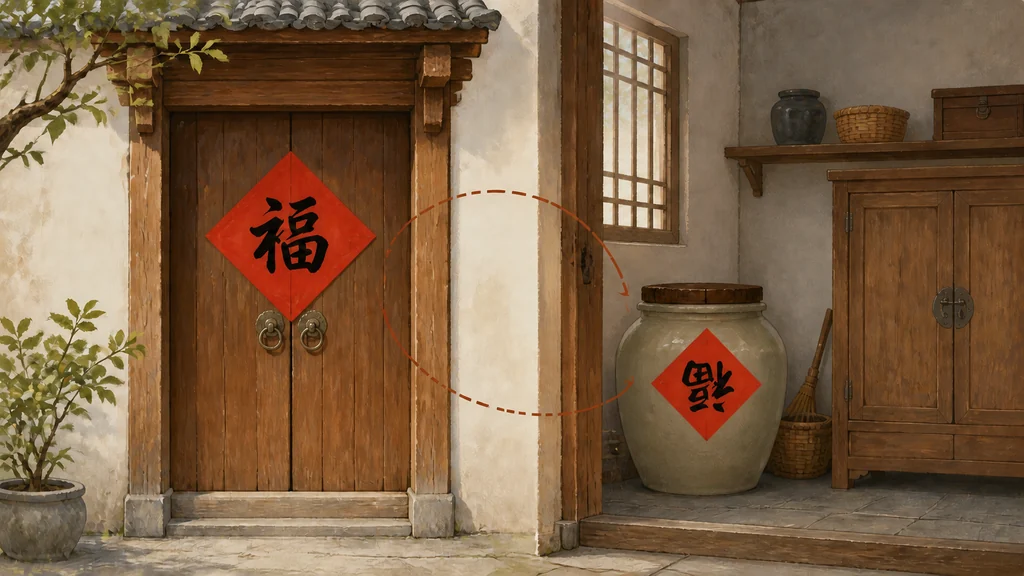
One handwritten fu in the British Museum’s collection of 1980s Chinese New Year papers stands upright. A red paper fu documented by the University of Hong Kong is turned upside down. Both are New Year decorations. The difference is deliberate: an inverted fu adds a spoken pun, while an upright one remains entirely appropriate.
Two dào sounds turn an orientation into a wish
The character 福, pronounced fú in Mandarin, can mean good fortune, happiness, or a blessing—not wealth alone. When the paper is rotated 180 degrees, the character is “upside down”: 倒, pronounced dào in this use. The verb 到, “to arrive,” is also pronounced dào. That makes 福倒了 (fú dào le, “fu is upside down”) sound the same as 福到了 (fú dào le, “fortune has arrived”).
The wordplay is specifically a Mandarin explanation; Chinese varieties do not all share exactly the same sound relationships. A related visual pun appears in an upside-down bat, where 蝠 (fú, bat) can evoke 福 (fú, good fortune), and inversion again supplies the 倒/到 link. The written fu, however, is simply rotated. It does not become a different character.
A front door and a storage jar may follow different customs
The pun does not make every fu an instruction to hang the character upside down. One influential interpretation, associated with folklorist Feng Jicai, keeps the fu on a main door upright as a formal welcome to good fortune. It allows an inverted fu on a water jar, grain container, or cupboard, where everyday talk about pouring or taking things out could otherwise suggest good fortune leaving with them.
Local records do not reduce to one national rule. A Spring Festival account from Rongcheng, Shandong, describes fu on doors and other places and says people may invert it for “fortune has arrived.” A Shenzhen Archives cultural article likewise describes upright and inverted forms on door lintels, windows, cupboards, and walls. The University of Hong Kong’s New Year project preserves another inverted red-paper example.
“Keep the main-door fu upright” is therefore a real custom and a widely repeated piece of advice, but not a timeless law followed in every region. In a family or community celebration, local practice is a better guide than an online rule that declares one orientation universally correct.
No single inventor of the upside-down fu has been established
Several popular stories explain who first inverted the character. One credits a quick-witted steward at Prince Gong’s Mansion. Others bring in the Hongwu emperor Zhu Yuanzhang and Empress Ma, or the late Qing figures Cixi and Li Lianying. The casts and plots conflict. Even the Shenzhen Archives article presents the Prince Gong story as a legend of uncertain truth, not as a documented invention.
Folklorist Xiao Fang has described the upside-down fu as a later custom that was not common in the past. The evidence used here does not supply a securely dated first example or an unbroken line back to one ancient creator. The inverted fu is a real and readily recognized modern New Year symbol; its familiarity today does not prove a single, ancient origin.
When you see an inverted fu, “fortune has arrived” is the intended reading. Whether a particular paper should face up or down depends on the place, object, and community using it.
The same wordplay also appears in pictures
The rebus is not limited to paper calligraphy. A late nineteenth- or early twentieth-century Chinese ornament in the Smithsonian collection uses an upside-down bat. Bat is fú (蝠), a homophone of blessing, while “upside down” and “arrive” both use the sound dào. The inverted animal can therefore be read as another version of “fortune has arrived.” It does not prove when people first turned the written 福 upside down, but it shows how the same pair of sounds could operate through an image.
This comparison also explains why pronunciation alone is insufficient evidence for an origin story. Wordplay can support several visual inventions in different objects and periods. A dated object establishes that one version existed by that time; it does not identify the first person to create the custom.
For a modern decoration, the intended blessing is usually clear even when the history is not. Meaning and origin are separate questions: the pun explains how viewers read the image today, while dated records are needed to trace when and where each form appeared.
Sources and further reading
- Ministry of Education, Taiwan: 倒
- Ministry of Education, Taiwan: 到
- British Museum: New Year print and calligraphy
- University of Hong Kong: Character Fú
- Mentougou Civilization Office: Inverted fu
- China Education and Research Network: Xiao Fang on changing Spring Festival customs
- Rongcheng Municipal Government: Spring Festival customs
- Shenzhen Archives: Should fu be upright or upside down?
- Hubei Provincial Foreign Affairs Office: Spring Festival expressions
- Smithsonian National Museum of Asian Art: Inverted bat rebus