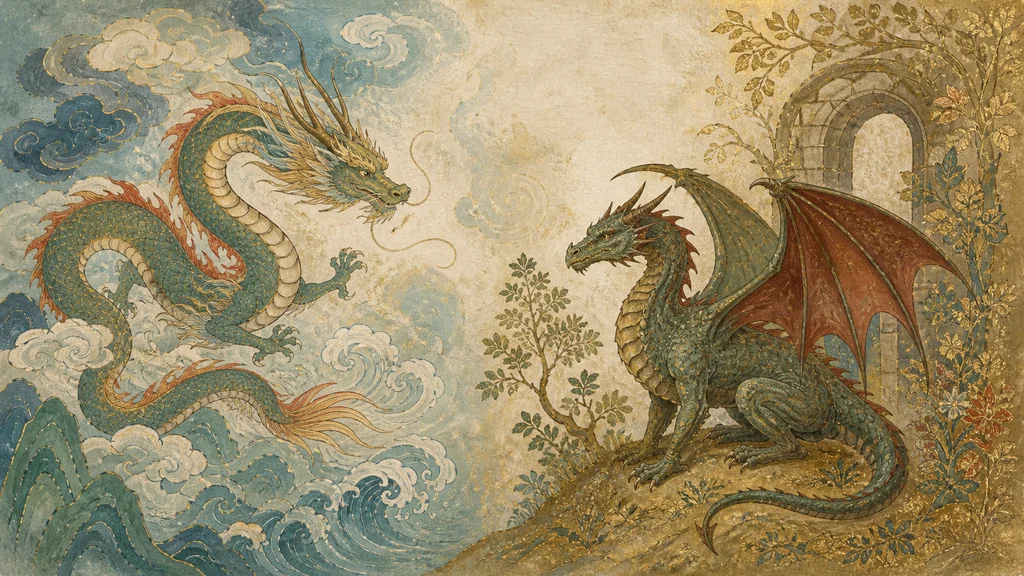
English usually translates the Chinese word lóng (龙) as “dragon.” The translation is useful, but it can make two different traditions look like versions of the same imaginary animal. Both creatures may have scales, claws, and an imposing head. Their bodies and their roles in stories come from different visual histories.
Their bodies do not follow the same pattern
In Chinese art, a dragon often has a long, curving body, horns, and four legs. It moves through clouds, water, and waves and needs no wings to rise into the sky. Early jade dragons, dragon motifs on Shang and Zhou bronzes, and the five-clawed dragons of the Ming and Qing courts do not share one fixed design.
The dragon familiar from modern European and American fantasy often has a heavy body, bat-like wings, and fiery breath. Medieval images were far less consistent. Manuscripts surveyed by the British Library include dragons that resemble lizards, creatures with two or four legs, and animals with or without wings. Not all of them breathe fire.
One often moves through clouds; the other often falls beneath a saint
Chinese dragons frequently accompany clouds, water, and rain. They can express auspicious power and the force of nature. This does not make every dragon gentle. Dragons in legends and novels may become angry, fight, punish people, or create danger. As the image entered imperial systems, it also acquired meanings of authority and rank.
In medieval Christian art, dragons often meet Saint George, the Archangel Michael, or Saint Margaret. In these scenes the dragon represents the Devil, sin, or a danger to be overcome. A saint spearing or trampling it turns the picture into a victory of good over evil. This tradition strongly shaped the later English-speaking image of the dragon.
“Chinese dragons are good and Western dragons are evil” captures only part of the difference. European dragons also appear in heraldry, borders, decoration, and secular adventure stories, where they do not always represent the Devil. Chinese dragons likewise change character with period, place, and story.
Even a five-clawed dragon needs context
Palace Museum material notes that the dragon’s association with rulers strengthened from around the Han period. By the Ming and Qing dynasties, dragon motifs covered buildings, clothes, seals, and furnishings in the Forbidden City. The Qing court used claw number, the number and posture of dragons, colour, and surrounding emblems to distinguish status and function.
An emperor’s Qianlong-period festival robe in the Metropolitan Museum of Art carries dragons together with the sun, moon, constellations, mountain, fire, and the rest of the Twelve Symbols. The complete set represents the emperor’s ordered rule. Another Met robe bears nine five-clawed dragons and belonged to the imperial family, yet its lack of the Twelve Symbols means it cannot be identified as an emperor’s robe on that feature alone. Counting claws is sometimes only the beginning.
To read a dragon image, first establish its period, region, and medium. Then look at its companions and at the role it plays. English can continue to call both creatures “dragons,” but their visual traditions should not be laid directly on top of each other.
Translation keeps the shared word but not a shared biography
Using dragon for 龙 is not an error that needs a new invented English animal name. The word gives readers a practical bridge, especially in museum labels and general writing. The mistake begins only when features from one tradition are used as evidence about the other: wings and fire are projected onto a Chinese image, or rain-making and imperial rank are assumed for a European manuscript creature.
A reliable comparison therefore works at three levels. Compare visible anatomy, compare the scene in which the creature acts, and compare the institution or story that gave the image meaning. A long wingless body among clouds suggests a different visual problem from a winged beast beneath Saint George, even though both labels contain the word dragon. Translation groups them for conversation; the object and its context keep their histories distinct.
That method also prevents a modern fantasy design from being mistaken for a historical rule. Contemporary artists freely combine wings, antlers, serpentine bodies, fire, and clouds. Such hybrids may be deliberate; they should be described as modern combinations unless a dated source supports an older lineage.
Sources and further reading
- Palace Museum, [Auspicious Dragons for the Year of the Dragon](https://digicol.dpm.org.cn/specialTopic/detail?id=8)
- Palace Museum, [Dragons in the Forbidden City](https://www.dpm.org.cn/architectural_art/246279.html)
- Metropolitan Museum of Art, [Emperor’s twelve-symbol festival robe](https://www.metmuseum.org/art/collection/search/60506)
- Metropolitan Museum of Art, [Peacocks and Dragons, Oh My!](https://www.metmuseum.org/perspectives/peacocks-and-dragons)
- British Library, [The Anatomy of a Dragon](https://www.bl.uk/stories/blogs/posts/the-anatomy-of-a-dragon)
- Getty, [What Did People Believe about Animals in the Middle Ages?](https://www.getty.edu/news/what-did-people-believe-about-animals-in-the-middle-ages/)
- Metropolitan Museum of Art, [Seven Necessary Dragons](https://www.metmuseum.org/perspectives/seven-necessary-dragons)